Treat your emotions like a dog

I often tell people, try treating your emotions like a dog.

Yeah, they’re like “what the actual fuck is this guy on about” as well. But hear me out. This espresso has got my psychology juices flowing.

One thing I’ve noticed over the years is that shitty dogs almost always have shitty owners.

The dog’s level of discipline is reflected in the owner’s emotional maturity and self-discipline.

It’s very rare to see a dog that’s wrecking the house, eating all the toilet paper and shitting on the couch which has an owner who has their own shit together.

This is because our connections with dogs are purely emotional.

And if we suck at dealing with our own emotions, then we’ll suck at dealing with our dogs. It’s that simple.

If you don’t know how to limit yourself and tell yourself “no” when necessary, then, well, don’t get a dog.

And if you do get one, don’t fucking move into my estate (or neighbourhood for my American followers).

Our emotions are kind of like our dog that’s living inside our head.

We have this part of ourselves that just wants to eat, sleep, fuck and play, but has no conception of future consequences or risks.

That’s the part of ourselves we need to train.

Our emotions are important. But they’re also kind of dumb and designed to overreact to things.

They evolved to keep us alive when we were hunting water buffalo on the savannah and shit like that.

When we’re scared we want to run away or hide. When we’re angry we want to break stuff.

But thankfully, our brains also evolved logic and the ability to consider the past and the future, and all that great Gucci stuff.

That’s what makes us humans. And not dogs.

The problem is, our “dog brain” is actually what controls our behavior.

You can intellectually know that eating ice cream for breakfast is a bad idea, but if your dog brain wants fucking ice cream for breakfast, then that’s ultimately where your body is going to go.

It’s only by training your dog brain with your people brain, “No, bad Lee, ice cream for breakfast is bad, go do something else that feels good and is healthy like lifting some heavy shit off the ground,” that your dog brain gradually learns.

Do that enough and you have a well-behaved dog brain.

Now, after that rollercoaster of emotions can you see why I said train your emotions like a dog? Yeah? Good.

Welcome to growth you beautiful motherfucker.

Fuck, I nearly forgot. Drink your damn coffee and don’t be an asshole today, the world has plenty of them already.

Love,

Lee

5 Truths That Are Hard to Hear

(Brace Yourself):

At some point we all must admit the inevitable:

Life is short, not all of our dreams can come true, so we should carefully pick and choose what we have the best shot at and then commit.

We try things. Some of them go well. Some of them don’t.

The point is to stick with the ones that go well and move on, not get upset about every little thing that didn’t go our way.

What we don’t realize is that there is a fine art of not giving a fuck. People aren’t just born not giving a fuck.

Not giving a fuck must be honed over years of deliberate practice.

Finding meaning and purpose is not a five-day spa retreat. It’s a fucking hike through mud and shit with golf-ball-sized hail pelting you in the face. And you have to love it.

You have to laugh about it. To show the world your gleaming bruises and scars and say, ” I stood for THIS.”

No one is going to stand up at your funeral and say, “He fucked like a wildebeest and had the best golf swing I’ve ever seen.”

Life is about loving people, not impressing them.

So with that being said drink your damn coffee, stay true to yourself and have a beautiful day motherfuckers 🤙🏻

Lee ❤️

Meaning of Life

You know the question. It’s the ultimate question. The question that you and I and everyone have lain awake at night thinking about.

The question that brings equal parts wonder and terror to our feeble fucking minds. Why are we here? What is the point of it all? What is the meaning of life so to speak?

Well, fortunately, I figured it out while I was drinking a coffee this morning. I’m pretty sure it’s coffee. And no, I’m not saying that just because I’m having coffee. There’s an explanation here. I’m going to explain it, clickbait titles and all, in, oh, the next eight minutes or so.

First off, before we can even appropriately ask “What is the meaning of life?” we must first settle something more subtle and something more important. Namely, what is meaning?

WHAT IS MEANING?

What is meaning? That may strike you as terribly navel-gazey and ultra-philosophical. And if that’s the case, I invite you to think about coffee for a moment, and just stick with me for a minute. Because it’s important.

What does it mean for something to mean something? As humans, we have a constant need to attach meaning to everything that happens in our lives.

Look, a guy climbed a rock looking for meaning! My mom hugs me, that must mean that she loves me. My boss complimented me, that must mean I do good work. It’s going to be sunny tomorrow, that must mean I can wear my super-cool SpongeBob tank top to the store.

Meaning is the association that we draw between two experiences or events in our minds. X happens, then Y happens, so we assume that means X causes Y. Z happens, and we get really pissed off and feel shit, therefore we assume that Z sucks.

Our brains invent meaning the way dogs shit, they do it gleefully and not even realising that they’re ruining the fucking carpet.

Our brains invent meaning as a way to explain all the crazy shit going on in the world around us. This is important, as it helps us predict and control our lives.

But let’s be real: Meaning is an arbitrary mental construct.

Fifty people can watch the exact same event and draw fifty different meanings from said event. That’s why there’s so much arguing in politics. That’s why eyewitnesses are so unreliable in court.

That’s why your friends are sometimes the biggest assholes, because that meaning you just shared, to them, meant something completely different or nothing at all

TYPES OF MEANING IN LIFE

Our brains slap together two different types of meaning:

• Cause/Effect Meaning: You kick the ball, the ball moves. You tell your friend his hair is ugly, your friend slaps you in the face. You do X, and with reliable certainty, Y will result.We all need Cause/Effect meaning to survive. It helps us predict the future and learn from the past. Cause/Effect meaning primarily involves the logical parts of our brain. Science, for instance, is the constant search of more and more Cause/Effect Meaning.

• Better/Worse Meaning: Eating is better than starving. Making money is better than being broke. Sharing is better than stealing. Better/Worse meaning has to do with the nature of our values—what we perceive to be most important and useful in our lives.Better/Worse meaning relies mostly on the emotional parts of our brains. Generally what makes us feel good is what we immediately assume to be “good” or “better.”

Both forms of meaning evolved in our brains to help us survive. For thousands of years, humans needed to remember where certain food could be found, how various animals would respond when hunted, how weather patterns change and how to read the terrain. They also needed to know what would gain them acceptance within their tribe, what would curry favour from friends and earn approval from that sexy guy/gal in the loin cloth over yonder.

So in that sense, meaning is nature’s tool for motivation. It’s how evolution made sure we got shit done. Meaning drives all of our actions. When there is great meaning attached to something, like our child is sick and starving, we will go to insane lengths to make things right. People will often even go as far as giving up their lives for some grand sense of meaning (see: religion, every war ever). Meaning is that effective at moving people.

Meaning is nature’s tool for motivation.

Conversely, when we feel we lack meaning in our lives, when shit just doesn’t seem to matter, when there’s no clarity on how or why things happen to us, we do nothing. We sit on the couch and twiddle our thumbs and watch lame reruns while complaining on the internet about lame reruns. But here’s the kicker (and I swear I’m going to get to the coffee):

Meaning is a resource that we must cultivate in our lives.

Meaning is not something that exists outside of ourselves. It is not some cosmic universal truth waiting to be discovered. It is not some grand ‘eureka’ moment that will change our lives forever.

Meaning requires action. Meaning is something that we must continually find and nurture. Consistently.

Man’s great search for the meaning of life usually ends like this.

Meaning is like the water of our psychological health. Without it, our hearts and minds will shrivel and die. And like water, meaning flows through us—what is important today is not what was important years ago, and what is important tomorrow will not be the same as what is important today. Meaning must be sought out and replenished frequently.

HOW TO FIND MEANING IN YOUR LIFE

In a very real sense, the meaning of life is therefore to create meaning. So how does one create meaning? Two ways:

• Solve Problems. The bigger the problem, the more meaning one will feel. The more work you do towards that problem, also the more meaning you will feel. Solving problems basically means finding ways to make the world a slightly better place. Can be as simple as fixing up your aging mother’s dilapidated house. Or as complex as working on the new great breakthrough in physics.The point here is not to be picky. It’s easy, when we start thinking of how insignificant we are on a cosmic scale of the universe, to start thinking there’s no point in doing anything unless we’re going to save the world or something. This is just a distraction. There are tons of small, everyday problems going on around you that need your attention. Start giving it.

• Help Others. This is the biggie. As humans, we’re wired to thrive on our relationships. Studies show that our overall well-being is deeply tied to the quality of our relationships, and the best way to build healthy relationships is through helping others. In fact, some studies have even found that giving stuff away makes us happier than giving stuff to ourselves. Go figure. As such, it seems to be a “hack” in our brains that helping out other people gives us a greater sense of meaning and purpose. Just the fact you can say to yourself, “If I died, then someone is better off because I lived,” creates that sense of meaning that can propel you forward.

THE TRAP OF SETTING GOALS

A lot of people find meaning through setting goals for themselves. They want the corner office, the big car, the fancy-pants shoes. It gives them a reason to wake up in the morning, a reason to bust their ass at work. It gives them something that makes them feel important and something to look forward to every day.

But goals are a double-edged sword. You have to be careful.

Goals are good tools for building motivation. The problem is that, by themselves, they are arbitrary and empty. Unless there’s a “why” behind the goal full of meaning, the goal itself will provide little long-term happiness or satisfaction. Ever seen star athletes flounder after retirement? Or a guy who finally made his millions become deeply miserable because he doesn’t know what else to do with his life?

Goals are dangerous because the meaning they provide when you’re working towards them is the meaning that is taken away once you achieve them.

This is why all the superficial stuff like make a billion euros, or own a Rolls Royce, or get your face plastered on the cover of a magazine all lead to a type of happiness that is shallow and short-lived—because the meaning is shallow and short-lived.

There has to be a deeper reason for your goals. Otherwise, the goals themselves will be empty and worthless in the long run.

Some athletes handle retirement well. Others end up on Dancing with the fucking Stars.

Notice that it’s the athletes who aspire to be the best at their sport for some greater reason to build a charity, to start a business, to transition into another career who handle retirement the best.

Notice it’s the millionaires who spent their life working towards a deeper cause that remain content once all of their goals are checked off the checklist.

But some goals don’t even have to be big and sexy.

Take a cup of coffee. I sat down to write this blog craving a coffee. That’s a problem in my life. And I promised myself I’d pump out this draft before going and getting this magnificent sexy coffee. That gave this hour some extra meaning.

And you know what? Maybe my fiancé is craving one too and I can get her one. You know, make the world a better place and all that shit while I’m at it.

So what’s the meaning of life? Well, for me, right now, it’s a coffee. What will yours be?

PS: if you haven’t already, get a damn coffee and have an amazing day you beautiful motherfucker.

WHAT IS NARCISSISM?

Ah, narcissists. Checking themselves out in every reflective surface they walk by. Yammering on about that one time they won the third class spelling bee. Thinking they’re God’s gift to the fucking universe after all, why else would He (yes I called god a “he” don’t shoot me 🙄) have put them right in the middle of it?

But here’s the thing: Narcissism is way more complex and, quite frankly, way more annoying than that.

Yes, it’s an inflated sense of self-importance and a hankering for constant admiration, combined with a devastating lack of empathy for others. It’s the “Me, Myself and I” syndrome, where the world must revolve around a single person, and everyone else is just an extra in the movie of their life.

But before you start pointing fingers at your ex or that obnoxious coworker, remember: We’ve all got a smidgeon of narcissism in us. It’s just that some people got an extra dollop. Or five.

So let’s dive headfirst into this bottomless pit of ego and self-absorption, cutting through the bullshit, and maybe, just maybe, we’ll come out on the other side understanding what makes these narcissists tick.

And who knows, we might even figure out how to deal with them without losing our damn sanity. Let’s unpack this sweaty bag of asses together.

WHAT IS NARCISSISM?

First, let’s clarify what narcissism actually is.

Simply put, narcissism is a chronic state of entitlement. A narcissist might believe they are exceptionally extraordinary or exceptionally deprived. In either case, the rules that apply to everyone else don’t apply to them. The narcissist owes the world nothing, while the world owes them everything.

As with most things in life, narcissism comes in varying degrees. No one is 0% or 100% narcissistic. Everyone falls along a spectrum. We all exhibit a few narcissistic traits that is, a certain amount of entitlement on our worst days.

But, at the extreme end, a person might be suffering from a full blown personality disorder. And even those who are clinically diagnosed will fall along a spectrum from high-functioning individuals to complete neurotic messes.

We all engage in at least some narcissistic behaviors at some point or another. The problem arises when narcissism becomes our default mode and we don’t realize we’re behaving like a narcissist.

THE TWO TYPES OF NARCISSISM

I have talked about two types of entitlement before, which are really two types of narcissism. Let’s pick apart each one.

THE GRANDIOSE NARCISSIST

The “grandiose narcissist” is the type we mostly think of when we say that someone is a narcissist. They’re the thin-skinned, attention-seeking, arrogant asshats who are oblivious to the needs of others and will exploit anything and anyone.

Now, we all know someone who thinks a little too highly of themselves, craves attention and admiration a little too much.

They can’t take criticism, they blame everyone else when things go wrong, and they expect to get extra special treatment because they’re above the plebes and schlubs and “normal people” who cower beneath them.

But these kinds of narcissists also often have a charm about them, at least at first. Their outward self-confidence can be refreshing to be around, especially if you aren’t a person who feels a shit tone of confidence to begin with.

But their bullshit quickly sours.The blaming, the gaslighting, the manipulation, the way they constantly turn everything back onto themselves.It gets exhausting.

Some Tell-Tale Signs of a Grandiose Narcissist

• Being arrogant, braggy, and showing off

• Exaggerating accomplishments and/or talents

• Requiring constant admiration and praise

• Believing others are envious and jealous of them

• Having a preoccupation with success, power, brilliance, beauty, and/or the ideal mate

• Taking advantage of and exploiting others for personal gain

• Lacking empathy

• Having a sense of specialness/uniqueness that only other special/unique people can understand

• Having unreasonable expectations of special treatment

THE VULNERABLE NARCISSIST

Let me paint a picture of someone else we all know too.

This is the person who’s much more reserved and doesn’t really seek out attention in all those loud and obnoxious ways. They can be shy at times, and they might even put themselves down a little too much.

Like a grandiose narcissist, they are hyper-sensitive and need constant reassurance. But unlike a grandiose narcissist, they don’t believe they are better than everyone else. In fact, they believe the opposite—they believe they are uniquely victimized or oppressed by everyone else.

Vulnerable narcissism is a more subtle form of narcissism. But it’s still narcissism. The difference is that a grandiose narcissist thinks they’re uniquely superior, while the vulnerable narcissist thinks they’re uniquely inferior.

A grandiose narcissist believes they are uniquely privileged while a vulnerable narcissist believes they are uniquely under-privileged. A grandiose narcissist takes pride in taking advantage of others while a vulnerable narcissist takes pride in being taken advantage of by others.

Like the grandiose narcissist, the vulnerable narcissist thinks they deserve special treatment because of their uniqueness.

These are the self-labeled, perpetual victims. They may be shy and outwardly self-effacing. But underneath that cowering exterior is a sense of grandiosity.

They’ll get offended by the smallest slights and anything and everything distresses them.

Some Signs of a Vulnerable Narcissist

• Appearing submissive

• Putting themselves down

• Feeling under-recognized and under-appreciated

• Being easily offended

• Being envious and jealous of others

• Getting easily distressed

• Not taking good care of themselves like in grooming or health

• Having a sense of specialness/uniqueness that only other special/unique people can understand

• Having unreasonable expectations of special treatment

Though grandiose and vulnerable narcissists are different in important ways, both are extraordinarily self-absorbed and have a fragile sense of self they have to maintain by viewing themselves as exceptional again, either exceptionally extraordinary or exceptionally deficient.

They deny any realities that do not support their grandiose self-perception and as a result tend to engage only in superficial relationships or withdraw from social situations altogether.

At the heart of it, both kinds of narcissists are overly self-entitled individuals who believe they’re special and that different rules in life apply to them.

WHERE DOES NARCISSISM COME FROM?

Narcissism is a pretty complex personality trait, and psychologists haven’t completely untangled how it comes about, but they have found some clues.

For one, certain approaches to parenting appear to influence the development of narcissism.

There is some evidence to suggest that children are at a higher risk of developing narcissistic qualities if they grow up with parents who are authoritarian, highly indulgent, or overly neglectful of their children’s emotions.

Let’s take these one at a time:

1. Authoritarian Parenting

These parents try to control their children’s behavior to an unhealthy degree. They demand strict obedience to rules, while providing little in the way of warmth, support, or open communication.

Authoritarian parents may base their child’s worth on accomplishments and conformity to rules, which can lead children to develop an inflated sense of self-importance to cope with this pressure. They may also develop a deep-seated sense of entitlement as a defense mechanism against feeling unloved or not good enough.

2. INDULGENT PARENTING

On the opposite end of the spectrum, children who are overly validated by gushing parents also tend to end up as narcissists.

Not surprisingly, if a child constantly hears how “special” and “wonderful” and “beautiful” they are (spoiler: you’re not fucking special), they end up internalizing their parents’ inflated views of them and grow up to believe they’re entitled to extra privileges in life.

3. NEGLECTFUL PARENTING

Also known as uninvolved parenting, this style is characterized by low levels of both warmth and control.

Neglectful parents may be unresponsive to their children’s needs and may not provide necessary guidance or feedback. They often fail to validate their children’s emotions or thoughts.

In response, children may develop narcissistic traits as a coping mechanism, using an inflated sense of self-importance to compensate for feelings of neglect and unworthiness.

On the surface, these parenting styles seem wildly different, so how could they all contribute to developing narcissism?

Well, the one thing they all have in common is that they don’t help the child to fully express a realistic, independent identity.

Authoritarian parents are overly controlling and therefore don’t let their children find their own way in life. This makes them seek more and more outside validation in order to feel good about themselves, which could turn into narcissism.

Indulgent parents, on the other hand, provide too few boundaries for their children, and instead contribute to an inflated sense of self that isn’t grounded in reality.

And neglectful parents provide little to no validation for their children’s emotional needs, so they might grow up narcissistic to overcompensate for feelings of shame and inadequacy. Shame, in fact, plays a crucial role in people who develop vulnerable narcissism.

IT’S NOT ALL YOUR PARENTS’ FAULT

Now, before you go off and start hating your parents (or hating them more than you already do…), it’s important to understand that parenting is just one factor that might contribute to narcissism.

Research into the origins of narcissism is still in its early stages. We don’t really know how genetics, peer groups, trauma and many, many other factors might contribute.

And so, while I think parenting is important, I’m not one to blame parents for too much.

In fact, a balance between each of the above parenting styles appears to be the antidote to raising narcissistic kids. Namely, children with parents who encourage their kids, show warmth towards them, set strong boundaries, and also have high standards for them tend to turn out pretty well adjusted.

So it seems that our parents just did the best they could, but they might have focused a little too much on one style over others.

My point is: don’t blame parents for everything. Most (yes I say most because “some” aren’t doing a fucking thing) are just doing the best they can.

THE PROBLEM WITH NARCISSISM

The past decade or two has seen a very public debate about the possibility of a narcissism “epidemic” in our current culture, especially among young people.

The reality is that every culture in recorded history has had to deal with narcissism and the myriad problems associated with it. At the extreme end, narcissism has been linked to substance abuse and a wide range of personality disorders, from bipolar to borderline and passive-aggressive disorders.

Grandiose narcissism tends to co-occur with antisocial traits and paranoia, while vulnerable narcissism tends to be accompanied by depression, anxiety, and suicidal tendencies.

People with grandiose narcissistic traits tend to crave power and those who emerge as leaders can create a pretty toxic environment for the poor souls they reign over.

And though it’s often grandiose narcissists who we see as exploitative, vulnerable narcissists are also not very good at empathizing with others and can be equally dickish.

Worse, narcissism has been consistently linked with violence. Researchers bicker over whether narcissism is increasing in prevalence, but I’d argue this is merely semantics. Narcissism—both as a personality trait and a mental disorder—is as serious a problem today as it was in 1978 or ancient Greece, for that matter.

HOW TO DEAL WITH NARCISSISTIC PEOPLE

The first rule of dealing with narcissistic people is: don’t.

If you can avoid having to interact with a narcissist, then don’t interact with them. Don’t try to convince them, persuade them, change them, fix them, or change their mind. It’s probably impossible and even if it’s not, it’s definitely not worth it.

That being said, sometimes you have to deal with a narcissistic person and if you’re going to have to deal with them, then it’s important to understand how to go about it.

Obviously, how you deal with narcissists will vary depending on the context in which you interact with them; e.g., how you handle a narcissistic boss will be different from how you handle your narcissistic boyfriend and parents. Even in the same context, each individual is different, so obviously, the approach here varies.

But basically, the key to handling narcissistic people is boundaries. Decide how much exposure you are willing to have to them, and decide to what extent you’re willing to interact with them. Decide beforehand what you’re willing to do and not do with them, what you’re willing and not willing to talk about with them, and what you’re willing and not willing to share with them. Then stick to it.

Narcissists have got nothing on you if you have and enforce boundaries in your life, be it with your colleagues, your friends, your partner, or even your family.

Unfortunately, most of us are pretty bad at maintaining healthy boundaries and as a result get embroiled in drama and end up doing things we don’t really want to do.

Having healthy boundaries means taking responsibility for your own actions and emotions—and NOT taking responsibility for the actions or emotions of others.

It’s when your narcissistic colleague tries to take credit for your work and you refuse and proudly stake your claim.

It’s when your narcissistic uncle asks to borrow money because something bad always happens to him and oh he’s so unlucky and you tell him a firm “no.”

It’s when your narcissistic partner tries to bully you into feeling guilty that you stayed late at work that one time and you call them out on their bullshit.

If you can’t avoid having narcissists in your life, surround yourself with boundaries. Draw lines in the sand and enforce them. If you want to deep dive into how, I’ve got just the article for you.

HOW TO DEAL WITH YOUR OWN NARCISSISM

Plot twist: but what if you’re the narcissist? Not sure? Ask yourself the following questions:

• Do you feel that people often don’t (or can’t) understand you or your problems?

• Do you feel that there are many barriers in your life which you have no control over?

• Do you often ask for help from others and/or feel like few people are willing to help you?

• Do you feel like you often don’t receive the attention or appreciation that you deserve?

• Do people often complain that you don’t listen to them, when in fact, you feel like they don’t listen to you?

• Do you feel like most other people have lives that are much easier than yours?

• Do you fight with close friends and loved ones often?

• If so, is it usually their fault?

• Do people suddenly drop contact with you with no explanation and refuse to communicate with you again?

• Do you often feel helpless, like you have little opportunity to improve your life?

If you answered “yes” to most of the above, then you might actually be the problem.

If you recognize and accept you have narcissistic traits, congratulations: you’ve made it further than most narcissistic people ever will.

Clinical narcissism is notoriously difficult to treat. There is no one proven therapy, and the many recommended therapies commonly practiced all require long-term effort and engagement.

In short: seek medical help and buckle down for the long haul baby.

If you’re simply exhibiting traits of narcissism some of the time, I’ve got some tips or rather, some life-altering truths—to help reduce your narcissistic tendencies.

Narcissism boils down to believing you’re special and entitled to be treated differently than others. The antidote and this is easier said than done, is simply to accept that you are not fucking special.

In fact, you’re average at almost everything, most of the time. And that’s ok. You don’t need to be special or great at something to be a worthy person or live a meaningful life.

Instead of weaving elaborate narratives to convince yourself of your specialness, you’ll be much better off avoiding labeling yourself anything and just living.

You don’t know if you’re great or not, and that’s fine. You’ll do your best anyway. You don’t know if you’re a victim or not. That’s fine. You’ll get better and feel healthy again anyway. You don’t know if you deserve good or bad treatment and that’s fine. You’ll take responsibility for your life anyway.

Find satisfaction in the simply everyday pleasures of life.

Every day when you wake up, rejoice that you’re still alive. Marvel at the wonders of toothpaste when you brush your teeth every morning. See beauty in how the light reflects off the surface of passing cars. Be curious about other people.

You’re not “destined” for greatness. You’re not destined for anything.

Stop trying so hard to prove you’re better than everyone else. Stop whining about how unfair the world has been to you.

Take a deep breath and get on with your day. Just like everybody fucking else.

Side note: what you are destined for is a beautifully crafted cup of coffee today. Go grab it and have an amazing day!

Until next time,

❤️ Lee

When You can be Your Own Worst Enemy

The French philosopher Blaise Pascal once wrote, “All of humanity’s problems stem from man’s inability to sit quietly in a room alone.” It was a simple and profound thought about the nature of boredom, self-awareness, and our endless capacity to distract ourselves with dumb shit.

Try it: sit in a quiet room with no distractions—no phone, no music, no television or podcasts or video games and do nothing for twenty minutes. Don’t sing. Don’t dance. Don’t see how many push-ups you can do or trim your toenails or count the spackle on the ceiling. Just sit and be alone with your own mind. Sounds easy right?

Unless you’re experienced with meditation, chances are you would have a hard time doing this. Or, at least, it would be incredibly unpleasant and/or boring for you.

In fact, psychologists have tested this a number of times, and surprise, surprise… people really don’t like doing it. In one experiment roughly half of a group disliked it so much that they chose to receive an electric shock in order to get out of it and exit the room early.

THE FEAR OF SITTING ALONE IN A QUIET ROOM

What is it about sitting alone with our own thoughts that causes us to become so uncomfortable?

Pascal seemed to believe that our inability to allow ourselves to be bored—i.e., our constant need for validation causes us to do a lot of stupid and harmful things, both to ourselves and others.

But there’s also a slightly deeper, more subtle explanation. There are certain characteristics of our thoughts and feelings that we don’t like about ourselves.

Therefore, we likely feel a need to distract ourselves from ourselves in proportion to all of the unsavory stuff rattling around between our ears.

The more we deny or reject our internal world, the more we compulsively look for external things to occupy our attention.

It’s this self-rejection that leads to self-destructive behaviors, thrill-seeking, and addiction. And some of us apparently are so nonplussed with ourselves that we’d rather experience the external pain of electrocution than the internal pain of our own self-reflection.

What a… shocking conclusion.

(Sorry…)

HOW TO STOP BEING SO SELF-CONSCIOUS

There’s a fine line between healthy self-awareness and (often unhealthy) self-consciousness.

Self-awareness is the simple noticing and acknowledgement of whatever’s rattling around inside your brain.

You notice that you’re feeling angry. You notice that you are having trouble focusing. You notice that you think your co-worker’s story about their weekend is dumb and think to yourself, “Nobody cares.”

Self-awareness is like sitting on the park bench of your own mind, watching the thoughts and feelings and impulses walk by.

Sometimes, it’s a shitshow in our mental park. There’s rubbish everywhere, a bunch of screaming kids fighting with one another, maybe a crack addict rummaging through the rubbish cans.

And this is where self-consciousness comes in…Self-consciousness is the judgment of what is happening within our minds.

Noticing that we’re irritable on a Monday morning is self-aware. Worrying that we are an asshole for being irritable is self-conscious.

Thinking a co-worker’s story is dumb is self-aware. Believing that you are a horrible co-worker and a bad human being for thinking their story is dumb is self-conscious.

If self-awareness is simply sitting in our mental park and watching our inner hobo take a shit on the children’s slide, self-consciousness is running around the park screaming, “This is all wrong! Stop! Make it stop!”

Self-consciousness makes us more insecure and anxious because it attempts to hold our inner life to some arbitrary standard created by our outer life.

We judge our anger because we believe the world expects us to be happy. We judge our impatience because we believe the world expects us to be considerate. We judge our insecurity because we believe the world expects us to be confident.

The Buddha said that hatred was like drinking poison and expecting the other person to die. Well, self-consciousness is kind of like stabbing yourself because you think the puncture wounds will make you way more likeable to others.

The remedy to self-consciousness is simply more self-awareness. Just as you notice the irritability as an object of your attention, you then notice the judgment of that irritability as the object of your attention.

There’s the emotion—then there’s the emotion about the emotion, or the “meta-emotion” …and then it’s just turtles all the way down.

BOREDOM LEADS TO CREATIVITY

There’s another benefit to being able to sit and stew in one’s own boredom:

it promotes creativity.

Creativity is an area where people’s assumptions and the actual research couldn’t be more different.

We generally assume that creative people are wild, spontaneous, and a little crazy. It turns out that most of the creative geniuses throughout history have been routine-driven workaholics.

We assume that creativity comes from an exciting life full of hardship and challenges. In fact, it comes from the willingness to spend significant amounts of time thinking and being bored.

One of the ways to be more creative, which I’be alluded too before, is to simply become more prolific. When you research the towering creative figures throughout history, it turns out that most of them simply out-produced their contemporaries by a wide margin.

To use a basketball analogy, it wasn’t that they were more accurate shooters, it was mostly that they took way more shots.

History then disregards their misses.

All that’s left to say is enjoy your weekend and make sure you drink your damn coffee!

Until next time motherfuckers

Lee ❤️

Where I’ve been these past few weeks

I know I know, before you even start I realise I’ve been MIA for the past god knows how long.

It’s with good reason.

Many major milestones (both good and bad) have been experienced since we last spoke.

For instance, my brother got married. It was an emotionally charged day, full of love and happiness but also tough, due to our own father not being there.

I travelled. Since we last spoke I’ve done some travelling around Ireland and taken a hiatus to the Italian alps, where me and my fiancé rented a Campervan and travelled, hiked and camped our way around the dolomites for two weeks.We also visited Tenerife for a cheeky few days where we did nothing! Kicked back in the sun and enjoyed just being together.

We lost our family pet since we last spoke also. Skylar was our baby for 13yrs. She helped me through some very dark times in my life and would always listen to me complain when it was just me and her in my life.

I’ve also experienced one of the worst set backs of my professional career since we last spoke. I had many many (5 to be exact) interviews with the same company for a position I felt I was perfect for. Which I knew I was perfect for. Even the recruitment lead for Europe agreed, my future boss to be agreed but at the last post I was pipped. Pipped by someone who has been left go by Meta who needed a job and “knew someone”. So to say this was a bitter pill to swallow would be a fucking understatement.

Going back to a job I had one foot out of was even tougher.

Alas, we are still here, still keeping my head down and attacking everyday as best as I can.

Being brutally honest I needed a break from writing also. This shit isn’t easy. I was never much of a story teller or writer so when I say I got burnt out quick, I mean it.

I felt I was repeating myself and had nothing of value to give you the reader so I said “fuck it” and didn’t write anything. I fell into that trap (something I hope to write about soon)

With all this being said, I’m back.

I’m back with a fucking bang to shake all of you awake to the harsh truths of life, the happiness that can be found in the mundane and how we can all say fuck you to mediocrity, depression and anxiety to create a better more successful and content version of ourselves!

Before I go tho.. I really hope you’ve been drinking your damn coffee 😏

You’ll be hearing from me soon motherfuckers.

Peace 👋🏻

Does the perfect career even exist and if it does, how to find or create it

Ready for a depressing statistic? Good! Me too. Here it is: The average worker spends somewhere between 10 and 14 years over the course of their lifetime at work. Basically, around 20 to 25% of your waking adult life is spent working.

Yeah…..FUCK.

Spending so much time at our jobs, you would think that we’d try to pick careers that are at least somewhat fulfilling, or hell, even just bearable most of the time. But the sad reality is that over 80% of people hate their jobs, meaning that 80% of people hate a big chunk of their lives pretty much all the time.

Think about that: four out of every five people get up every morning to go do something they loathe and they just keep doing it, day in and day out.

I know not everyone can just drop everything and go find their dream job right this second. And I’m definitely not saying that a fulfilling career is all fun and games, all of the time. I know people that are doing what they love and they hate parts of it at times. That’s just a fact of life.

But given that we spend so much of our waking lives working, we should strive to make the most of it and find a career that, at the very least, doesn’t make us miserable most of the time.

Instead, I’d argue that the perfect career comes at the intersection of three things:

• What you value

• What you’re good at

• What the world values

Let’s take these one by one, and then tie them all together.

STEP 1. FIGURING OUT WHAT YOU VALUE

Most people start by asking themselves “what am I passionate about” and then think about all the cool shit they like to do while they drink beer with their friends (video games, foosball, underwater basket weaving) and then lament that they’ll never make any fucking money.

But this approach misses the point entirely. Because asking yourself what you enjoy is superficial—most of us only enjoy these things for short periods, or when there’s no stress or pressure put on us.

The better question is “what do you value” Because if you value what you’re doing, not only will you enjoy it, but you will also find it meaningful even when it becomes difficult. And having meaning is key to pushing through the hard times.

So, how do you figure out what you value that could lead you to a fulfilling career? Here are a few questions to get you started.

WHAT’S A BIG PROBLEM IN THE WORLD THAT MOST PEOPLE DON’T CARE ENOUGH ABOUT?

Do you think more people should be worried about growing economic inequality? Does it baffle you that more people don’t pay attention to investing and basic personal finance? Did you know that college students are experiencing a growing rate of homelessness? And isn’t it really absurd how unaware most people are about human trafficking in this day and age?

What problems do you see—either right in front of your face or hidden away somewhere—that you can’t believe more people aren’t aware of and/or don’t care enough about?

If you can identify something like this in your life, you likely value it more than most others. This is a good place to start.

And it doesn’t have to be some grand, world-changing idea either. Maybe you’re aghast that people in your neighbourhood aren’t aware of the lack of good Thai food in your part of the town/city and feel the need to change that. Maybe you’re wondering why there aren’t more widget stores or access to services in your community. Maybe you can’t believe people don’t take advantage of the natural beauty in and around your town/city.

All of these are problems that need solving, and solving problems gives us purpose and can (often) get us paid.

WHAT PROBLEMS DO I ENJOY SOLVING THAT MOST PEOPLE DON’T ENJOY?

Is there some activity or task you just love to do that makes other people’s eyes glaze over? Like, they think you’re a masochistic psycho, but you just see it as normal or, even better, amazingly fun?

I once had a dental hygienist who told me she absolutely loved cleaning teeth. Every dirty tooth she came across, she saw as a diamond in the rough, a beautiful little chomper in waiting. Like the dental version goddamn Cinderella or something, she loved seeing a tartare-caked molar transform into a shiny white pearl in a patient’s mouth.

I don’t know about you, but I would rather clean up rat shit from the subway floors than look into people’s mouths and scrape crap off their teeth all day.

But not her, she valued her work and her patients. Scraping teeth day in and day out wasn’t some horrible, drawn-out slog of an existence for her.

Maybe you enjoy setting up spreadsheets and budgeting for your own personal finances or doing repairs/updates around your house or refinishing random pieces of furniture you find on Facebook or talking to that one friend who always complains about his or her life when no one else wants to hear his shit anymore (we all have one).

Most people hate doing these things. Which is why they pay others (really well) to do it for them.

Hint, hint.

WHERE DO I NATURALLY SPEND MY THOUGHTS AND ENERGY WHEN LEFT TO MY OWN DEVICES?

I’ve written before that if you have to look for a “passion” you’re probably not passionate about it in the first place.

What I mean by this is that there’s something that fills your time, something that takes up your mental energy and focus between 2-for-1 deals at Dealz and Netflix binges. And if you can’t figure out what it is, you’re either 1) ignoring that you’re actually into it or 2) you do it or think about it so much you don’t realise it’s not “normal.”

I used to spend hours and hours on internet forums writing long, detailed screes about anything and everything I was interested in: politics, music, sports, relationships, etc. It never occurred to me that most people don’t do that sort of thing “for fun.”

I never thought of myself as a no nonsense blogger, but there I was, writing for hours upon hours, sharpening my ideas, experimenting with my voice, developing my own style. Now I write potty-mouth blogs and articles for fun. Go figure.

A CAVEAT: THE DIFFERENCE BETWEEN VALUES AND COMPULSION

Now, before we move on, I want to point out one major caveat here: there’s a difference between doing something because you truly value it and doing something out of compulsion.

An alcoholic values beer, but it’s because it’s an addiction. That’s an obvious example, but the same could be said about a lot of leisure activities as well. I love to play video games, but I’ve recognised over the years that they’re an escape for me, not something I hold as a core value.

Maybe you’re really into fitness and you’re constantly working out, live off green smoothies and have 3% body fat. Hey, that’s great… you fucking psycho. But do you think you would be a good physical trainer because you value a healthy lifestyle and you want to pass that along to other people’s lives? Or do you work out so much out as a way to punish yourself, to escape painful realities you don’t want to face?

And that’s the key here: you have to recognise when you’re doing something because you truly value doing it, or if you’re just running away from something important in your life. It’s not an easy question to answer. And it often takes trying and failing a few times to figure it out.

STEP 2. FIGURING OUT WHAT YOU’RE GOOD AT

Having an idea of what you value in your life gets you in the right ballpark, but if you’re going to find the perfect career, you also need to be good at what you do.

You might have some technical skills you already know you’re “good” at. That’s an obvious place to start, and if any of those skills are aligned with what you value, hey, you’re one step closer to finding the perfect career for yourself.

For example, let’s say you’re good at setting up complicated spreadsheets, analysing budgets, and overall you do a good job managing your money. If you’re someone who also values personal finance and money management, you might make a great financial planner.

But I would argue (and research would support) that intangible skills are becoming even more important in today’s world. So which intangible, soft skills do you bring to the table?

To stick with the above example, are you also good at identifying emotional barriers to sound money management? Can you be empathetic with people who have trouble with their finances? Can you find new and creative ways to explain basic personal finance topics that most people find mind-numbingly boring?

Or maybe you love art and design and you’re really good at it, but do you think you can also manage clients’ expectations well and nudge them in the right direction when they need it?

Think of the soft skills you’re good at and how might apply them to a given career. Are you good with people? Are you very organised and detailed-oriented? Can you manage projects and expectations well?

If you’re having trouble with this, there are a million resources out there to help you find your strengths, but I tend to like the methods that use the Big Five Personality scale, like strength finder.

3. FIGURING OUT WHAT THE WORLD VALUES

The final step in figuring out how you’ll get paid.

If you find something to do that you value and you’re good at it but you don’t get paid, that’s a hobby, not a career. And there is absolutely nothing wrong with having hobbies.

In fact, we all need something in our lives that we do for the pure and simple pleasure of doing it. But that doesn’t put food on your table or pay for your kid’s college. You get paid based on the value you add to the world. So what does the world value enough to pay you for?

There are two ways to go about this:

1. Take what you value (step 1 above) and your strengths (step 2 above) and look for market opportunities already present in the world.

A lot of people, once they figure out their values and strengths, will find that there are tons of job opportunities for their skill set.

Whether you’re super into planning things like parties or birthdays or your grandparents’ 200th anniversary or you’re an amazing cook and love to feed people, there’s probably an existing job out there that will fit you well.

The key, then—beyond making yourself the best candidate for the job—is to find the right place to work in your chosen field.Studies have shown there are, unsurprisingly, multiple factors that determine how satisfied you are with your job, and money isn’t as big of a factor as you probably think (though, it doesn’t hurt to get paid more, obviously).

Things like how much influence and autonomy you feel you have, opportunities for training and advancement, how respected you feel, your level of achievement—all of these impact how fulfilling you find your work.

What all of these are getting at, I think, is how meaningful you find your work—and research backs this up, too.11 And here’s the real kicker: finding meaning in anything you do, including your job, is up to you.

There’s that old fable about three bricklayers who were working when someone came and asked them what they were doing. The first replied, “I’m laying one brick on top of the other.” The second said, “I’m getting six pence an hour.” And the third replied, “I’m building a cathedral—a house of God.”

My point is that you have to decide what’s meaningful to you. You might find meaning in your work because it provides for your family or because you get to help people or because of some other impact you make. And what’s meaningful to you might not be meaningful for someone else, so don’t lean on others too much to tell you what you should value in a job.

2. Take your values and talents and look for where the market is under-serving the world and create something new to fill that gap.

This is entrepreneurship, where you combine what you care about with your abilities and create something the world values but doesn’t even know it yet. Or, at least, hopefully, that’s the case.

These days, there’s a bazillion-and-one resources out there to help you start your own business and be a billionaire entrepreneur on a yacht and only work, like, three hours a month and blah blah blah. There’s a lot of scams and fucking bullshit out there, so be wary of anything that sounds too good to be true (because it is).

However you choose to go about it, there are really only two (big) questions you need to be able to answer “yes” to: 1) Can you create something that people actually want and are willing to pay for? 2) Can you relentlessly execute on your plan to get it out into the world?

You will fuck up, you will fail a lot, and you will probably want to quit at least a few times. You will see your friends buying nice cars and houses in the suburbs and wonder if you’re making a terrible mistake by not doing what they’re doing.

Whichever path you choose a job or the entrepreneurial route make sure you’re choosing it for the right reasons, because if you don’t you’re setting your self up for failure and failure might not come straight away, it could take a week, a month or even a year but it will come.

There’s been an explosion of the “be your own boss” culture and entrepreneur worship in recent years that, in my opinion, is kind of fucking ridiculous. There’s absolutely nothing wrong with getting paid to work for someone else doing a job you like. And some people don’t like taking on big risks or they’re in situations where they can’t take big risks, like supporting a family.

Don’t run off and quit your job to start a business with a half-baked idea because you think it will make you look cool or smart or sexy or whatever. If you’re going to do it, do it because you see a need you can fill and you’re in it for the long haul not just because you read a “get rich or die trying” kinda book (disclaimer, this is the name of a 50cent album not a book, but you catch my drift).

By the same token, if you feel bogged down working for other people but you worry about what your friends and family will think if you quit your job to start your own company, well you’re probably going to be pretty miserable and you should consider what it is you really want out of your work life.

If you don’t have major obligations, like a family who depends on you for their survival at the moment, and you can stomach the uncertainty that goes along with being an entrepreneur, then fuck it. You only live once, right? And life is too short to be stuck doing what you don’t find fulfilling or meaningful.

So with all this being said, I leave you with one, profound, solid as a rock advice.

Whatever you do today, whatever grand idea for a business you come up with, start it or finish it with a fresh brew of coffee and thank me later 😏

Life’s Purpose

Most of us have no clue what we want to do with our lives. Even after we finish school. Even after we get a job. Even after we’re making money. Between ages 18 and 25, I changed career aspirations more often than I changed my underwear. And even after I had this career in the military, it took another five years to clearly define what I wanted for my life.

Chances are you’re more like me and have no clue what you want to do. It’s a struggle almost every adult goes through. “What do I want to do with my life?” “What am I passionate about?” “What do I not suck at?” I often receive emails from people in their 40s and 50s who still have no clue what they want to do with themselves.

THE PROBLEM WITH LOOKING FOR A “LIFE PURPOSE”

Part of the problem is the concept of “life purpose” itself. The idea that we were each born for some higher purpose and it’s now our cosmic mission to find it. This is the same kind of shitty logic used to justify things like spirit crystals or that your lucky number is 34 (but only on Tuesdays or during full moons).

Here’s the truth. We exist on this earth for some undetermined period of time. During that time we do things. Some of these things are important. Some of them are unimportant. And those important things give our lives meaning and happiness. The unimportant ones basically just kill time.

So when people say, “What should I do with my life?” or “What is my life purpose?” what they’re actually asking is:

“What can I do with my time that is important?”

This is an infinitely better question to ask. It’s far more manageable and it doesn’t have all of the ridiculous baggage that the “life purpose” question does. There’s no reason for you to be contemplating the cosmic significance of your life while sitting on your couch all day eating Doritos. Rather, you should be getting off your ass and discovering what feels important to you.

One of the most common email questions I get is people asking me what they should do with their lives, what their “life purpose” is. This is an impossible question for me to answer. After all, for all I know, this person is really into knitting sweaters for kittens or filming gay bondage porn in their basement. I have no clue. Who am I to say what’s right or what’s important to them? But after some research, I have put together a series of questions to help you figure out for yourself what is important to you and what can add more meaning to your life.

These questions are by no means exhaustive or definitive. In fact, they’re a little bit ridiculous. But I made them that way because discovering purpose in our lives should be something that’s fun and interesting, not a chore.

So whether you’re looking for your dream job, thinking about starting a second career, or you just don’t want to spend your entire life wondering “what if…”, hopefully you find some meaningful answers to these ridiculous—but kind of thought-provoking—questions.

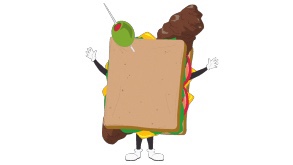
1. WHAT’S YOUR FAVOURITE FLAVOUR OF SHIT SANDWICH AND DOES IT COME WITH AN OLIVE?

What shit sandwich do you want to eat? Because eventually, we all get served one.

Ah, yes. The all-important question. What flavour of shit sandwich would you like to eat? Because here’s the sticky little truth about life that they don’t tell you at high school pep rallies: Everything sucks, some of the time.

Now, that probably sounds incredibly pessimistic. And you may be thinking, “Hey Mr. Conroy, turn that frown upside down.” But I actually think this is a liberating idea.

Everything involves sacrifice. Everything includes some sort of cost. Nothing is pleasurable or uplifting all of the time. So, the question becomes: what struggle or sacrifice are you willing to tolerate? Ultimately, what determines our ability to stick with something we care about is our ability to handle the rough patches and ride out the inevitable rotten days.

If you want to be a brilliant tech entrepreneur, but you can’t handle failure, then you’re not going to make it far. If you want to be a professional artist, but you aren’t willing to see your work rejected hundreds, if not thousands of times, then you’re done before you start. If you want to be a hotshot court lawyer, but can’t stand the 80-hour workweeks, then I’ve got bad news for you.

What unpleasant experiences are you able to handle? Are you able to stay up all night coding? Are you able to put off starting a family for 10 years? Are you able to have people laugh you off the stage over and over again until you get it right?

What shit sandwich do you want to eat? Because we all get served one eventually.

And your favourite shit sandwich is your competitive advantage. By definition, anything that you’re willing to do (that you enjoy doing) that most people are not willing to do gives you a huge leg-up.

So, find your favourite shit sandwich. And you might as well pick one with an olive.

THE ANSWER TO THIS QUESTION WILL TELL YOU:

• What struggles you are willing to tolerate to get what you want

• What you will likely be better than other people at

2. WHAT’S TRUE ABOUT YOU TODAY THAT WOULD MAKE YOUR 8-YEAR-OLD SELF CRY?

Something about the social pressures of adolescence and professional pressures of young adulthood squeezes the passion out of us. We’re taught that the only reason to do something is if we’re somehow rewarded for it. And the transactional nature of the world inevitably stifles us and makes us feel lost or stuck.

When I was a child, I used to write stories. I used to sit in my room for hours by myself, writing away, about aliens, about superheroes, about great warriors, about my friends and family. Not because I wanted anyone to read it. Not because I wanted to impress my parents or teachers. But for the sheer joy of it.

And then, for some reason, I stopped. And I don’t remember why.

We all have a tendency to lose touch with what we loved as a child. Something about the social pressures of adolescence and professional pressures of young adulthood squeezes the passion out of us. We’re taught that the only reason to do something is if we’re somehow rewarded for it. And the transactional nature of the world inevitably stifles us and makes us feel lost or stuck.

It wasn’t until I was 30 that I rediscovered how much I loved writing. And it wasn’t until I started my website that I remembered how much I enjoyed peeling away life’s problems.

The funny thing though, is that if my 8-year-old self asked my 20-year-old self, “Why don’t you write anymore?” and I replied, “Because I’m not good at it,” or “Because nobody would read what I write,” or “Because you can’t make money doing that,” not only would I have been completely wrong, but that eight-year-old-boy version of me would have probably started crying. That eight-year-old boy didn’t care about Google traffic or social media virality or book advances. He just wanted to play. And that’s where passion always begins: with a sense of play.

THE ANSWER TO THIS QUESTION WILL TELL YOU:

• What childhood passion you lost to adulthood

• What activity you should revisit, just for the fun of it

3. WHAT MAKES YOU FORGET TO EAT AND POOP?

Look at the activities that keep you up all night, but look at the cognitive principles behind those activities that enthrall you. Because they can easily be applied elsewhere.

We’ve all had that experience where we get so wrapped up in something that minutes turn into hours and hours turn into “Holy crap, I forgot to have dinner.”

Supposedly, in his prime, Isaac Newton’s mother had to regularly come in and remind him to eat because he would spend entire days so absorbed in his work that he would forget.

I used to be like that with video games. This probably wasn’t a good thing. In fact, for many years it was kind of a problem. I would sit and play video games instead of doing more important things like studying for an exam, or showering regularly, or speaking to other humans face-to-face.

It wasn’t until I gave up the games that I realised my passion wasn’t for the games themselves (although I do love them). My passion is for improvement, being good at something and then trying to get better. The games themselves—the graphics, the stories—they were cool, but I can easily live without them. It’s the competition with others and with myself that I thrive on.

And when I applied that obsessiveness for self-improvement and competition to my writing, well, things took off in a big way.

Maybe for you, it’s something else. Maybe it’s organising things efficiently, or getting lost in a fantasy world, or teaching somebody something, or solving technical problems. Whatever it is, don’t just look at the activities that keep you up all night, but look at the cognitive principles behind those activities that enthrall you. Because they can easily be applied elsewhere.

THE ANSWER TO THIS QUESTION WILL TELL YOU:

• What you truly enjoy doing

• What other activities to check out that you might also enjoy

4. HOW CAN YOU BETTER EMBARRASS YOURSELF?

Embrace embarrassment. Feeling foolish is part of the path to achieving something important, something meaningful. The more a major life decision scares you, chances are the more you need to be doing it.

Before you are able to be good at something and do something important, you must first suck at something and have no clue what you’re doing. That’s pretty obvious. And in order to suck at something and have no clue what you’re doing, you must embarrass yourself in some shape or form, often repeatedly. And most people try to avoid embarrassing themselves, namely because it sucks.

Ergo, due to the transitive property of awesomeness, if you avoid anything that could potentially embarrass you, then you will never end up doing something that feels important. Yes, it seems that once again, it all comes back to vulnerability.

Right now, there’s something you want to do, something you think about doing, something you fantasise about doing, yet you don’t do it. You have your reasons, no doubt. And you repeat these reasons to yourself ad infinitum.

But what are those reasons? Because I can tell you right now that if those reasons are based on what others would think, then you’re screwing yourself over big time.

If your reasons are something like, “I can’t start a business because spending time with my kids is more important to me,” or “Playing Starcraft all day would probably interfere with my music, and music is more important to me,” then OK. Sounds good.

But if your reasons are, “My parents would hate it,” or “My friends would make fun of me,” or “If I failed, I’d look like an idiot,” then chances are, you’re actually avoiding something you truly care about because caring about that thing is what scares the shit out of you, not what mom thinks or what Timmy next door says.

Great things are, by their very nature, unique and unconventional. Therefore, to achieve them, we must go against the herd mentality. And to do that is scary.

Embrace embarrassment. Feeling foolish is part of the path to achieving something important, something meaningful. The more a major life decision scares you, chances are the more you need to be doing it.

THE ANSWER TO THIS QUESTION WILL TELL YOU:

• What scares the shit out of you… for good reason

• That you should stop making lousy excuses and start doing something

5. HOW ARE YOU GOING TO SAVE THE WORLD?

you’re not going to fix the world’s problems by yourself. But you can contribute and make a difference. And that feeling of making a difference is ultimately what’s most important for your own happiness and fulfilment.

In case you haven’t seen the news lately, the world has a few problems. And by “a few problems,” what I really mean is, “everything is fucked and we’re all going to die.”

I’ve harped on this before, and the research also bears it out, but to live a happy and healthy life, we must hold on to values that are greater than our own pleasure or satisfaction.

So pick a problem and start saving the world. There are plenty to choose from. Our screwed up education systems, economic development, domestic violence, mental health care, governmental corruption. Hell, I just saw an article this morning on sex trafficking in the US and it got me all riled up and wishing I could do something. It also ruined my breakfast.

Find a problem you care about and start solving it. Obviously, you’re not going to fix the world’s problems by yourself. But you can contribute and make a difference. And that feeling of making a difference is ultimately what’s most important for your own happiness and fulfilment. And importance equals purpose.

Now, I know what you’re thinking. “Gee Lee, I read all of this horrible stuff and I get all pissed off too, but that doesn’t translate to action, much less a new career path.”

Glad you asked…

THE ANSWER TO THIS QUESTION WILL TELL YOU:

• What problem you care about that’s larger than you

• How you can make a difference

6. GUN TO YOUR HEAD, IF YOU HAD TO LEAVE THE HOUSE ALL DAY, EVERY DAY, WHERE WOULD YOU GO AND WHAT WOULD YOU DO?

Discovering what you’re passionate about in life and what matters to you is a full-contact sport, a trial-by-fire process. None of us know exactly how we feel about an activity until we actually do the activity.

For many of us, the enemy is just old-fashioned complacency. We get into our routines. We distract ourselves. The couch is comfortable. The Doritos are cheesy. And nothing new happens.

This is a problem.

What most people don’t understand is that passion is the result of action, not the cause of it.

Discovering what you’re passionate about in life and what matters to you is a full-contact sport, a trial-by-fire process. None of us know exactly how we feel about an activity until we actually do the activity.

So ask yourself, if someone put a gun to your head and forced you to leave your house every day for everything except for sleep, how would you choose to occupy yourself? And no, you can’t just go sit in a coffee shop and browse Facebook. You probably already do that. Let’s pretend there are no useless websites, no video games, no TV. Take yourself back to the 90’s when Facebook, Instagram, all this social media clusterfuck most of us spend half our lives on had yet to be invented.

You have to be outside of the house all day every day actively doing something until it’s time to go to bed—where would you go and what would you do?

Sign up for a dance class? Join a book club? Go get another degree? Invent a new form of irrigation system that can save the thousands of children’s lives in rural Africa? Learn to hang glide?

What would you do with all of that time? What activity would you choose above all others? We all have only 24 hours in a day, and so we’re back to the all-important question that we all should be asking ourselves:

“What can I do with my time that is important?”

If it strikes your fancy, write down a few answers and then, you know, go out and actually do them. Bonus points if it involves embarrassing yourself.

THE ANSWER TO THIS QUESTION WILL TELL YOU:

• What you were passionate about all along

• How you should spend your time

7. IF YOU KNEW YOU WERE GOING TO DIE ONE YEAR FROM TODAY, WHAT WOULD YOU DO AND HOW WOULD YOU WANT TO BE REMEMBERED?

Ultimately, death is the only thing that gives us perspective on the value of our lives. Because it’s only by imagining your non-existence that you can get a sense of what is most important about your existence.

Most of us don’t like thinking about death. It freaks us out. But thinking about our own death surprisingly has a lot of practical advantages. One of those advantages is that it forces us to zero in on what’s actually important in our lives and what’s just frivolous and distracting.

When I was in college, I used to walk around and ask people, “If you had a year to live, what would you do?” As you can imagine, I was a huge hit at parties. A lot of people gave vague and boring answers. A few drinks were nearly spat on me. But it did cause people to really think about their lives in a different way and re-evaluate what their priorities were.

Ultimately, death is the only thing that gives us perspective on the value of our lives. Because it’s only by imagining your non-existence that you can get a sense of what is most important about your existence. What is your legacy going to be? What are the stories people are going to tell when you’re gone? What is your obituary going to say? Is there anything to say at all? If not, what would you like it to say? How can you start working towards that today?

And again, if you fantasise about your obituary saying a bunch of badass shit that impresses a bunch of random other people, then again, you’re failing here.

When people feel like they have no sense of direction, no purpose in their life, it’s because they don’t know what’s important to them, they don’t know what their values are.

And when you don’t know what your values are, then you’re essentially taking on other people’s values and living other people’s priorities instead of your own. This is a one-way ticket to unhealthy relationships and eventual misery.

Discovering one’s “purpose” in life essentially boils down to finding those one or two things that are bigger than yourself, and bigger than those around you, values that will determine your priorities and guide your actions. It’s not about some great achievement, but merely finding a way to spend your limited amount of time well. And to do that you must get off your couch and act, and take the time to think beyond yourself, to think greater than yourself, and paradoxically, to imagine a world without yourself.

THE ANSWER TO THIS QUESTION WILL TELL YOU:

• What is most important to you

• What values should guide your actions

Oh and don’t forget to drink your coffee today 😏

Why being average is ok

There’s this guy. World-renowned billionaire. Tech genius. Inventor and entrepreneur. Athletic and talented and handsome with a jaw so chiseled it looks like Zeus came down from Olympus and carved the fucker himself.

This guy’s got a small fleet of sports cars, a few yachts, and when he’s not giving millions of dollars to charities, he’s changing out supermodel girlfriends like other people change their socks.

This guy’s smile can melt the damn room. His charm is so thick you can swim in it. Half of his friends were TIME’s “Man of the Year.” And the ones who weren’t don’t care because they could buy the magazine if they wanted to. When this guy isn’t jet setting around the world or coming up with the latest technological innovation to save the planet, he spends his time helping the weak and helpless and downtrodden.

This man is, you guessed it, Bruce Wayne. Also known as the Batman. And (spoiler alert) he doesn’t actually exist. He is fiction.

It’s an interesting facet of human nature that we seem to have a need to come up with these sort of fictional heroes that embrace body perfection and everything we wish we could be. Medieval Europe had its tales about gallant knights slaying dragons and saving princesses. Ancient Rome and Greece had their myths about heroes who won wars single-handedly and in some cases confronted the Gods themselves. Every other human culture is replete with such fantastical stories as well.

And today, we have comic book superheroes. Take Superman. I mean, the guy is basically a God with a human body wearing a blue jumpsuit and red underpants on inside-out.

He is indestructible and unbeatable. And the only thing as sturdy as his physical fortitude is his moral fortitude. In Superman’s world, justice is always black/white, and Superman never wavers from doing what’s right. No matter what.

I don’t think I’m exactly shaking up the field of psychology by suggesting that, as humans, we have a need to conjure up these heroes to help us cope with our own feelings of powerlessness. There are over 7.2 billion people on this planet, and really only about 1,000 of those have major worldwide influence at any given time. That leaves the other 7,199,999,000 +/- of us to come to terms with the limited scope of our lives and the fact that the vast majority of what we do will likely not matter long after we’ve died. This is not a fun thing to think about or accept.

Today, I want to take a detour from our “make more, buy more, fuck more” culture and argue for the merits of mediocrity, of being blasé boring and average.

Not the merits of pursuing mediocrity, mind you — because we all should try to do the best we possibly can — but rather, the merits of accepting mediocrity when we end up there despite our best efforts.

BEHIND THE CURVE

Everything in life is a trade off. Some of us are born with high aptitudes for academic learning. Others are born with great physical skills. Others are athletic. Others are artistic. Others can fuck like rabbits and never break a sweat. In terms of skills and talents, humans are a wildly diverse group of smelly creatures. Sure, what we end up accomplishing in life ultimately depends on our practice and effort but we are all born with different aptitudes and potentials.

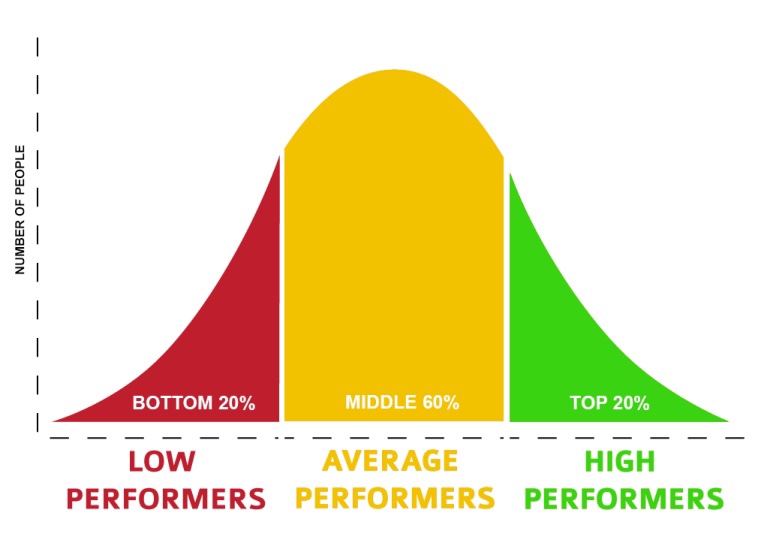
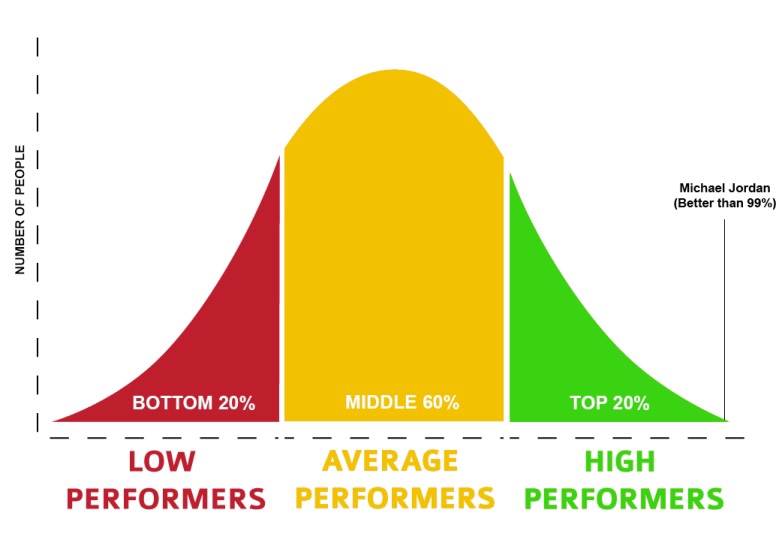
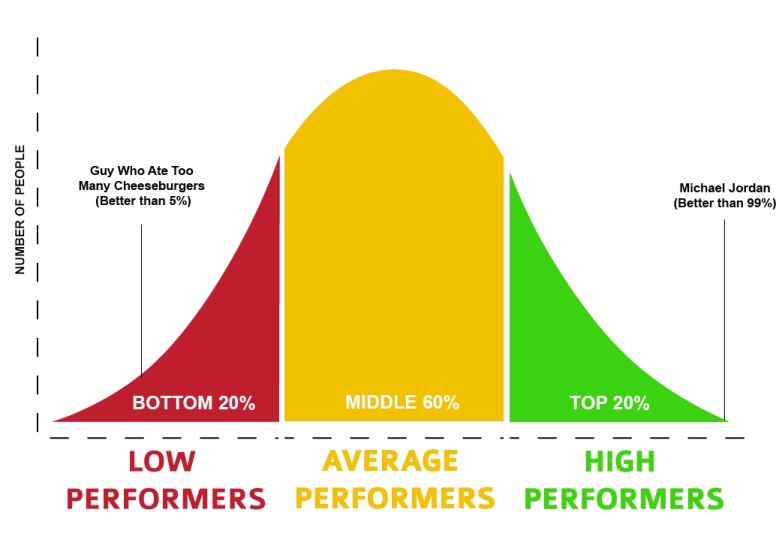
This here is called a bell curve. Any of you who have taken a statistics class and survived will recognise it.

A bell curve is quite simple. Take a population of people, like, let’s say people who play golf at least once a year. The horizontal axis represents how good they are at golf. Further to the right means they’re really good, further to the left means they’re really bad.

Now, notice that it gets really thin at the far ends of the curve. That means there are a few people who are really, really good at golf. And a few people who are really, really bad. The majority fall into the mediocre middle.

We can apply a “curve” in this way to tons of things in a population. Height. Weight. Emotional maturity. Wages. How often people like to fuck. And so on.

For example, this is Michael Jordan dunking a basketball:

It’s well-known that he’s one of the best to ever do it. Therefore, he’s way on the right side of the bell curve, better than 99.99% of anyone else who has ever dunked a basketball. Few can compare.

Then you have this guy:

Obviously, he’s no Michael Jordan. In fact, chances are many people reading this right now could do much better than this guy. That means he’s probably towards the bottom end of the bell curve, an extreme on the other side.

We stand in awe of MJ because he’s more athletic than all of us. We laugh at the trampoline guy because he’s less athletic than most of us. Both are at different extremes of the bell curve. And most of us are the majority in the middle.

WE’RE ALL PRETTY AVERAGE AT MOST THINGS

We all have our own strengths and weaknesses. But the fact is, most of us are pretty average at most things we do. Even if you’re truly exceptional at one thing — say math, or jump rope, or making money off the black gun market — chances are you’re pretty average or below average at most other things. That’s just the nature of life. To become truly great at something, you have to dedicate time and energy to it. And because we all have limited time and energy, few of us ever become truly exceptional at more than one thing, if anything at all.

We can then say that it is a complete statistical improbability that any single person can be an extraordinary performer in all areas of their life, or even many areas of their life. Bruce Wayne does not exist. It just doesn’t happen. Brilliant businessmen are often fuck ups in their personal lives. Extraordinary athletes are often shallow and as dumb as a lobotomised rock. Most celebrities are probably just as clueless about life as the people who gawk at them and follow their every move.

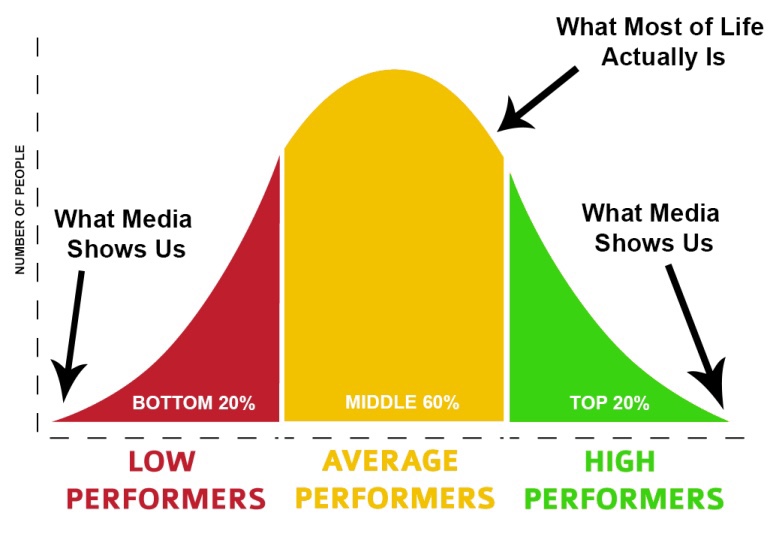
We’re all, for the most part, pretty average people. It’s the extremes that get all of the publicity. We all kind of intuitively know this, but we rarely think and/or talk about it. T

he vast majority of us will never be truly exceptional at, well, anything. And that’s ok.

Which leads to an important point: that mediocrity, as a goal, sucks. But mediocrity, as a result, is OK.

Few of us get this. And fewer of us accept it. Because problems arise — serious, “My God, what’s the point of living” type problems — when we expect to be extraordinary. Or worse, we feel entitled to be extraordinary.

When in reality, it’s just not viable or likely. For every Michael Jordan or Kobe Bryant, there are 10 million scrubs stumbling around parks playing pickup games… and losing. For every Picasso or DaVinci there have been about a billion drooling idiots eating Play-Doh and slapping around fingerpaints. And for every Leo Motherfucking Tolstoy, there’s a lot of, well, me, scribbling and playing at writer.

THE TYRANNY OF A CULTURE OF EXCEPTIONALISM

So here’s the problem. I would argue that we have this expectation (or this entitlement) more today than any other time in history. And the reason is because of the nature of our technology and economic privilege.

Having the internet, Google, Facebook, YouTube and access to 500+ channels of television is amazing. We have access to more information than any other time in history.

But our attention is limited There’s no way we can process the tidal waves of information flowing through the internet at any given time. Therefore the only ones that break through and catch our attention are the truly exceptional pieces of information. The 99.999th percentile.

All day, every day, we are flooded with the truly extraordinary. The best of the best. The worst of the worst. The greatest physical feats. The funniest jokes. The most upsetting news. The scariest threats. Non-stop.

Our lives today are filled with information coming from the extremes of the bell curve, because in the media that’s what gets eyeballs and the eyeballs bring dollars. That’s it. Yet the vast majority of life continues to reside in the middle.

It’s my belief that this flood of extreme information has conditioned us to believe that “exceptional” is the new normal. And since all of us are rarely exceptional, we all feel pretty damn insecure and desperate to feel “exceptional” all the time. So we must compensate. Some of us do this by cooking up get-rich-quick schemes. Others do it by taking off across the world to save starving babies in Africa. Others do it by excelling in school and winning every award. Others do it by shooting up a school. Others do it by trying to have sex with anything that talks and breathes.

There’s this kind of psychological tyranny in our culture today, a sense that we must always be proving that we are special, unique, exceptional all the time, no matter what, only to have that moment of exceptionalism swept away in the current of all the other human greatness that’s constantly happening.

The crazy thing is that every single person in this video, for their five seconds of incredible footage, likely spent years and years and years practicing their craft as well as dozens of hours of recording to just get that perfect five-second spot.

Yet we are not exposed to those years of practice. Or those hours of drab and failed footage. We’re merely exposed to each person’s absolute finest moment — possibly in their entire lives.

And then we watch this and forget about it within minutes. Because we’re onto the next thing. And then the next.

B-B-B-BUT, IF I’M NOT GOING TO BE SPECIAL OR EXTRAORDINARY, WHAT’S THE POINT?

It’s an accepted part of our culture today to believe that we are all destined to do something truly extraordinary. Celebrities say it. Business tycoons say it. Politicians say it. Even Oprah says it. Each and every one of us can be extraordinary. We all deserve greatness.

The fact that this statement is inherently contradictory — after all, if everyone was extraordinary, then by definition, no one would be extraordinary — is missed by most people, and instead we eat the message up and ask for more. (More tacos, that is.)

Being “average” has become the new standard of failure. The worst thing you can be is in the middle of the pack, the middle of the bell curve.

The problem is that, statistically speaking, pretty much all of us are in the middle of that bell curve almost all of the time, in almost everything we do. Sure, you might be a world-class putt-putt golfer. But then you have to go home and be a lousy father and get drunk on cheap beer faster than 90% of the population and piss the bed at night. Or worse, you could be Tiger Woods. No one stays exceptional for very long.

A lot of people are afraid to accept mediocrity because they believe that if they accept being mediocre, then they’ll never achieve anything, never improve, and that their life doesn’t matter.

I find this sort of thinking to be dangerous. Once you accept the premise that a life is only worthwhile if it is truly notable and great, then you basically accept the fact that most of the human population sucks and is worthless. And ethically speaking, that is a really dark place to put yourself.

But most people’s problem with accepting being average is more practical. They worry that, “If I accept that I’m average, then I’ll never achieve anything great. I’ll have no motivation to improve yourself or do something great. What if I am one of the rare few?”

This, too, is a misguided belief. The people who become truly exceptional at something do so not because they believe they’re exceptional. On the contrary, they become amazing because they are obsessed with improvement. And that obsession with improvement stems from an unerring belief that they are, in fact, not that great at all. That they are mediocre. That they are average. And that they can be so much better.

This is the great irony about ambition. If you wish to be smarter and more succesful than everybody else, you will always feel like a failure. If you wish to be the most loved and most popular, then you will always feel alone. If you wish to be the most powerful and admired, then you will always feel weak and impotent.

All of this “every person can be extraordinary and achieve greatness” stuff is basically just jerking off your fucking ego. It’s shit sold to you to make you feel good for a few minutes and to get you through the week without hanging yourself in your cubicle. It’s a message that tastes good going down, but in reality, is nothing more than empty calories that make you emotionally fat and bloated, the proverbial Big Mac for your heart and your brain.

The ticket to emotional health, like physical health, comes from eating your veggies — that is, through accepting the bland and mundane truths of life: a light salad of “you’re actually pretty average in the grand scheme of things” and some steamed broccoli of “the vast majority of your life will be mediocre.” This will taste bad at first. Very bad. You will avoid eating it.

But once ingested, your body will wake up feeling more potent and more alive. After all, that constant pressure to always be something amazing, to be the next big thing, will be lifted off your back. The stress and anxiety of feeling inadequate will dissipate. And the knowledge and acceptance of your own mundane existence will actually free you to accomplish what you truly want to accomplish with no judgments and no lofty expectations.

You will have a growing appreciation for life’s basic experiences. You will learn to measure yourself through a new, healthier means: the pleasures of simple friendship, creating something, helping a person in need, reading a good book, laughing with someone you care about.

Sounds boring, doesn’t it? That’s because these things are average. But maybe they’re average for a reason. Because they are what actually matter.

Speaking of things that matter. Grab yourself a freshly brewed coffee and Thank me later.

Loneliness

Loneliness is low-key the root of so many of the mental health and social welfare issues today, yet nobody seems to know how to talk about or solve it.

Loneliness is a tough topic to tackle. It’s so widespread, yet we still know little about how or why it happens.

WHAT’S THE DEAL WITH LONELINESS?

First, here are a couple of things that we know that are probably true:

• Loneliness is widespread in the western world. In numerous surveys in the US and Europe, anywhere from 30% to 60% of the population self-reports feeling lonely and/or says that they have no meaningful in-person interactions on a daily basis.What’s more surprising is that younger people often report experiencing more loneliness than older people.

• Loneliness is bad for you. Here’s a famous stat that gets bandied about claiming that loneliness shortens your lifespan as much as smoking 15 cigarettes per day. I always think it’s pretty ridiculous how they calculate these factoids, but the point remains: loneliness is unhealthy, both physically and mentally. It raises the risk of anxiety and depression. It also harms your physical health. Studies find people who are lonely experience more heart disease, high blood pressure, and weaker immune systems.

WHAT WE DON’T KNOW ABOUT LONELINESS

Okay, so that sounds pretty bad. But wait, there’s more! Here’s what we don’t know:

WHY THIS IS HAPPENING

Loneliness afflicts the western world in a way that it doesn’t appear to affect other cultures. There are many theories for why this is, but we still don’t have any solid answers.

Some point to westerners’ more individualistic culture with less emphasis on family or community. Some blame urbanization and cultural norms around owning your own house, living alone, working independently, etc. Some point to demographic changes: people are having fewer children, move from city to city more often, and spend less time with the elderly. Some point to the decline in religiosity, arguing that religion has historically been the core of human community and camaraderie. It could be any or all of these.

HOW TO FIX IT

Again, there are a lot of theories, but we know little for sure.

Connections online and through devices seem to be a poor replacement for the emotional and psychological sustenance we get from being around others. Social media and video games are like the diet soda of our emotional well-being—it tastes like we’re hanging out with people, but there are no emotional calories. And in this case, no emotional calories is a bad thing… it’s starving us.

Loneliness is both a function of quality and quantity of social interactions. Not only do we need to see people we know often, but we also need to feel some degree of intimacy and trust with those we know.

That said, efforts are being made. In 2018, the UK appointed a “minister of loneliness”Scandinavian countries such as Denmark are having success with “co-housing policies” where a mixture of elderly retired people and young families in need of childcare are “matched” into housing units where they share living spaces and can support each other.

But overall, this appears to be a big issue. It’s an issue to the point where the medical world has taken notice and pharmaceutical companies are even questioning if they could develop a drug to treat loneliness much in the same way there are pills to treat depression (sidenote: please fucking don’t).

But this still doesn’t get at why I think loneliness is “the low-key root” of so many social and cultural issues today…

THE DARK PATH FROM LONELINESS

Psychologically speaking, we’re social animals. Most of the meaning and purpose we derive in life comes via our relationships with other individuals or from our perceived role within society, at large.

In fact, it appears that our need for human connection is so strong that much of our ability to form functional beliefs of ourselves and the world is tied to our relationships. Like a muscle, you lose empathy if you don’t use it.

And this is why, when people look at what motivates religious fanatics, conspiracy nuts, and political extremists, time and time again, what they find is an abiding loneliness.

Rejection and social isolation radicalize people. In the absence of affection and understanding, people fall back onto delusional ideas of revolution and saving the world to give themselves a sense of purpose.

Hannah Arendt, the mid-20th century philosopher and writer, was a German Jew who successfully escaped the Nazis. After the war, she spent years studying totalitarianism, the rise and fall of fascism, the communist revolutions, the horrors of Stalin and Hitler and Mussolini and Mao—and more importantly, why these leaders became so popular so quickly among their followers despite the terror they invoked.

She then produced a classic book called The Origins of Totalitarianism

The book stretches to nearly 500 pages in length and, in the end, she comes to a startling conclusion: she argued that loneliness makes people susceptible to the contempt and fragmentation that causes functional societies to collapse into extremism and violence.

I will quote her at length here and hope her progeny don’t sue me:

“Loneliness, the common ground for terror, the essence of totalitarian government, the preparation of its executioners and its victims, is closely connected with uprootedness and [meaninglessness] which have been the curse of modern masses since the beginning of the industrial revolution and have become acute with the rise of the imperialism at the end of the last century and the breakdown of political institutions and social traditions in our own time.

What prepares men for totalitarian domination in the non-totalitarian world is the fact that loneliness, once a borderline experience usually suffered in certain marginal social conditions like old age, has become an everyday experience of the ever-growing masses of our century. The merciless process into which totalitarianism drives and organizes the masses looks like a suicidal escape from this reality. [The reasoning] which “seizes you as in a vise” appears like a last support in a world where nobody is reliable and nothing can be relied upon. It is the inner coercion whose only content is the strict avoidance of contradiction that seems to confirm a man’s identity outside the relationships with others”

Basically, once cut off from empathetic social contact to ground us, the only way we make sense of the world is by adopting radical all/nothing views.

And within these views, people begin to see a need for radical overthrow of the status quo. They begin to imagine themselves complete victims or destined saviors of society.

Keep in mind, too, that she wrote this in 1951, long before Trump and woke leftists and Twitter were thought to have ruined everything.

And perhaps this is the real threat of social media : it does not necessarily make us lonelier or angrier or more selfish or more spiteful—it simply enables the lonely and angry and selfish and spiteful to self-organize and be heard like never before.

It used to be that if you were a radical Marxist who wished for violent revolution or if you were a quack who thought Bill Gates was implanting microchips in millions of African children, you kinda had to keep that shit to yourself.

You’d cause a lot of awkward silences and shifty side-glances until you’d realized you weren’t being invited to kids’ birthday parties anymore.

So… you’d shut the fuck up. And eventually, you’d start to realize, hey, most people are alright. Things are going to be fine.

But now?

There’s a forum somewhere full of people with the exact same batshit crazy you have. And what do all humans who have similar yet strange beliefs do when they get together?

That’s right, they convince themselves that they’re going to save the fucking world with their knowledge. That is, they go on a crusade.

And you and I and everyone else has to listen to them, emboldened and invigorated by their new internet “friends,” as they explain to us at Thanksgiving why Jesus was a communist and the movie Armageddon was really a coded message from QAnon explaining why Bruce Willis doesn’t just run a pedophile ring, but he is secretly a sixteen-year-old boy being held prisoner against his wishes, and…

(Fuck, now I’m really going to get sued.)

Anyway, where was I? Oh yeah! Loneliness…

Perhaps another way to look at Arendt’s argument is that we run the risk of extremists taking over when it becomes easier for radicals with fringe beliefs to mobilize and organize than the moderate majority.

Historically, this mobilisation of the extremes was enabled by economic depressions and famines and (gulp) pandemics and whatnot.

Today, perhaps social media and smartphones have inadvertently made that mobilisation more possible.

But who knows… I could be wrong about all of this.

The fact is, we still don’t know enough to say for sure.

But what I do know is this.

Grab yourself a fresh brew, coffee won’t cure loneliness, but it’s better to be caffeinated and lonely than not caffeinated and lonely 😉