Treat your emotions like a dog

I often tell people, try treating your emotions like a dog.

Yeah, they’re like “what the actual fuck is this guy on about” as well. But hear me out. This espresso has got my psychology juices flowing.

One thing I’ve noticed over the years is that shitty dogs almost always have shitty owners.

The dog’s level of discipline is reflected in the owner’s emotional maturity and self-discipline.

It’s very rare to see a dog that’s wrecking the house, eating all the toilet paper and shitting on the couch which has an owner who has their own shit together.

This is because our connections with dogs are purely emotional.

And if we suck at dealing with our own emotions, then we’ll suck at dealing with our dogs. It’s that simple.

If you don’t know how to limit yourself and tell yourself “no” when necessary, then, well, don’t get a dog.

And if you do get one, don’t fucking move into my estate (or neighbourhood for my American followers).

Our emotions are kind of like our dog that’s living inside our head.

We have this part of ourselves that just wants to eat, sleep, fuck and play, but has no conception of future consequences or risks.

That’s the part of ourselves we need to train.

Our emotions are important. But they’re also kind of dumb and designed to overreact to things.

They evolved to keep us alive when we were hunting water buffalo on the savannah and shit like that.

When we’re scared we want to run away or hide. When we’re angry we want to break stuff.

But thankfully, our brains also evolved logic and the ability to consider the past and the future, and all that great Gucci stuff.

That’s what makes us humans. And not dogs.

The problem is, our “dog brain” is actually what controls our behavior.

You can intellectually know that eating ice cream for breakfast is a bad idea, but if your dog brain wants fucking ice cream for breakfast, then that’s ultimately where your body is going to go.

It’s only by training your dog brain with your people brain, “No, bad Lee, ice cream for breakfast is bad, go do something else that feels good and is healthy like lifting some heavy shit off the ground,” that your dog brain gradually learns.

Do that enough and you have a well-behaved dog brain.

Now, after that rollercoaster of emotions can you see why I said train your emotions like a dog? Yeah? Good.

Welcome to growth you beautiful motherfucker.

Fuck, I nearly forgot. Drink your damn coffee and don’t be an asshole today, the world has plenty of them already.

Love,

Lee

5 Truths That Are Hard to Hear

(Brace Yourself):

At some point we all must admit the inevitable:

Life is short, not all of our dreams can come true, so we should carefully pick and choose what we have the best shot at and then commit.

We try things. Some of them go well. Some of them don’t.

The point is to stick with the ones that go well and move on, not get upset about every little thing that didn’t go our way.

What we don’t realize is that there is a fine art of not giving a fuck. People aren’t just born not giving a fuck.

Not giving a fuck must be honed over years of deliberate practice.

Finding meaning and purpose is not a five-day spa retreat. It’s a fucking hike through mud and shit with golf-ball-sized hail pelting you in the face. And you have to love it.

You have to laugh about it. To show the world your gleaming bruises and scars and say, ” I stood for THIS.”

No one is going to stand up at your funeral and say, “He fucked like a wildebeest and had the best golf swing I’ve ever seen.”

Life is about loving people, not impressing them.

So with that being said drink your damn coffee, stay true to yourself and have a beautiful day motherfuckers 🤙🏻

Lee ❤️

Meaning of Life

You know the question. It’s the ultimate question. The question that you and I and everyone have lain awake at night thinking about.

The question that brings equal parts wonder and terror to our feeble fucking minds. Why are we here? What is the point of it all? What is the meaning of life so to speak?

Well, fortunately, I figured it out while I was drinking a coffee this morning. I’m pretty sure it’s coffee. And no, I’m not saying that just because I’m having coffee. There’s an explanation here. I’m going to explain it, clickbait titles and all, in, oh, the next eight minutes or so.

First off, before we can even appropriately ask “What is the meaning of life?” we must first settle something more subtle and something more important. Namely, what is meaning?

WHAT IS MEANING?

What is meaning? That may strike you as terribly navel-gazey and ultra-philosophical. And if that’s the case, I invite you to think about coffee for a moment, and just stick with me for a minute. Because it’s important.

What does it mean for something to mean something? As humans, we have a constant need to attach meaning to everything that happens in our lives.

Look, a guy climbed a rock looking for meaning! My mom hugs me, that must mean that she loves me. My boss complimented me, that must mean I do good work. It’s going to be sunny tomorrow, that must mean I can wear my super-cool SpongeBob tank top to the store.

Meaning is the association that we draw between two experiences or events in our minds. X happens, then Y happens, so we assume that means X causes Y. Z happens, and we get really pissed off and feel shit, therefore we assume that Z sucks.

Our brains invent meaning the way dogs shit, they do it gleefully and not even realising that they’re ruining the fucking carpet.

Our brains invent meaning as a way to explain all the crazy shit going on in the world around us. This is important, as it helps us predict and control our lives.

But let’s be real: Meaning is an arbitrary mental construct.

Fifty people can watch the exact same event and draw fifty different meanings from said event. That’s why there’s so much arguing in politics. That’s why eyewitnesses are so unreliable in court.

That’s why your friends are sometimes the biggest assholes, because that meaning you just shared, to them, meant something completely different or nothing at all

TYPES OF MEANING IN LIFE

Our brains slap together two different types of meaning:

• Cause/Effect Meaning: You kick the ball, the ball moves. You tell your friend his hair is ugly, your friend slaps you in the face. You do X, and with reliable certainty, Y will result.We all need Cause/Effect meaning to survive. It helps us predict the future and learn from the past. Cause/Effect meaning primarily involves the logical parts of our brain. Science, for instance, is the constant search of more and more Cause/Effect Meaning.

• Better/Worse Meaning: Eating is better than starving. Making money is better than being broke. Sharing is better than stealing. Better/Worse meaning has to do with the nature of our values—what we perceive to be most important and useful in our lives.Better/Worse meaning relies mostly on the emotional parts of our brains. Generally what makes us feel good is what we immediately assume to be “good” or “better.”

Both forms of meaning evolved in our brains to help us survive. For thousands of years, humans needed to remember where certain food could be found, how various animals would respond when hunted, how weather patterns change and how to read the terrain. They also needed to know what would gain them acceptance within their tribe, what would curry favour from friends and earn approval from that sexy guy/gal in the loin cloth over yonder.

So in that sense, meaning is nature’s tool for motivation. It’s how evolution made sure we got shit done. Meaning drives all of our actions. When there is great meaning attached to something, like our child is sick and starving, we will go to insane lengths to make things right. People will often even go as far as giving up their lives for some grand sense of meaning (see: religion, every war ever). Meaning is that effective at moving people.

Meaning is nature’s tool for motivation.

Conversely, when we feel we lack meaning in our lives, when shit just doesn’t seem to matter, when there’s no clarity on how or why things happen to us, we do nothing. We sit on the couch and twiddle our thumbs and watch lame reruns while complaining on the internet about lame reruns. But here’s the kicker (and I swear I’m going to get to the coffee):

Meaning is a resource that we must cultivate in our lives.

Meaning is not something that exists outside of ourselves. It is not some cosmic universal truth waiting to be discovered. It is not some grand ‘eureka’ moment that will change our lives forever.

Meaning requires action. Meaning is something that we must continually find and nurture. Consistently.

Man’s great search for the meaning of life usually ends like this.

Meaning is like the water of our psychological health. Without it, our hearts and minds will shrivel and die. And like water, meaning flows through us—what is important today is not what was important years ago, and what is important tomorrow will not be the same as what is important today. Meaning must be sought out and replenished frequently.

HOW TO FIND MEANING IN YOUR LIFE

In a very real sense, the meaning of life is therefore to create meaning. So how does one create meaning? Two ways:

• Solve Problems. The bigger the problem, the more meaning one will feel. The more work you do towards that problem, also the more meaning you will feel. Solving problems basically means finding ways to make the world a slightly better place. Can be as simple as fixing up your aging mother’s dilapidated house. Or as complex as working on the new great breakthrough in physics.The point here is not to be picky. It’s easy, when we start thinking of how insignificant we are on a cosmic scale of the universe, to start thinking there’s no point in doing anything unless we’re going to save the world or something. This is just a distraction. There are tons of small, everyday problems going on around you that need your attention. Start giving it.

• Help Others. This is the biggie. As humans, we’re wired to thrive on our relationships. Studies show that our overall well-being is deeply tied to the quality of our relationships, and the best way to build healthy relationships is through helping others. In fact, some studies have even found that giving stuff away makes us happier than giving stuff to ourselves. Go figure. As such, it seems to be a “hack” in our brains that helping out other people gives us a greater sense of meaning and purpose. Just the fact you can say to yourself, “If I died, then someone is better off because I lived,” creates that sense of meaning that can propel you forward.

THE TRAP OF SETTING GOALS

A lot of people find meaning through setting goals for themselves. They want the corner office, the big car, the fancy-pants shoes. It gives them a reason to wake up in the morning, a reason to bust their ass at work. It gives them something that makes them feel important and something to look forward to every day.

But goals are a double-edged sword. You have to be careful.

Goals are good tools for building motivation. The problem is that, by themselves, they are arbitrary and empty. Unless there’s a “why” behind the goal full of meaning, the goal itself will provide little long-term happiness or satisfaction. Ever seen star athletes flounder after retirement? Or a guy who finally made his millions become deeply miserable because he doesn’t know what else to do with his life?

Goals are dangerous because the meaning they provide when you’re working towards them is the meaning that is taken away once you achieve them.

This is why all the superficial stuff like make a billion euros, or own a Rolls Royce, or get your face plastered on the cover of a magazine all lead to a type of happiness that is shallow and short-lived—because the meaning is shallow and short-lived.

There has to be a deeper reason for your goals. Otherwise, the goals themselves will be empty and worthless in the long run.

Some athletes handle retirement well. Others end up on Dancing with the fucking Stars.

Notice that it’s the athletes who aspire to be the best at their sport for some greater reason to build a charity, to start a business, to transition into another career who handle retirement the best.

Notice it’s the millionaires who spent their life working towards a deeper cause that remain content once all of their goals are checked off the checklist.

But some goals don’t even have to be big and sexy.

Take a cup of coffee. I sat down to write this blog craving a coffee. That’s a problem in my life. And I promised myself I’d pump out this draft before going and getting this magnificent sexy coffee. That gave this hour some extra meaning.

And you know what? Maybe my fiancé is craving one too and I can get her one. You know, make the world a better place and all that shit while I’m at it.

So what’s the meaning of life? Well, for me, right now, it’s a coffee. What will yours be?

PS: if you haven’t already, get a damn coffee and have an amazing day you beautiful motherfucker.

WHAT IS NARCISSISM?

Ah, narcissists. Checking themselves out in every reflective surface they walk by. Yammering on about that one time they won the third class spelling bee. Thinking they’re God’s gift to the fucking universe after all, why else would He (yes I called god a “he” don’t shoot me 🙄) have put them right in the middle of it?

But here’s the thing: Narcissism is way more complex and, quite frankly, way more annoying than that.

Yes, it’s an inflated sense of self-importance and a hankering for constant admiration, combined with a devastating lack of empathy for others. It’s the “Me, Myself and I” syndrome, where the world must revolve around a single person, and everyone else is just an extra in the movie of their life.

But before you start pointing fingers at your ex or that obnoxious coworker, remember: We’ve all got a smidgeon of narcissism in us. It’s just that some people got an extra dollop. Or five.

So let’s dive headfirst into this bottomless pit of ego and self-absorption, cutting through the bullshit, and maybe, just maybe, we’ll come out on the other side understanding what makes these narcissists tick.

And who knows, we might even figure out how to deal with them without losing our damn sanity. Let’s unpack this sweaty bag of asses together.

WHAT IS NARCISSISM?

First, let’s clarify what narcissism actually is.

Simply put, narcissism is a chronic state of entitlement. A narcissist might believe they are exceptionally extraordinary or exceptionally deprived. In either case, the rules that apply to everyone else don’t apply to them. The narcissist owes the world nothing, while the world owes them everything.

As with most things in life, narcissism comes in varying degrees. No one is 0% or 100% narcissistic. Everyone falls along a spectrum. We all exhibit a few narcissistic traits that is, a certain amount of entitlement on our worst days.

But, at the extreme end, a person might be suffering from a full blown personality disorder. And even those who are clinically diagnosed will fall along a spectrum from high-functioning individuals to complete neurotic messes.

We all engage in at least some narcissistic behaviors at some point or another. The problem arises when narcissism becomes our default mode and we don’t realize we’re behaving like a narcissist.

THE TWO TYPES OF NARCISSISM

I have talked about two types of entitlement before, which are really two types of narcissism. Let’s pick apart each one.

THE GRANDIOSE NARCISSIST

The “grandiose narcissist” is the type we mostly think of when we say that someone is a narcissist. They’re the thin-skinned, attention-seeking, arrogant asshats who are oblivious to the needs of others and will exploit anything and anyone.

Now, we all know someone who thinks a little too highly of themselves, craves attention and admiration a little too much.

They can’t take criticism, they blame everyone else when things go wrong, and they expect to get extra special treatment because they’re above the plebes and schlubs and “normal people” who cower beneath them.

But these kinds of narcissists also often have a charm about them, at least at first. Their outward self-confidence can be refreshing to be around, especially if you aren’t a person who feels a shit tone of confidence to begin with.

But their bullshit quickly sours.The blaming, the gaslighting, the manipulation, the way they constantly turn everything back onto themselves.It gets exhausting.

Some Tell-Tale Signs of a Grandiose Narcissist

• Being arrogant, braggy, and showing off

• Exaggerating accomplishments and/or talents

• Requiring constant admiration and praise

• Believing others are envious and jealous of them

• Having a preoccupation with success, power, brilliance, beauty, and/or the ideal mate

• Taking advantage of and exploiting others for personal gain

• Lacking empathy

• Having a sense of specialness/uniqueness that only other special/unique people can understand

• Having unreasonable expectations of special treatment

THE VULNERABLE NARCISSIST

Let me paint a picture of someone else we all know too.

This is the person who’s much more reserved and doesn’t really seek out attention in all those loud and obnoxious ways. They can be shy at times, and they might even put themselves down a little too much.

Like a grandiose narcissist, they are hyper-sensitive and need constant reassurance. But unlike a grandiose narcissist, they don’t believe they are better than everyone else. In fact, they believe the opposite—they believe they are uniquely victimized or oppressed by everyone else.

Vulnerable narcissism is a more subtle form of narcissism. But it’s still narcissism. The difference is that a grandiose narcissist thinks they’re uniquely superior, while the vulnerable narcissist thinks they’re uniquely inferior.

A grandiose narcissist believes they are uniquely privileged while a vulnerable narcissist believes they are uniquely under-privileged. A grandiose narcissist takes pride in taking advantage of others while a vulnerable narcissist takes pride in being taken advantage of by others.

Like the grandiose narcissist, the vulnerable narcissist thinks they deserve special treatment because of their uniqueness.

These are the self-labeled, perpetual victims. They may be shy and outwardly self-effacing. But underneath that cowering exterior is a sense of grandiosity.

They’ll get offended by the smallest slights and anything and everything distresses them.

Some Signs of a Vulnerable Narcissist

• Appearing submissive

• Putting themselves down

• Feeling under-recognized and under-appreciated

• Being easily offended

• Being envious and jealous of others

• Getting easily distressed

• Not taking good care of themselves like in grooming or health

• Having a sense of specialness/uniqueness that only other special/unique people can understand

• Having unreasonable expectations of special treatment

Though grandiose and vulnerable narcissists are different in important ways, both are extraordinarily self-absorbed and have a fragile sense of self they have to maintain by viewing themselves as exceptional again, either exceptionally extraordinary or exceptionally deficient.

They deny any realities that do not support their grandiose self-perception and as a result tend to engage only in superficial relationships or withdraw from social situations altogether.

At the heart of it, both kinds of narcissists are overly self-entitled individuals who believe they’re special and that different rules in life apply to them.

WHERE DOES NARCISSISM COME FROM?

Narcissism is a pretty complex personality trait, and psychologists haven’t completely untangled how it comes about, but they have found some clues.

For one, certain approaches to parenting appear to influence the development of narcissism.

There is some evidence to suggest that children are at a higher risk of developing narcissistic qualities if they grow up with parents who are authoritarian, highly indulgent, or overly neglectful of their children’s emotions.

Let’s take these one at a time:

1. Authoritarian Parenting

These parents try to control their children’s behavior to an unhealthy degree. They demand strict obedience to rules, while providing little in the way of warmth, support, or open communication.

Authoritarian parents may base their child’s worth on accomplishments and conformity to rules, which can lead children to develop an inflated sense of self-importance to cope with this pressure. They may also develop a deep-seated sense of entitlement as a defense mechanism against feeling unloved or not good enough.

2. INDULGENT PARENTING

On the opposite end of the spectrum, children who are overly validated by gushing parents also tend to end up as narcissists.

Not surprisingly, if a child constantly hears how “special” and “wonderful” and “beautiful” they are (spoiler: you’re not fucking special), they end up internalizing their parents’ inflated views of them and grow up to believe they’re entitled to extra privileges in life.

3. NEGLECTFUL PARENTING

Also known as uninvolved parenting, this style is characterized by low levels of both warmth and control.

Neglectful parents may be unresponsive to their children’s needs and may not provide necessary guidance or feedback. They often fail to validate their children’s emotions or thoughts.

In response, children may develop narcissistic traits as a coping mechanism, using an inflated sense of self-importance to compensate for feelings of neglect and unworthiness.

On the surface, these parenting styles seem wildly different, so how could they all contribute to developing narcissism?

Well, the one thing they all have in common is that they don’t help the child to fully express a realistic, independent identity.

Authoritarian parents are overly controlling and therefore don’t let their children find their own way in life. This makes them seek more and more outside validation in order to feel good about themselves, which could turn into narcissism.

Indulgent parents, on the other hand, provide too few boundaries for their children, and instead contribute to an inflated sense of self that isn’t grounded in reality.

And neglectful parents provide little to no validation for their children’s emotional needs, so they might grow up narcissistic to overcompensate for feelings of shame and inadequacy. Shame, in fact, plays a crucial role in people who develop vulnerable narcissism.

IT’S NOT ALL YOUR PARENTS’ FAULT

Now, before you go off and start hating your parents (or hating them more than you already do…), it’s important to understand that parenting is just one factor that might contribute to narcissism.

Research into the origins of narcissism is still in its early stages. We don’t really know how genetics, peer groups, trauma and many, many other factors might contribute.

And so, while I think parenting is important, I’m not one to blame parents for too much.

In fact, a balance between each of the above parenting styles appears to be the antidote to raising narcissistic kids. Namely, children with parents who encourage their kids, show warmth towards them, set strong boundaries, and also have high standards for them tend to turn out pretty well adjusted.

So it seems that our parents just did the best they could, but they might have focused a little too much on one style over others.

My point is: don’t blame parents for everything. Most (yes I say most because “some” aren’t doing a fucking thing) are just doing the best they can.

THE PROBLEM WITH NARCISSISM

The past decade or two has seen a very public debate about the possibility of a narcissism “epidemic” in our current culture, especially among young people.

The reality is that every culture in recorded history has had to deal with narcissism and the myriad problems associated with it. At the extreme end, narcissism has been linked to substance abuse and a wide range of personality disorders, from bipolar to borderline and passive-aggressive disorders.

Grandiose narcissism tends to co-occur with antisocial traits and paranoia, while vulnerable narcissism tends to be accompanied by depression, anxiety, and suicidal tendencies.

People with grandiose narcissistic traits tend to crave power and those who emerge as leaders can create a pretty toxic environment for the poor souls they reign over.

And though it’s often grandiose narcissists who we see as exploitative, vulnerable narcissists are also not very good at empathizing with others and can be equally dickish.

Worse, narcissism has been consistently linked with violence. Researchers bicker over whether narcissism is increasing in prevalence, but I’d argue this is merely semantics. Narcissism—both as a personality trait and a mental disorder—is as serious a problem today as it was in 1978 or ancient Greece, for that matter.

HOW TO DEAL WITH NARCISSISTIC PEOPLE

The first rule of dealing with narcissistic people is: don’t.

If you can avoid having to interact with a narcissist, then don’t interact with them. Don’t try to convince them, persuade them, change them, fix them, or change their mind. It’s probably impossible and even if it’s not, it’s definitely not worth it.

That being said, sometimes you have to deal with a narcissistic person and if you’re going to have to deal with them, then it’s important to understand how to go about it.

Obviously, how you deal with narcissists will vary depending on the context in which you interact with them; e.g., how you handle a narcissistic boss will be different from how you handle your narcissistic boyfriend and parents. Even in the same context, each individual is different, so obviously, the approach here varies.

But basically, the key to handling narcissistic people is boundaries. Decide how much exposure you are willing to have to them, and decide to what extent you’re willing to interact with them. Decide beforehand what you’re willing to do and not do with them, what you’re willing and not willing to talk about with them, and what you’re willing and not willing to share with them. Then stick to it.

Narcissists have got nothing on you if you have and enforce boundaries in your life, be it with your colleagues, your friends, your partner, or even your family.

Unfortunately, most of us are pretty bad at maintaining healthy boundaries and as a result get embroiled in drama and end up doing things we don’t really want to do.

Having healthy boundaries means taking responsibility for your own actions and emotions—and NOT taking responsibility for the actions or emotions of others.

It’s when your narcissistic colleague tries to take credit for your work and you refuse and proudly stake your claim.

It’s when your narcissistic uncle asks to borrow money because something bad always happens to him and oh he’s so unlucky and you tell him a firm “no.”

It’s when your narcissistic partner tries to bully you into feeling guilty that you stayed late at work that one time and you call them out on their bullshit.

If you can’t avoid having narcissists in your life, surround yourself with boundaries. Draw lines in the sand and enforce them. If you want to deep dive into how, I’ve got just the article for you.

HOW TO DEAL WITH YOUR OWN NARCISSISM

Plot twist: but what if you’re the narcissist? Not sure? Ask yourself the following questions:

• Do you feel that people often don’t (or can’t) understand you or your problems?

• Do you feel that there are many barriers in your life which you have no control over?

• Do you often ask for help from others and/or feel like few people are willing to help you?

• Do you feel like you often don’t receive the attention or appreciation that you deserve?

• Do people often complain that you don’t listen to them, when in fact, you feel like they don’t listen to you?

• Do you feel like most other people have lives that are much easier than yours?

• Do you fight with close friends and loved ones often?

• If so, is it usually their fault?

• Do people suddenly drop contact with you with no explanation and refuse to communicate with you again?

• Do you often feel helpless, like you have little opportunity to improve your life?

If you answered “yes” to most of the above, then you might actually be the problem.

If you recognize and accept you have narcissistic traits, congratulations: you’ve made it further than most narcissistic people ever will.

Clinical narcissism is notoriously difficult to treat. There is no one proven therapy, and the many recommended therapies commonly practiced all require long-term effort and engagement.

In short: seek medical help and buckle down for the long haul baby.

If you’re simply exhibiting traits of narcissism some of the time, I’ve got some tips or rather, some life-altering truths—to help reduce your narcissistic tendencies.

Narcissism boils down to believing you’re special and entitled to be treated differently than others. The antidote and this is easier said than done, is simply to accept that you are not fucking special.

In fact, you’re average at almost everything, most of the time. And that’s ok. You don’t need to be special or great at something to be a worthy person or live a meaningful life.

Instead of weaving elaborate narratives to convince yourself of your specialness, you’ll be much better off avoiding labeling yourself anything and just living.

You don’t know if you’re great or not, and that’s fine. You’ll do your best anyway. You don’t know if you’re a victim or not. That’s fine. You’ll get better and feel healthy again anyway. You don’t know if you deserve good or bad treatment and that’s fine. You’ll take responsibility for your life anyway.

Find satisfaction in the simply everyday pleasures of life.

Every day when you wake up, rejoice that you’re still alive. Marvel at the wonders of toothpaste when you brush your teeth every morning. See beauty in how the light reflects off the surface of passing cars. Be curious about other people.

You’re not “destined” for greatness. You’re not destined for anything.

Stop trying so hard to prove you’re better than everyone else. Stop whining about how unfair the world has been to you.

Take a deep breath and get on with your day. Just like everybody fucking else.

Side note: what you are destined for is a beautifully crafted cup of coffee today. Go grab it and have an amazing day!

Until next time,

❤️ Lee

When You can be Your Own Worst Enemy

The French philosopher Blaise Pascal once wrote, “All of humanity’s problems stem from man’s inability to sit quietly in a room alone.” It was a simple and profound thought about the nature of boredom, self-awareness, and our endless capacity to distract ourselves with dumb shit.

Try it: sit in a quiet room with no distractions—no phone, no music, no television or podcasts or video games and do nothing for twenty minutes. Don’t sing. Don’t dance. Don’t see how many push-ups you can do or trim your toenails or count the spackle on the ceiling. Just sit and be alone with your own mind. Sounds easy right?

Unless you’re experienced with meditation, chances are you would have a hard time doing this. Or, at least, it would be incredibly unpleasant and/or boring for you.

In fact, psychologists have tested this a number of times, and surprise, surprise… people really don’t like doing it. In one experiment roughly half of a group disliked it so much that they chose to receive an electric shock in order to get out of it and exit the room early.

THE FEAR OF SITTING ALONE IN A QUIET ROOM

What is it about sitting alone with our own thoughts that causes us to become so uncomfortable?

Pascal seemed to believe that our inability to allow ourselves to be bored—i.e., our constant need for validation causes us to do a lot of stupid and harmful things, both to ourselves and others.

But there’s also a slightly deeper, more subtle explanation. There are certain characteristics of our thoughts and feelings that we don’t like about ourselves.

Therefore, we likely feel a need to distract ourselves from ourselves in proportion to all of the unsavory stuff rattling around between our ears.

The more we deny or reject our internal world, the more we compulsively look for external things to occupy our attention.

It’s this self-rejection that leads to self-destructive behaviors, thrill-seeking, and addiction. And some of us apparently are so nonplussed with ourselves that we’d rather experience the external pain of electrocution than the internal pain of our own self-reflection.

What a… shocking conclusion.

(Sorry…)

HOW TO STOP BEING SO SELF-CONSCIOUS

There’s a fine line between healthy self-awareness and (often unhealthy) self-consciousness.

Self-awareness is the simple noticing and acknowledgement of whatever’s rattling around inside your brain.

You notice that you’re feeling angry. You notice that you are having trouble focusing. You notice that you think your co-worker’s story about their weekend is dumb and think to yourself, “Nobody cares.”

Self-awareness is like sitting on the park bench of your own mind, watching the thoughts and feelings and impulses walk by.

Sometimes, it’s a shitshow in our mental park. There’s rubbish everywhere, a bunch of screaming kids fighting with one another, maybe a crack addict rummaging through the rubbish cans.

And this is where self-consciousness comes in…Self-consciousness is the judgment of what is happening within our minds.

Noticing that we’re irritable on a Monday morning is self-aware. Worrying that we are an asshole for being irritable is self-conscious.

Thinking a co-worker’s story is dumb is self-aware. Believing that you are a horrible co-worker and a bad human being for thinking their story is dumb is self-conscious.

If self-awareness is simply sitting in our mental park and watching our inner hobo take a shit on the children’s slide, self-consciousness is running around the park screaming, “This is all wrong! Stop! Make it stop!”

Self-consciousness makes us more insecure and anxious because it attempts to hold our inner life to some arbitrary standard created by our outer life.

We judge our anger because we believe the world expects us to be happy. We judge our impatience because we believe the world expects us to be considerate. We judge our insecurity because we believe the world expects us to be confident.

The Buddha said that hatred was like drinking poison and expecting the other person to die. Well, self-consciousness is kind of like stabbing yourself because you think the puncture wounds will make you way more likeable to others.

The remedy to self-consciousness is simply more self-awareness. Just as you notice the irritability as an object of your attention, you then notice the judgment of that irritability as the object of your attention.

There’s the emotion—then there’s the emotion about the emotion, or the “meta-emotion” …and then it’s just turtles all the way down.

BOREDOM LEADS TO CREATIVITY

There’s another benefit to being able to sit and stew in one’s own boredom:

it promotes creativity.

Creativity is an area where people’s assumptions and the actual research couldn’t be more different.

We generally assume that creative people are wild, spontaneous, and a little crazy. It turns out that most of the creative geniuses throughout history have been routine-driven workaholics.

We assume that creativity comes from an exciting life full of hardship and challenges. In fact, it comes from the willingness to spend significant amounts of time thinking and being bored.

One of the ways to be more creative, which I’be alluded too before, is to simply become more prolific. When you research the towering creative figures throughout history, it turns out that most of them simply out-produced their contemporaries by a wide margin.

To use a basketball analogy, it wasn’t that they were more accurate shooters, it was mostly that they took way more shots.

History then disregards their misses.

All that’s left to say is enjoy your weekend and make sure you drink your damn coffee!

Until next time motherfuckers

Lee ❤️

Life’s Purpose

Most of us have no clue what we want to do with our lives. Even after we finish school. Even after we get a job. Even after we’re making money. Between ages 18 and 25, I changed career aspirations more often than I changed my underwear. And even after I had this career in the military, it took another five years to clearly define what I wanted for my life.

Chances are you’re more like me and have no clue what you want to do. It’s a struggle almost every adult goes through. “What do I want to do with my life?” “What am I passionate about?” “What do I not suck at?” I often receive emails from people in their 40s and 50s who still have no clue what they want to do with themselves.

THE PROBLEM WITH LOOKING FOR A “LIFE PURPOSE”

Part of the problem is the concept of “life purpose” itself. The idea that we were each born for some higher purpose and it’s now our cosmic mission to find it. This is the same kind of shitty logic used to justify things like spirit crystals or that your lucky number is 34 (but only on Tuesdays or during full moons).

Here’s the truth. We exist on this earth for some undetermined period of time. During that time we do things. Some of these things are important. Some of them are unimportant. And those important things give our lives meaning and happiness. The unimportant ones basically just kill time.

So when people say, “What should I do with my life?” or “What is my life purpose?” what they’re actually asking is:

“What can I do with my time that is important?”

This is an infinitely better question to ask. It’s far more manageable and it doesn’t have all of the ridiculous baggage that the “life purpose” question does. There’s no reason for you to be contemplating the cosmic significance of your life while sitting on your couch all day eating Doritos. Rather, you should be getting off your ass and discovering what feels important to you.

One of the most common email questions I get is people asking me what they should do with their lives, what their “life purpose” is. This is an impossible question for me to answer. After all, for all I know, this person is really into knitting sweaters for kittens or filming gay bondage porn in their basement. I have no clue. Who am I to say what’s right or what’s important to them? But after some research, I have put together a series of questions to help you figure out for yourself what is important to you and what can add more meaning to your life.

These questions are by no means exhaustive or definitive. In fact, they’re a little bit ridiculous. But I made them that way because discovering purpose in our lives should be something that’s fun and interesting, not a chore.

So whether you’re looking for your dream job, thinking about starting a second career, or you just don’t want to spend your entire life wondering “what if…”, hopefully you find some meaningful answers to these ridiculous—but kind of thought-provoking—questions.

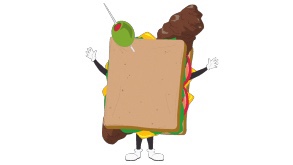
1. WHAT’S YOUR FAVOURITE FLAVOUR OF SHIT SANDWICH AND DOES IT COME WITH AN OLIVE?

What shit sandwich do you want to eat? Because eventually, we all get served one.

Ah, yes. The all-important question. What flavour of shit sandwich would you like to eat? Because here’s the sticky little truth about life that they don’t tell you at high school pep rallies: Everything sucks, some of the time.

Now, that probably sounds incredibly pessimistic. And you may be thinking, “Hey Mr. Conroy, turn that frown upside down.” But I actually think this is a liberating idea.

Everything involves sacrifice. Everything includes some sort of cost. Nothing is pleasurable or uplifting all of the time. So, the question becomes: what struggle or sacrifice are you willing to tolerate? Ultimately, what determines our ability to stick with something we care about is our ability to handle the rough patches and ride out the inevitable rotten days.

If you want to be a brilliant tech entrepreneur, but you can’t handle failure, then you’re not going to make it far. If you want to be a professional artist, but you aren’t willing to see your work rejected hundreds, if not thousands of times, then you’re done before you start. If you want to be a hotshot court lawyer, but can’t stand the 80-hour workweeks, then I’ve got bad news for you.

What unpleasant experiences are you able to handle? Are you able to stay up all night coding? Are you able to put off starting a family for 10 years? Are you able to have people laugh you off the stage over and over again until you get it right?

What shit sandwich do you want to eat? Because we all get served one eventually.

And your favourite shit sandwich is your competitive advantage. By definition, anything that you’re willing to do (that you enjoy doing) that most people are not willing to do gives you a huge leg-up.

So, find your favourite shit sandwich. And you might as well pick one with an olive.

THE ANSWER TO THIS QUESTION WILL TELL YOU:

• What struggles you are willing to tolerate to get what you want

• What you will likely be better than other people at

2. WHAT’S TRUE ABOUT YOU TODAY THAT WOULD MAKE YOUR 8-YEAR-OLD SELF CRY?

Something about the social pressures of adolescence and professional pressures of young adulthood squeezes the passion out of us. We’re taught that the only reason to do something is if we’re somehow rewarded for it. And the transactional nature of the world inevitably stifles us and makes us feel lost or stuck.

When I was a child, I used to write stories. I used to sit in my room for hours by myself, writing away, about aliens, about superheroes, about great warriors, about my friends and family. Not because I wanted anyone to read it. Not because I wanted to impress my parents or teachers. But for the sheer joy of it.

And then, for some reason, I stopped. And I don’t remember why.

We all have a tendency to lose touch with what we loved as a child. Something about the social pressures of adolescence and professional pressures of young adulthood squeezes the passion out of us. We’re taught that the only reason to do something is if we’re somehow rewarded for it. And the transactional nature of the world inevitably stifles us and makes us feel lost or stuck.

It wasn’t until I was 30 that I rediscovered how much I loved writing. And it wasn’t until I started my website that I remembered how much I enjoyed peeling away life’s problems.

The funny thing though, is that if my 8-year-old self asked my 20-year-old self, “Why don’t you write anymore?” and I replied, “Because I’m not good at it,” or “Because nobody would read what I write,” or “Because you can’t make money doing that,” not only would I have been completely wrong, but that eight-year-old-boy version of me would have probably started crying. That eight-year-old boy didn’t care about Google traffic or social media virality or book advances. He just wanted to play. And that’s where passion always begins: with a sense of play.

THE ANSWER TO THIS QUESTION WILL TELL YOU:

• What childhood passion you lost to adulthood

• What activity you should revisit, just for the fun of it

3. WHAT MAKES YOU FORGET TO EAT AND POOP?

Look at the activities that keep you up all night, but look at the cognitive principles behind those activities that enthrall you. Because they can easily be applied elsewhere.

We’ve all had that experience where we get so wrapped up in something that minutes turn into hours and hours turn into “Holy crap, I forgot to have dinner.”

Supposedly, in his prime, Isaac Newton’s mother had to regularly come in and remind him to eat because he would spend entire days so absorbed in his work that he would forget.

I used to be like that with video games. This probably wasn’t a good thing. In fact, for many years it was kind of a problem. I would sit and play video games instead of doing more important things like studying for an exam, or showering regularly, or speaking to other humans face-to-face.

It wasn’t until I gave up the games that I realised my passion wasn’t for the games themselves (although I do love them). My passion is for improvement, being good at something and then trying to get better. The games themselves—the graphics, the stories—they were cool, but I can easily live without them. It’s the competition with others and with myself that I thrive on.

And when I applied that obsessiveness for self-improvement and competition to my writing, well, things took off in a big way.

Maybe for you, it’s something else. Maybe it’s organising things efficiently, or getting lost in a fantasy world, or teaching somebody something, or solving technical problems. Whatever it is, don’t just look at the activities that keep you up all night, but look at the cognitive principles behind those activities that enthrall you. Because they can easily be applied elsewhere.

THE ANSWER TO THIS QUESTION WILL TELL YOU:

• What you truly enjoy doing

• What other activities to check out that you might also enjoy

4. HOW CAN YOU BETTER EMBARRASS YOURSELF?

Embrace embarrassment. Feeling foolish is part of the path to achieving something important, something meaningful. The more a major life decision scares you, chances are the more you need to be doing it.

Before you are able to be good at something and do something important, you must first suck at something and have no clue what you’re doing. That’s pretty obvious. And in order to suck at something and have no clue what you’re doing, you must embarrass yourself in some shape or form, often repeatedly. And most people try to avoid embarrassing themselves, namely because it sucks.

Ergo, due to the transitive property of awesomeness, if you avoid anything that could potentially embarrass you, then you will never end up doing something that feels important. Yes, it seems that once again, it all comes back to vulnerability.

Right now, there’s something you want to do, something you think about doing, something you fantasise about doing, yet you don’t do it. You have your reasons, no doubt. And you repeat these reasons to yourself ad infinitum.

But what are those reasons? Because I can tell you right now that if those reasons are based on what others would think, then you’re screwing yourself over big time.

If your reasons are something like, “I can’t start a business because spending time with my kids is more important to me,” or “Playing Starcraft all day would probably interfere with my music, and music is more important to me,” then OK. Sounds good.

But if your reasons are, “My parents would hate it,” or “My friends would make fun of me,” or “If I failed, I’d look like an idiot,” then chances are, you’re actually avoiding something you truly care about because caring about that thing is what scares the shit out of you, not what mom thinks or what Timmy next door says.

Great things are, by their very nature, unique and unconventional. Therefore, to achieve them, we must go against the herd mentality. And to do that is scary.

Embrace embarrassment. Feeling foolish is part of the path to achieving something important, something meaningful. The more a major life decision scares you, chances are the more you need to be doing it.

THE ANSWER TO THIS QUESTION WILL TELL YOU:

• What scares the shit out of you… for good reason

• That you should stop making lousy excuses and start doing something

5. HOW ARE YOU GOING TO SAVE THE WORLD?

you’re not going to fix the world’s problems by yourself. But you can contribute and make a difference. And that feeling of making a difference is ultimately what’s most important for your own happiness and fulfilment.

In case you haven’t seen the news lately, the world has a few problems. And by “a few problems,” what I really mean is, “everything is fucked and we’re all going to die.”

I’ve harped on this before, and the research also bears it out, but to live a happy and healthy life, we must hold on to values that are greater than our own pleasure or satisfaction.

So pick a problem and start saving the world. There are plenty to choose from. Our screwed up education systems, economic development, domestic violence, mental health care, governmental corruption. Hell, I just saw an article this morning on sex trafficking in the US and it got me all riled up and wishing I could do something. It also ruined my breakfast.

Find a problem you care about and start solving it. Obviously, you’re not going to fix the world’s problems by yourself. But you can contribute and make a difference. And that feeling of making a difference is ultimately what’s most important for your own happiness and fulfilment. And importance equals purpose.

Now, I know what you’re thinking. “Gee Lee, I read all of this horrible stuff and I get all pissed off too, but that doesn’t translate to action, much less a new career path.”

Glad you asked…

THE ANSWER TO THIS QUESTION WILL TELL YOU:

• What problem you care about that’s larger than you

• How you can make a difference

6. GUN TO YOUR HEAD, IF YOU HAD TO LEAVE THE HOUSE ALL DAY, EVERY DAY, WHERE WOULD YOU GO AND WHAT WOULD YOU DO?

Discovering what you’re passionate about in life and what matters to you is a full-contact sport, a trial-by-fire process. None of us know exactly how we feel about an activity until we actually do the activity.

For many of us, the enemy is just old-fashioned complacency. We get into our routines. We distract ourselves. The couch is comfortable. The Doritos are cheesy. And nothing new happens.

This is a problem.

What most people don’t understand is that passion is the result of action, not the cause of it.

Discovering what you’re passionate about in life and what matters to you is a full-contact sport, a trial-by-fire process. None of us know exactly how we feel about an activity until we actually do the activity.

So ask yourself, if someone put a gun to your head and forced you to leave your house every day for everything except for sleep, how would you choose to occupy yourself? And no, you can’t just go sit in a coffee shop and browse Facebook. You probably already do that. Let’s pretend there are no useless websites, no video games, no TV. Take yourself back to the 90’s when Facebook, Instagram, all this social media clusterfuck most of us spend half our lives on had yet to be invented.

You have to be outside of the house all day every day actively doing something until it’s time to go to bed—where would you go and what would you do?

Sign up for a dance class? Join a book club? Go get another degree? Invent a new form of irrigation system that can save the thousands of children’s lives in rural Africa? Learn to hang glide?

What would you do with all of that time? What activity would you choose above all others? We all have only 24 hours in a day, and so we’re back to the all-important question that we all should be asking ourselves:

“What can I do with my time that is important?”

If it strikes your fancy, write down a few answers and then, you know, go out and actually do them. Bonus points if it involves embarrassing yourself.

THE ANSWER TO THIS QUESTION WILL TELL YOU:

• What you were passionate about all along

• How you should spend your time

7. IF YOU KNEW YOU WERE GOING TO DIE ONE YEAR FROM TODAY, WHAT WOULD YOU DO AND HOW WOULD YOU WANT TO BE REMEMBERED?

Ultimately, death is the only thing that gives us perspective on the value of our lives. Because it’s only by imagining your non-existence that you can get a sense of what is most important about your existence.

Most of us don’t like thinking about death. It freaks us out. But thinking about our own death surprisingly has a lot of practical advantages. One of those advantages is that it forces us to zero in on what’s actually important in our lives and what’s just frivolous and distracting.

When I was in college, I used to walk around and ask people, “If you had a year to live, what would you do?” As you can imagine, I was a huge hit at parties. A lot of people gave vague and boring answers. A few drinks were nearly spat on me. But it did cause people to really think about their lives in a different way and re-evaluate what their priorities were.

Ultimately, death is the only thing that gives us perspective on the value of our lives. Because it’s only by imagining your non-existence that you can get a sense of what is most important about your existence. What is your legacy going to be? What are the stories people are going to tell when you’re gone? What is your obituary going to say? Is there anything to say at all? If not, what would you like it to say? How can you start working towards that today?

And again, if you fantasise about your obituary saying a bunch of badass shit that impresses a bunch of random other people, then again, you’re failing here.

When people feel like they have no sense of direction, no purpose in their life, it’s because they don’t know what’s important to them, they don’t know what their values are.

And when you don’t know what your values are, then you’re essentially taking on other people’s values and living other people’s priorities instead of your own. This is a one-way ticket to unhealthy relationships and eventual misery.

Discovering one’s “purpose” in life essentially boils down to finding those one or two things that are bigger than yourself, and bigger than those around you, values that will determine your priorities and guide your actions. It’s not about some great achievement, but merely finding a way to spend your limited amount of time well. And to do that you must get off your couch and act, and take the time to think beyond yourself, to think greater than yourself, and paradoxically, to imagine a world without yourself.

THE ANSWER TO THIS QUESTION WILL TELL YOU:

• What is most important to you

• What values should guide your actions

Oh and don’t forget to drink your coffee today 😏

ACTION AND MOTIVATION

Here’s a news flash for you:

Action isn’t just the effect of motivation, but also the cause of it.

Most people only commit to action if they feel a certain level of motivation. And they only feel motivation when they feel an emotional inspiration.

People only become motivated to study for the exam when they’re afraid of the consequences. People only pick up and learn that instrument when they feel inspired by the people they can play for.

And we’ve all slacked off for lack of motivation before. Especially in times where we shouldn’t.

We feel lethargic and apathetic towards a certain goal that we’ve set for ourselves because we lack the motivation and we lack the motivation because we don’t feel any overarching emotional desire to accomplish something.

We typically think motivation works something like this:

Emotional Inspiration → Motivation → Desirable Action

But there’s a problem with operating under this framework: often the changes and actions we need in our lives are inspired by negative emotions that simultaneously hinder us from taking action.

If someone wants to fix their relationship with their mother the emotions of the situation (hurt, resentment, avoidance) completely go against the necessary action to fix it (confrontation, honesty, communication).

If someone wants to lose weight but experiences massive amounts of shame about their body, then the act of going to the gym is apt to inspire in them the exact

emotions that kept them at home on the couch in the first place.

Past traumas, negative expectations, and feelings of guilt, shame, and fear often motivate us away from the actions necessary to overcome those very traumas, negative expectations, and negative emotions.

HOW TO GET MOTIVATED: THE “DO SOMETHING” PRINCIPLE

It’s a Catch-22 of sorts. But the thing about the motivation chain is that it’s not only a three-part chain but an endless loop:

Your actions create further emotional reactions and inspirations and move on to motivate your future actions. Taking advantage of this knowledge, we can actually re-orient our mindset in the following way:

Action → Inspiration → Motivation

The conclusion is that if you lack the motivation to make an important change in your life, then do something, anything really, and then harness the reaction to that action as a way to begin motivating yourself.

This is known as The “Do Something” Principle.

It began out of simple pragmatism: you paid me to be here so you might as well do something. I don’t care, do anything!

What I found is that often once they did something, even the smallest of actions, it would soon give them the inspiration and motivation to do something else. They had sent a signal to themselves, “OK, I did that, I guess I can do more.” And slowly we could take it from there.

Over the years, I’ve applied The “Do Something” Principle in my own life as well.

I quickly learned that forcing myself to do something, even the most menial of tasks, quickly made the larger tasks seem much easier.

If I had to redesign an entire website (like this exact one) or project, then I’d force myself to sit down and would say, “OK, I’ll just design the header right now.” But after the header was done, I’d find myself moving on to other parts of it. And before I knew it, I’d be energised and engaged in the project.

If I’m about to tackle a large project that I’m anxious about, or if I’m in a new country and I need to give myself a little push to get out and meet people, I apply the “Do Something” Principle. Instead of expecting the moon, I just decide, “OK, I’ll start on the outline,” or “OK, I’ll just go out and have a beer and see what’s going on.” The mere action of doing this almost always spurs me on.

Inevitably, the appropriate action occurs at some point or another. The motivation is natural. The inspiration is genuine. It’s an overall far more pleasant way of accomplishing my goals

You may recognise this concept among other writings in different guises. I’ve seen it mentioned in terms such as “failing forward” or “ready, fire, aim.”

But no matter how you frame it to yourself, it’s an extremely useful mindset and habit to adopt. The more time goes on, the more I realize that success in anything is tied less to knowledge or talent, and more to action supplemented by knowledge and talent.

You can become successful at something without knowing what you are doing. You can become successful at something without having much particular talent at it. But you can never become successful at anything without taking action. Ever.

A FEW TIPS ON STAYING MOTIVATED

Willpower is finite. Motivation comes and goes. Inspiration can strike when you least expect it and leave you high and dry when you need it the most.

So whatever you call it—motivation, willpower, inspiration, your “muse”—you need to regularly nourish and replenish your supply.

The “Do Something” Principle is one such way to do this since it helps you get the ball rolling over and over again. You focus on starting, and that’s it.

Below are a few more tips on staying motivated in the long run.

1. DEVELOP A RITUAL

You might think that doing the same thing over and over again, day in and day out, sounds not only incredibly boring but incredibly limiting. But you’d be dead wrong.

Rituals put The “Do Something” Principle in overdrive. You designate a behaviour or set of behaviours to perform at a predetermined place or time—or ideally, both—in order to get you moving toward your desired behaviour. It won’t take long until all you have to do is simply set the ritual in motion—using the “Do Something” Principle, of course—and let inertia do the rest.

Then, something magical happens: The ritual soon takes on a life of its own. It becomes a sacred space and time and often just as important as your target behavior itself. Performing the desired action starts to feel empty without performing the ritual and vice versa.

Now, be careful not to get too caught up in exactly what your ritual is. A lot of people see someone who’s successful doing something like eating or wearing the same thing every day or working out at exactly 5:27 AM every morning because some study said it’s the best time to do it and blah blah blah and they think they need to do exactly the same thing as them. 

But you don’t. The important thing is simply having a ritual—any ritual—that gets you started in the right direction.

The rest will follow.

2. RUTHLESSLY CUT DISTRACTIONS OUT OF YOUR LIFE

Instagram memes. Email from the boss. Unread group texts from last night. Nine notifications on Facebook! Snap your oatmeal acai breakfast bowl (but forget that burger and fries you had for lunch yesterday). Odd DM from that weird girl in high school you friended 6 years ago… pyramid scheme. Leave on read—LOL! Group text is heating up again. Stacey and Jared need to break up. What is that kid doing on TikTok? Also, what is TikTok? Shocker: politician says something stupid again. What’s the weather today? And tomorrow… and next Thursday? Oooo, match on Tinder! Oh… dick pic. Guh, Brexit! Am I right?!?!

I apologise if you find it creepy that I just described the first 30 minutes of every day of your life for the past four years or more.

Im writing an article called how to improve your concentration that I feel will strike a chord with a lot of people. And that’s because we’re all collectively coming around to the reality that all this wonderful technology we use has a dark side with very real fucking consequences.

Part of that dark side is distraction. Now, this might seem like a little harmless fun, but distractions like these are rarely harmless.

The distractions of the digital age hack the vulnerabilities of our psychology. They give us little microbursts of dopamine that feel good in the moment, but amount to very little in the grand scheme of things.

Meanwhile, they’re sapping our motivation to do other things that don’t always feel good in the moment but add up to something much grander and more meaningful in the long run.

Calling your friend who’s having a bad day is more uncomfortable than texting them a winky smiley kissy-face with a “thinking of you” tacked on for good measure, but it’s much more helpful for them and your relationship.

Going for a silent walk through the park is much more demanding than scrolling through feeds with your thumb on one hand and mainlining a mocha latte quad shot swirly frappa caramel whip cream with the other, but—well, Jesus Christ, do I have to explain that one?

3. UNCOVER THE REAL REASONS FOR YOUR LACK OF MOTIVATION

If you’re still having trouble staying motivated after all of that, it’s time to take a good, hard look at your life and figure out what might be the proverbial piss in your cornflakes all the time.

If you consistently have no motivation to be productive at work, maybe you hate your job and it’s time to get serious about a new career.

If you’re having a hard time fitting regular exercise into your day, it might be time to examine your beliefs around your body, what you think a healthy lifestyle is, and whether or not you’re doing exercise that you find enjoyable and worthwhile.

If you find it difficult to want to work on your relationship with your partner, maybe it’s time to get brutally honest with each other and figure out a way forward, which could mean breaking up if it’s for the best.

Notice all of these situations require you to address some uncomfortable emotions.

But I’ve argued for years now that facing uncomfortable emotions is precisely what makes us grow as individuals, that traumatic events, as horrible as they are, can spur positive changes in our lives, that being happy all the time isn’t just impossible, it wouldn’t even be good for us, and that the demons we all try to hide are actually just the other side of our better angels.

So these are the moments you have to not only face, but embrace. Rather than turning away from discomfort, you turn towards it as a source of motivation itself.

And that’s when shit gets real, my friend.

And if all else fails in life, never forget, grab a brew, take a seat and take a sip and watch all the worlds problem seem a little less shitty.

The Backwards Law

There’s a part of Navy SEAL training called “drown-proofing” where they bind your hands behind your back, tie your feet together, and dump you into a 9-foot-deep pool.

Your job is to survive for five minutes.

Like most of SEAL training, the vast majority of sailors who attempt drown-proofing fail. Upon being tossed into the water, many of them panic and scream to be lifted back out. Some struggle until they slip underwater where they proceed to lose consciousness and have to be fished out and resuscitated. Over the years, a number of trainees have even died during the exercise.

But some people make it. And they do so because they understand two counterintuitive lessons.

The first lesson of drown-proofing is paradoxical: the more you struggle to keep your head above water, the more likely you are to sink.

With your arms and legs bound, it’s impossible to maintain yourself at the surface for the full five minutes. Even worse, your limited attempts to keep your body afloat will only cause you to sink faster. The trick to drown-proofing is to actually let yourself sink to the bottom of the pool. From there, you lightly push yourself off the pool floor and let your momentum carry you back to the surface. Once there, you can grab a quick breath of air and start the whole process over again.

Strangely, surviving drown-proofing requires no superhuman strength or endurance. It doesn’t even require that you know how to swim. On the contrary, it requires the ability to not swim. Instead of resisting the physics that would normally kill you, you must surrender to them and use them to save your own life.

The second lesson of drown-proofing is a bit more obvious, but also paradoxical: the more you panic, the more oxygen you will burn and the more likely you are to fall unconscious and drown. In a sick and twisted way, the exercise turns your survival instinct against you: the more intense your desire to breathe, the less you will be able to breathe. The more intense your will to live, the greater the chance you will die.

More than a test of physical will, drown-proofing is a test of each sailors emotional control in situations of extreme danger. Can he control his own impulses? Can he relax in the face of potential death? Can he willingly risk his life in the service of some higher value or goal?

These skills are far more important than any cadet’s ability to swim. They’re more important than his resilience, his physical toughness, or his ambition. They’re more important than how smart he is, what school he went to, or how damn good he looks in a crisp Italian suit.

This skill the ability to let go of control when one wants it most is one of the most important skills anyone can develop. And not just for SEAL training. For life.

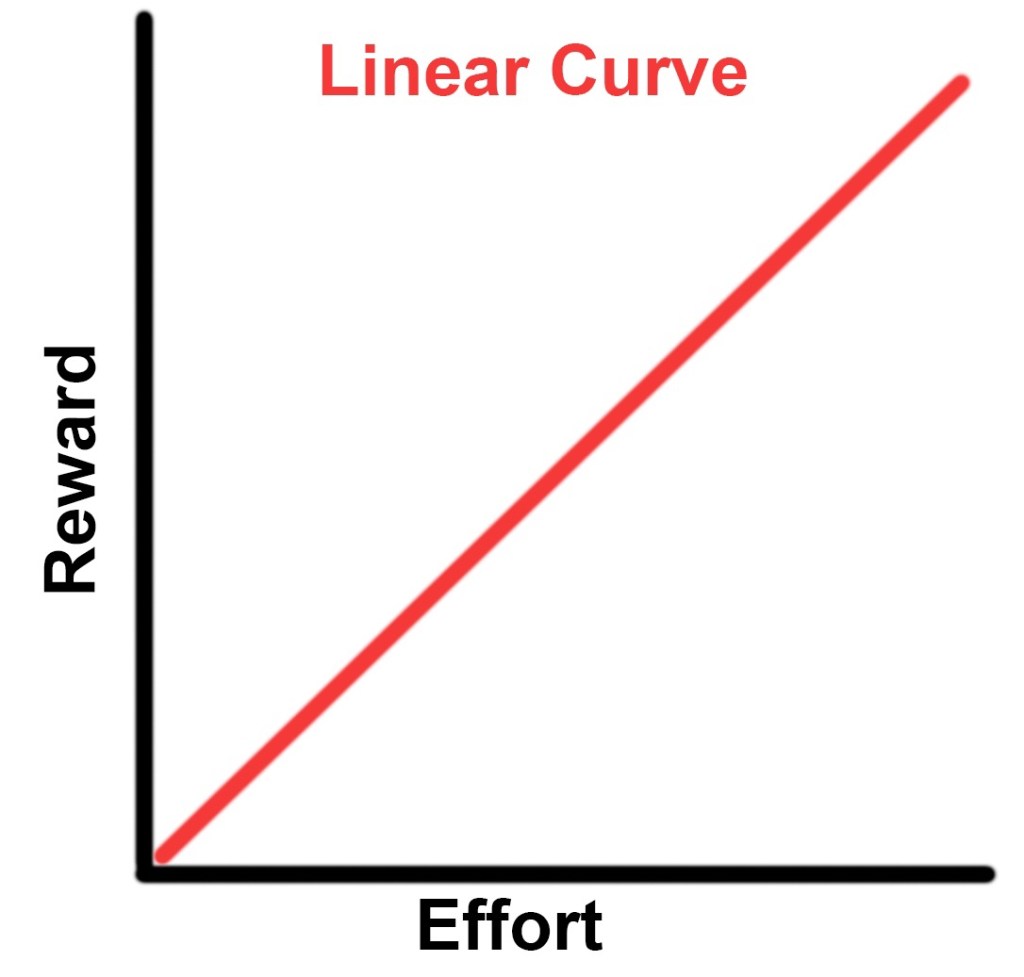
Most people assume the relationship between effort and reward is one-to-one. We think that working twice as long will produce twice the result. That caring about a relationship twice as much will make everyone feel twice as loved. That yelling your point twice as loud will make you twice as right.

The assumption here is that most of life exists on a linear curve, that there’s a one-to-one ratio between effort and reward with everything:

But allow me to inform you as someone who just tried drinking twice the normal amount of coffee so he could finish editing this damn thing—this is almost never true. Most of the world does not exist on a linear curve. Linear relationships only exist for mindless, rote, repetitive tasks—driving a car, filling out reams of paperwork, cleaning the bathroom, etc. In all of these cases, doing something for two hours will double the output of doing it for one hour. But that’s simply because they require no thought or ingenuity.

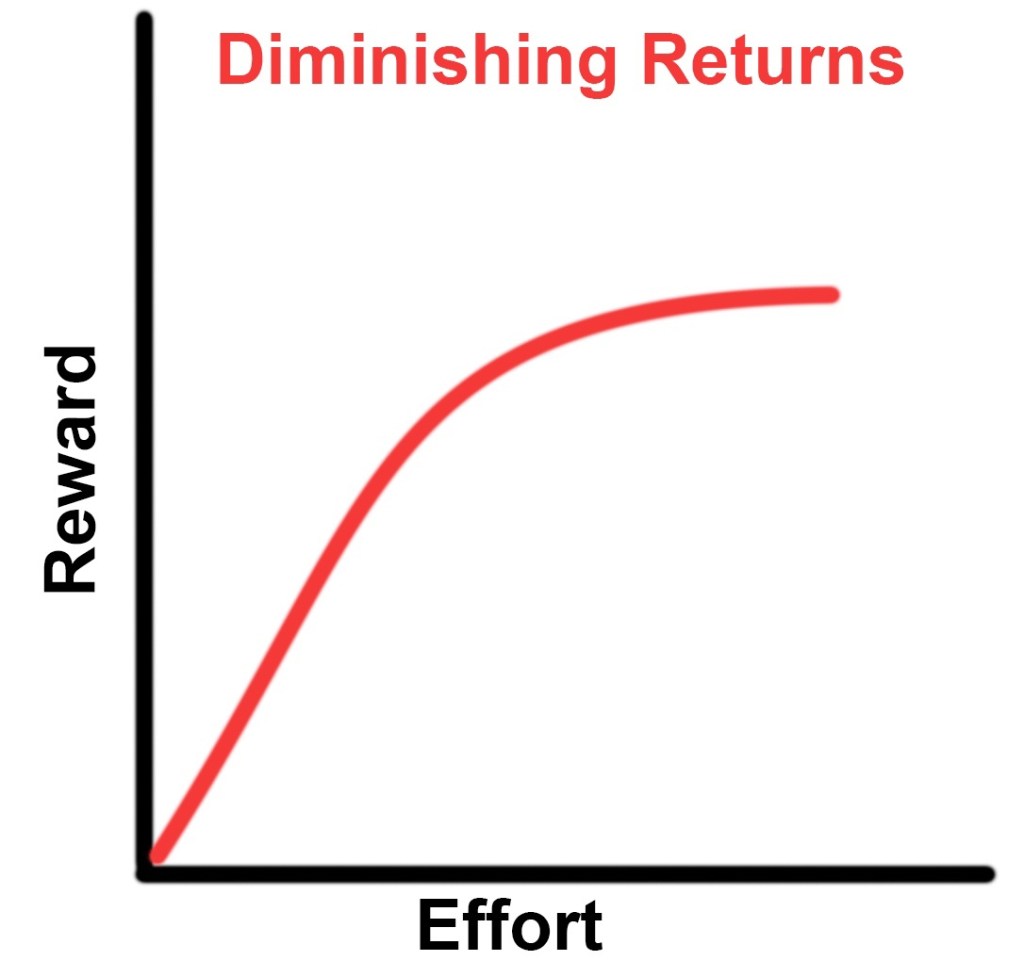
Most activities in life do not operate along the linear effort/reward curve because most activities in life are not basic nor mindless. Most activities are complex, mentally and/or emotionally taxing, and require adaptation.

Therefore, most activities produce a diminishing returns curve:

Diminishing returns means that the more you experience something, the less rewarding it becomes. The classic example is money. The difference between earning €20,000 and €40,000 is huge and life-changing. The difference between earning €120,000 and €140,000 means your car has slightly nicer seat heaters. The difference between earning €127,020,000 and €127,040,000 is basically a rounding error on your tax return.

The concept of diminishing returns applies to most experiences that are complex and novel, and even many of the mundane ones. The number of showers you take in a day, the number of chicken wings you inhale during happy hour, the number of trips home to visit your mother in a year—these are all experiences that start out highly valuable at first but then diminish in value the more frequently you do them (sorry, Mum).

Another example: studies on work productivity show that we’re really only productive for the first four to five hours of each day. Everything after that suffers severely diminished returns, to the point where the difference between working for 12 hours and 16 hours is basically nothing (not counting sleep deprivation).

Friendships operate on a diminishing returns curve. Having one friend is vital. Having two is clearly better than one. But having 10 instead of 9 changes little in your life. And having 21 instead of 20 just makes remembering people’s names that much more difficult.

Sex has diminishing returns, as does eating, sleeping, drinking alcohol, working out at the gym, reading books, taking vacations, hiring employees, consuming caffeine, saving for retirement, scheduling business meetings, studying for an exam, masturbating, staying up late to play video games, the examples are endless. All give back less the more you do them, the more you try, or the more you have. All operate on a diminishing returns curve.

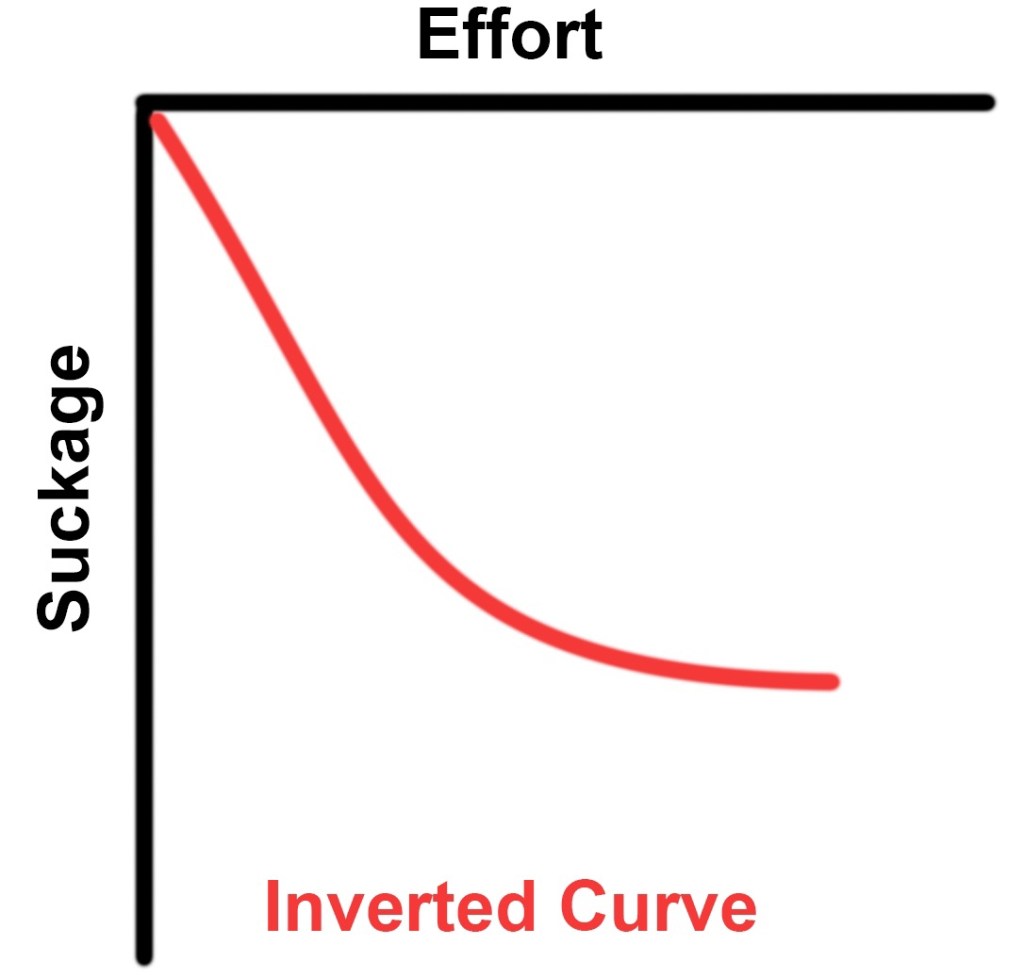
But there’s another curve, one that you’ve probably never seen or heard of before and that’s largely because I make a lot of this fucking shit up. That’s the inverted curve (yes I know, sounds sexy right):

The inverted curve is the bizarro “Twilight Zone” curve, where effort and reward have a negative correlation—that is, the more effort you put into doing something, the more you will fail to do it.

Drown proofing exists on an inverted curve. The more effort you put into rising to the surface, the more likely you will be to fail at it. Similarly, the more you want to breathe, the more likely you are to choke on a bunch of chlorinated piss water.

But I know you’re thinking, “So what, Lee? I’ve usually had too many piña coladas to even find the deep end of the pool, much less bind my arms and legs and try to survive in it. Who gives a shit about inverted curves?”

It’s true, few things in life function on an inverted curve. But the few things that do are extremely important. In fact, I will argue that the most important experiences and goals in life all exist on an inverted curve.

Effort and reward have a linear relationship when the action is mindless and simple. Effort and reward have a diminishing returns relationship when the action is complex and multivariate.

But when the action becomes purely psychological, an experience that exists solely within our own consciousness, the relationship between effort and reward becomes inverted.

Pursuing happiness takes you further away from it. Attempts at greater emotional control only remove us from it. The desire for greater freedom is often what causes us to feel trapped. The need to be loved prevents us from loving and accepting ourselves.

Aldous Huxley once wrote, “The harder we try with the conscious will to do something, the less we shall succeed. Proficiency and results come only to those who have learned the paradoxical art of doing and not doing, or combining relaxation with activity.”

The most fundamental components of our psychology are paradoxial. This is because when we consciously try to create a state of mind, the desire for that state of mind creates a different and often opposite state of mind from the one we’re trying to create.

This is “The Backwards Law” I explained in earlier blogs, but in a nutshell for all you shitheads who didn’t read it is this: desiring a positive experience is itself a negative experience, accepting a negative experience is a positive experience.

But this extends to most–if not all–aspects of our mental health and relationships:

• Control – The more we strive to control our emotions and impulses, the more powerless we will feel. Our emotional life is unruly and often uncontrollable, and it’s the desire to control it that makes it worse. Conversely, the more we accept our feelings and impulses, the more we’re able to direct and process them.

• Freedom – The constant desire for freedom ironically limits us in a number of ways. Similarly, it’s only by limiting ourselves–by choosing and committing to certain things in life–that we truly exercise our freedom.

• Happiness – trying to be happy, makes us less happy. Accepting unhappiness makes us happy.

• Security – Trying to make ourselves feel as secure as possible generates more insecurity. Being comfortable with uncertainty is what allows us to feel secure.

• Love – The more we try to make others love and accept us, the less they will, and more importantly, the less we will love and accept ourselves.

• Respect – The more we demand respect from others, the less they will respect us. The more we ourselves respect others, the more they will come to respect us.

• Trust – The more we try to make people trust us, the less inclined they will be to do so. The more we trust others, the more they will trust us in return.

• Confidence – The more we try to feel confident, the more insecurity and anxiety we will create. The more we accept our faults, the more comfortable we will feel in our own skin.

• Change – The more we desperately want to change ourselves, the more we will always feel as though we are not enough. Whereas, the more we accept ourselves, the more we will grow and evolve because we’ll be too busy actually doing cool shit to notice.

• Meaning – The more we pursue a deeper meaning or purpose of our lives, the more self-obsessed and shallow we will become. The more we try to add meaning to others’ lives, the more profound impact we will feel.

These internal, psychological experiences exist on an inverted curve because they are both the cause and the effect of the same thing: our minds. When you desire happiness, your mind is simultaneously the thing that is desiring and the target of its own desires.

When it comes to these lofty, abstract, existential goals, our minds are like a dog who, after a lifetime of successfully chasing and catching various small creatures, has turned and decided to exact that same strategy on its own tail. To the dog, this seems logical. After all, chasing has led her to catch everything else in her doggy life. Why not her tail, too?

But a dog can never catch her own tail. The more she chases, the more her tail seems to run away. That’s because the dog lacks the perspective to realise that she and the tail are the exact same thing.

The goal is to take your mind—a wonderful thing that has spent its life learning to chase various creatures and teach it to stop chasing its own tail. To stop chasing meaning and freedom and happiness because those only serve to move it further away from itself. To teach it to achieve what it desires by giving up what it desires. To show it how the only way to reach the surface is to let itself sink.

And how do we do this? By letting go. By giving up. By surrendering. Not out of weakness. But out of a respect that the world is beyond our grasp. By recognising that we are fragile and limited and but temporary specks in the infinite reaches of time. You do it by relinquishing control, not because you feel powerless, but because you are powerful. Because you decide to let go of things that are beyond your control. You decide to accept that sometimes, people won’t like you, that often you will fail, that usually you have no fucking clue what you’re doing.

You lean into the fear and uncertainty, and just when you think you’re going to drown, just as you reach the bottom, it will launch you back to your salvation. When it does launch you back, make sure its to your closest coffee shop to grab the sweet nectar of the gods, a freshly brewed coffee, life seems a hell of a lot simpler then.

The importance of your emotions

Years ago, I knew one of those guys who seemed to always be happy and excited. He was always a bundle of warm fuzzies. First to give you a hug. Always happy to see you. Complimented you about things that had no business being complimented. We’ll call him ‘Jon.’

Jon was like a dog, one of those rare people whose enthusiasm and unbridled joy is so unceasing that it actually becomes a little irritating at times. “Can you, just like… hate life a little?” I used to think to myself. And no, I wasn’t wearing eyeliner.

Alas, it never happened. And I felt like an asshole for having such thoughts. I was jealous. Or maybe worse: I was just a bad person.

But I never felt like a bad person for that long, because Jon was so damn fun and engaging. You couldn’t help but be lifted up by his spirits. He always wanted to know what was going on in your life. He was always encouraging. He was always happy for you and proud of you, even when you weren’t happy or proud of yourself.

I eventually just decided that Jon was one of those people who had it figured out. One of those people that the shittier parts of life seemed to pass on by. A person who somehow managed to walk between the raindrops. A person who was blessed and knew it and spent his days trying to make others feel just as great as he did.

Then one day, I walked in on him doing lines of coke off the back of a toilet. What the fuck?

No! This guy was supposed to be the one who had it figured out! This guy was the one who was supposed to be immune to these kinds of moments of weakness! Damnit man, you were the chosen one! (Insert Star Wars reference)

It turned out, Jon was a fucking mess. His family life was a mess. His personal life was a mess. His unceasing positivity and the occasional nose candy were the only things holding him together, like raggedy pieces of duct tape and a shoestring.

And here’s what took me a long time to figure out but surprised me: Jon sucked at emotions. I know that might sound crazy — on the surface, he appeared to be what we all want to be perfectly happy, loving and giving, always positive and encouraging, never in a dull mood. But it was true. He sucked at dealing with his emotions and he suffered more because of it.

WHAT DO EMOTIONS DO ANYWAY?

Emotions are the result of your mind comparing your external environment to your expectations.

The same way you feel hot and cold when you walk outside (you step into the air, your skin moderates the temperature relative to your body temperature and then sends a signal to your brain saying, “it’s hot” or “it’s cold”), your emotions do the same for complex psychological phenomena.

So you step outside, your body sends your brain the signal “it’s cold” and you run inside and get a coat. Similarly, if you come home from work and catch your husband blowing the mailman, your body sends the emotional signal to your brain which says, “What the actual fuck?” and then you divorce his ass and enjoy a massive settlement and lots of ice cream on the couch.

Emotions are designed to create strong incentives for us to take action and do something to get rid of conflict between our expectations and our environment, either by changing our environment or changing our expectations. We want alignment between the two, and we get mighty uncomfortable when they are at odds with each other. Emotions are like marriage counsellors, trying to get our expectations and our environment to read out loud what they wrote down for today’s session to try and make things work.

So for instance, say you’re talking with a co-worker and they let slip that bitch Betty took credit for your awesome idea and got a raise as a result. Fucking Betty.

Chances are you’re going to feel some strong emotions like anger, jealousy, and betrayal, among others. Chances are you’re going to take some sort of action to let that bitch Betty (and/or your boss) know exactly what you think of them. Shit’s going to get real in cubicle-ville because this injustice cannot stand, man.

That anger and pain you feel is also likely to make you take a long, hard look at your workplace and career. They’ll also probably make you a lot more vigilant in the future by virtue of the fact that you don’t want to ever feel like this again. So now you’ll do more to make sure your work gets noticed in the future. It might have been a painful experience at the time, but your emotions provoked you into dealing with the situation then and they will help you again in the future.

And that’s what makes our emotions so powerful and so useful. It doesn’t matter if they make us feel good or bad. What matters is they motivate us to take appropriate action and deal with whatever comes our way and bring balance to the force. Unlike this asshole.

Here’s the thing though: our emotions won’t help us deal with the shitty things life throws at us if they don’t match up well with the situation we find ourselves in. If I’m bored when I should be scared, or overjoyed when I should be raging pissed, then how the hell are my emotions going to help me do anything to help me cope with life, let alone survive? If your emotions don’t know what is going on, they cannot bring the tools required to fix the situation.

This is the problem with the feel good no matter what is happening in your fucking life mentality. And this is why Jon ended up being such a fucking mess. Instead of engaging the right emotions in the right situations, he was trying to wallpaper over everything with a bunch of bright, sunshiny bullshit.

HOW DIVERSIFYING YOUR EMOTIONS MAKES YOU A MORE RESILIENT PERSON

There’s a concept in psychology called “emotional diversity.” Emotional diversity is just what it sounds like: experiencing a variety of emotions. And it turns out that people who experience a wide variety of both positive and negative emotions are a lot better off, both mentally and physically, than people who only experience a few emotions regularly, good or bad.

Just like a more diverse stock portfolio is more resilient to large swings in stock values, the more diverse your emotional life is, the more resilient you are to the large swings in experience that life gives you. If you’re comfortable with anger, you’ll be able to call it up at the appropriate moments and use it. If you’re comfortable with joy or guilt or grief, you’ll be able to use those when you need to as well.

A diverse emotional life isn’t just made up of a few “good” and “bad” emotions. You can also have lots of emotional subcategories, like amusement, joy, contentment, greatfulness, pride, love, hope, and anger, sadness, guilt, contempt, anxiety, disgust, embarrassment, and on and on. People with access to emotional diversity have a network of roads to get to where they need to go; people without it might only have one big highway of anger and a dirt road of sadness.

Researchers think that people who experience a wider range of these types of specific subcategories of emotions are more resilient in the face of adversity because they’re better at identifying what triggers those emotions. And if you know exactly what’s making you feel the way you feel, it’s a whole lot easier to react appropriately.

People who practice a wide range of emotions are self aware enough to know what triggers these emotions and then act accordingly. Research has shown that self-awareness and the ability to self-label emotions has positive links to well-being. This awareness and labelling makes people feel more in control of their lives, a huge factor in determining happiness and general well-being.

More variety in emotional experience also gives you a greater appreciation for just how transient emotions are. When you only allow yourself to feel one or two emotions all the time, you start to feel as though they are permanent (or should be permanent). The world always sucks. Life is always great. You always feel guilty because you’re a horrible person. You’re always proud because you’re narcissistic and jerk off to your own high school yearbook pictures.

When you’re stuck in these one-emotion-defines-the-world mentalities, you forget that emotions are transient superficial things that don’t necessarily mean anything.

Emotional diversity shows us that emotions come and go. If you feel angry now, that’s fine, you won’t in a few hours. If you’re happy now, that’s great, enjoy it, because the next struggle is around the corner. If you feel guilty or sad, then that’s okay too, things will look up some time in the near future. The question is then how do we begin to diversify our emotional lives?

BECOMING AN EMOTIONAL NINJA

The first step in achieving greater emotional diversity: simple self awarness. Noticing and accepting what you feel when you feel it.

This sounds so simple. So simple as to be stupid. But what you’ll likely find is that if you’ve denied a certain emotion in yourself for long enough, you’ll actually stop realising when you’re feeling it. If you deny to yourself that you are sad for long enough, you lose the ability to recognize sadness in yourself.

I’ve always talked about identifying and infusing your emotions as one way to become more self-aware and to understand your emotions better. This is the next step. Learning to identify the emotion and then separating your decision-making from the emotion.

It’s the difference between wanting to punch some fucker in the face, and actually doing it. Doing it is unacceptable. Feeling like you want to is a natural human reaction (sometimes).

Practices like meditation become really useful in developing these skills: first awareness, then detachment. It’s also an aim of some treatments and practices within therapy and psychology.

Besides the number of health benefits that seem to come with meditating, and practicing detachment, it teaches you the ability to recognise what is going on in your mind and what you are feeling. If you stick with it long enough, you realise your emotions are just that, emotions. And they not only don’t last forever, they are a signal you can choose to listen to or to ignore when you are making your decisions.

Your emotions no longer have to control your actions.

Some practices within therapy and counseling also teach you to put your feelings into words, a practice called affect labelling that has been shown to lessen the intensity of those emotions If you can name or label the feeling, it seems to lose its power.

Once you unfused your emotions from your decisions, you can experience greater depth and complexity in your emotions. For example, you might feel depressed at some point, but if you can examine that feeling more closely, you might find that you’re also angry about the thing that’s making you depressed. Now we’re getting somewhere.

Instead of just being a depressed slouched on the couch and resigning to the fact that life is meaningless—and oh, what’s the point anyway?—that anger can motivate you to do something about your situation, to not withdraw from but rather to engage with it.

This is what being an emotionally well-adjusted person is all about. It is not about being happy or having some bubbling feeling of contentment all the time. It is about recognising the layers of feeling going on inside you and utilising them in ways that are helpful. Anger can lead to action. Sadness can lead to acceptance. Guilt can lead to change. Excitement can lead to motivation.

Life is not about controlling our emotions. That’s impossible. Emotions come and they go whether we want them to or not.

Life is about channeling emotions. And each emotion is almost its own skill. Like learning to fight with nunchucks and sweet-ass bo staffs and samurai swords are different skill sets within the realm of fighting, channeling each of our emotions for productive action is its own skill to be practiced and mastered through the experience of life.

And once you master them all, you become an emotional ninja, able to adapt and silently slice through any adversity life throws at you. And then maybe you skateboard through the sewers and eat a lot of pizza too (Yes I’m referring to teenage mutant ninja turtles)

That’s right. You thought the Ninja Turtles was just a kid’s show? Come on, man. There’s a deeper lesson there. They represent the mastery of each class of life’s emotions—Raphael is anger, Donatello is curiosity, Leonardo is insecurity, Michaelangelo is pizza.

Master them all and master yourself (hence, “Master Splinter”). Dude, where are you going? I’m serious here. Don’t hit the “back” button just yet. I’m just getting started.

You see, the pizza is a metaphor for the multilayered consumption of our own existential meaning and existence (Mind fucking blown right!), and each emotion consumes it differently.

Right, I’m done. Cowabunga, dude. Drink your damn coffee and namaste, fuckfaces

Everything wrong with the self help industry!

The self-help industry is a multi-billion euro industry. It fills bookstores like easons up and conference rooms in hotels. It’s made media celebrities out of people and capitalised wildly off the growing self-consciousness of recent generations. And although it’s changed the lives of millions of people, mostly for the better, I assume, it still lacks a certain credibility with most. Many regard it as simple snake oil. Others laugh at the bizarre superstitions that get passed off as legitimate life advice. Many try self-help out but are left feeling disgruntled.

Clinical psychology doesn’t exactly have a stellar track record of personal change either, but at least when you lay down on the sofa you know you’re dealing with a qualified expert who is telling you what to do based on what I fucking hope is 100+ years of empirical research.

With self help, god only knows where half of these people come from. It’s a market driven, rather than a peer reviewed industry. The onus is on the reader to sift through the material and decide what’s credible and what’s fucking nonsense. And that’s not always easy to do.

The following are five major problems with the self-help industry today, and they’re unlikely to go away anytime soon.

1. SELF-HELP REINFORCES PERCEPTIONS OF INFERIORITY AND SHAME

Two types of people get hooked on self-help material: those who feel something is fundamentally wrong with them and they are willing to try anything to make it better, and those people who think they’re already generally a good person, but they have some problems and blind spots and want to become great people.

Call these the “Bad-to-OK” people and the “OK-to-Great” people. Bad-to-OK people are in it because they believe that they’re fundamentally flawed and want to fix themselves. OK-to-Great people are in it because they think they are OK, but they want to become great.

Generally speaking, the OK-to-Great people do just that — they go from having an average and “OK” life and turn it into something unique and great over the course of years.

The Bad-to-OK people improve little, if at all, even after years of “effort”. In some cases, they may even get worse.

OK, why?

Bad-to-OK people consistently fail because they possess a fundamental worldview that interprets everything they do, including self-help, to support their inferiority or lack of worthiness.

For example, an OK-to-Great person may read a book on becoming happy and think, “Oh, cool, there are a bunch of things in here that I’m not doing. I should try them out.”

A Bad-to-OK person will read the same book and say, “Wow, look at all of this stuff I’m not doing. I’m an even bigger loser than I initially thought.”

The fundamental difference is that Bad-to-OK lack self-acceptance that most people have. An OK-to-Great person will look at the string of bad choices and mistakes throughout their life and decide that they should make better choices and learn how to be a better person. A Bad-to-OK person will assume every choice they make is bad because they are a fundamentally flawed person and that the only way they can make good choices is by doing exactly what someone else says, word-for-word.

The irony here is that the pre-requisite for self-help to be effective is the one crucial thing that self-help cannot actually help: accept yourself as a good person who occasionally fucks up.

Sure, sit with your Chi, be still in the “now,” say your affirmations and journal until you’re blue in the face, but Bad-to-OK people will continue to perceive themselves as “Bad” and never reach the “OK” they’re desperately looking for. Because this inadequacy is their worldview, everything they do will only reinforce it further. At best, all they can hope for is to cover it up or suppress it.

2. SELF-HELP IS OFTEN YET ANOTHER FORM OF AVOIDANCE

People consciously perceive their problems in all sorts of unique and creative ways: I don’t know when to kiss her; my family and I always fight; I feel tired and lazy all the damn time, I can’t stop eating sweets; my dog hates me; my ex-girlfriend burnt my house down; and on and on.

These all feel like “real” problems. But in almost every situation, the root of the problem is actually some deep form of anxiety/neuroticism or an unconscious feeling of shame or unworthiness.

We already saw how self-help usually proves ineffectual in dealing with the shame.

Unfortunately, it often fails in handling the anxiety/neuroticism as well.

When someone with an inordinate amount of anxiety comes to self-help material, two things usually happen, and neither of them fix the problem.

• They simply replace one neuroticism with another, slightly healthier neuroticism — think someone who goes from being an alcoholic and unable to hold a job, to meditating and doing yoga five hours a day and still unable to hold a job.

• Or they use the self-help material as another form of avoidance. Dating advice is a classic example here — I don’t know how to ask out the person I like on a date, so I’ll read four books about it and feel like I did something. Suddenly reading the books feels far more important than actually asking the person out.

(This is also commonly known as analysis paralysis.)

3. SELF-HELP MARKETING CREATES UNREALISTIC EXPECTATIONS

Although theoretically, I have no issue with the profit motive in the self help industry, in practice it causes problems.

With the profit motive, the incentive is not on creating real change but creating the perception of real change.

This can be done with placebos, teaching clients to suppress certain negative feelings or to pump their temporary emotional states. It can be done by placating anxious people with more information and neurotics with more relaxation techniques. These all create short-term sensations of accomplishment and improvement, but almost always dissipate within a few days or weeks.

I’m sorry, but you’re not going to get over a lifetime of feeling inadequate or shame in a single damn weekend. You just aren’t. What will happen is you’ll feel better about that inadequacy and shame for a weekend and then it will come back again. With a bang!

4. SELF-HELP IS (USUALLY) NOT SCIENTIFICALLY VALIDATED

Here are the self-help practices which have been shown in scientific studies to have some validity: meditation or mindfulness, keeping a journal, stating what you’re grateful for each day, being charitable and giving to others.

Here’s where the science is hit and miss (it usually depends on how or why it is used): Neuro Linguistic Programming, affirmations, hypnotherapy, getting in touch with your inner child.

Here’s what is complete bullshit: Feng shui, manifestations, tarot cards, telekinesis, psychics, crystals, power animals, tapping, the law of attraction, anything supernatural or woo woo.

The fact is that the majority of self-help information out there is either a placebo at best or complete bunk at worst.

Fortunately, in the past decade, many academics such as Brene Brown and Dan Gilbert are getting into the mix by writing self-help books based on scientific studies, rather than the usual trope of “I was cleaning out my closet when God spoke to me and I suddenly became enlightened and here’s my completely arbitrary and half-baked book on what you should and should not do with your life” Type of shit.

5. SELF-HELP IS A CONTRADICTION

The contradiction of self help is that the first and most fundamental step to growth is to admit that you’re ok as you are and that you don’t necessarily need anyone else’s help. It’s the prime belief and by its very definition, it’s something that can’t be given to you by someone else, it must be reached on your own.

The irony is that once you do accept that you don’t need someone else’s help or advice to become a good person, it’s only then that their advice truly becomes useful to you.

So in a way, self-help is most useful for people who don’t actually need self-help. It’s for the OK-to-Great people, not the Bad-to-OK people, although those are most of the people who get caught in its net and spend their money on it.

Self improvement is quite literal in its meaning — it’s used to enhance oneself, not to replace it. If you’re looking to replace who you are with something else, then you will never succeed, and you’re more likely to get sucked up into the nonsense and pseudo science and suppress your feelings of inadequacy rather than deal with them head on.

In other cases, self-help allows people to transfer and project their feelings of inadequacy onto others, or live vicariously through a fucking “guru” or someone else’s success. Again, it’s the perception of progress and not progress itself.

So what’s the point of all of this?

It’s this: figure this shit out for yourself! That may sound like an obvious cop out, but seriously, why would anyone else have the answers to your life but you?

You can take their experiences and ideas into consideration, but ultimately it’s their application to your life that matters.

None of this was supposed to be easy.

Anyone who tells you otherwise is probably fucking marketing something.

Be skeptical. Be selfish. And be fucking ruthless. This is your life we’re talking about. Nobody else can be happy for you.

If you find yourself having that expectation, well, then there’s your problem. And no one can help you except yourself.

Now, that’s out of the way. Drink your damn coffee 😏

Till next time you beautiful sons a bitches 🫡

#psychology #selfcare #selfhelp #problems #liferules #lifecoach #tacticalpsychology #trustyourgut #beruthless #positive #goodenergy #drinkyourcoffee