Never Trust Your Emotions

Look, I know you think the fact you feel upset or angry or anxious is important. That it matters. Hell, you probably think that because you feel like your face just got shat on makes you important. But it doesn’t. Feelings are just these… things that happen. The meaning we build around them what we decide is important or unimportant comes later.

There are only two reasons to do anything in life: a) because it feels good, or b) because it’s something you believe to be good or right. Sometimes these two reasons align. Something feels good AND is the right thing to do and that’s just fucking fantastic. Let’s throw a party and eat cake.

But more often, these two things don’t align. Something feels shitty but is right/good (getting up at 5AM and going to the gym, hanging out with grandma Joanie for an afternoon and making sure she’s still breathing), or something feels fucking great but is the bad/wrong thing to do (pretty much anything involving penises).

Acting based on our feelings is easy. You feel it. Then you do it. It’s like scratching an itch. There’s a sense of relief and cessation that comes along with it. It’s a quick satisfaction. But then that satisfaction is gone just as quickly as it fucking arrived.

Acting based on what’s good/right is difficult. For one, knowing what is good/right is not always clear. You often have to sit down and think hard about it. Often we have to feel ambivalent about our conclusions or fight through our lower impulses.

But when we do what’s good/right, the positive effects last much longer. We feel pride remembering it years later. We tell our friends and family about it and give ourselves cute little awards and put shit on our office walls and say, “Hey! I did that!”

The point is: doing what is good/right builds self-esteem and adds meaning to our lives.

YOUR TRICKY BRAIN

So we should just ignore our feelings and just do what is good/right all the time then, right? It’s simple.

Well, like many things in life, it is simple. But that doesn’t necessarily mean it’s easy.

The problem is that the brain doesn’t like to feel conflicted about its decision making. It doesn’t like uncertainty or ambiguity and will do mental acrobatics to avoid any discomfort.

So you know you shouldn’t eat ice cream or popping that beer open. But your brain says, “Hey, you had a hard day, a little bit won’t kill ya.” And you’re like, “Hey, you’re right! Thanks, brain!” What feels good suddenly feels right. And then you shamelessly inhale a bowl of Ben and Jerry’s and wash it down with a Peroni .

You know you shouldn’t cheat on your exam, but your brain says, “You’re working two jobs to put yourself through college, unlike these spoiled brats in your class. You deserve a little boost from time to time,” and so you sneak a peek at your classmate’s answers and voila, what feels good is also what feels right.

You know you should vote, but you tell yourself that the system is corrupt, and besides, your vote won’t matter anyway. And so you stay home and play with your new drone that’s probably illegal to fly in your neighborhood. But fuck it, who cares? This is Ireland and the whole point is to get fat doing whatever you want. That’s like, the sixth holy commandment, or something.

If you do this sort of thing long enough—if you convince yourself that what feels good is the same as what is good—then your brain will actually start to mix the two up. Your brain will start thinking the whole point of life is to just feel really awesome, as often as possible.

And once this happens, you’ll start deluding yourself into believing that your feelings actually matter. And once that happens, well…

If this is rubbing you the wrong way right now, just think about it for a second. Everything that’s screwed up in your life, chances are it got that way because you were too beholden to your feelings. You were too impulsive. Or too self-righteous and thought yourself the center of the universe.

Feelings have a way of doing that, you know? They make you think you’re the center of the universe. And I hate to be the one to tell you, but you’re not.

A lot of young people hate hearing this because they grew up with parents who worshipped their feelings as children, and protected those feelings, and tried to buy as many happy meals and swimming lessons as necessary to make sure those feelings were nice and fuzzy and protected at all times.

Sadly, these parents probably did this because they were also beholding their emotions, because they were unable to tolerate the pain of watching a child struggle, even if just for a moment.

They didn’t realize that children need some controlled measure of adversity to develop cognitively and emotionally, that experiencing failure is actually what sets us up for success , and that demanding to feel good all the time is pretty much a first-class ticket to having no friends once you hit adulthood.

This is the problem with organizing your life around feelings:

YOUR FEELINGS ARE SELF-CONTAINED

They are wholly and solely experienced only by you. Your feelings can’t tell you what’s best for your mother or your career or your neighbor’s dog. They can’t tell you what’s best for the environment. Or what’s best for the next parliament of Lithuania. All they can do is tell you what’s best for you… and even that is debatable.

YOUR FEELINGS ARE TEMPORARY

They only exist in the moment they arise. Your feelings cannot tell you what will be good for you in a week or a year or 20 years. They can’t tell you what was best for you when you were a kid or what you should have studied in school. All they can do is tell you what is best for you now… and even that is debatable.

YOUR FEELINGS ARE INACCURATE

Ever been talking to a friend and thought you heard them say this horrible mean thing and start to get upset and then it turned out your friend didn’t say that horrible, mean thing at all, you just heard it wrong?

Or ever got really jealous or upset with somebody close to you for a completely imagined reason? Like their phone dies and you start thinking they hate you and never liked you and were just using you for your westlife tickets?

Or ever been really excited to pursue something you thought was going to make you into a big bad ass but then later realized that it was all just an ego trip, and you pissed off a lot of people you cared about along the way?

Feelings kind of suck at the whole truth thing. And that’s a problem.

WHY IT’S HARD TO GET OVER YOUR OWN FEELINGS

Now, none of what I’m saying is really that surprising or new. In fact, you’ve probably tried to get over some of your own obnoxious feelings and impulses before and failed to do it.

The problem is when you start trying to control your own emotions , the emotions multiply. It’s like trying to exterminate rabbits. The fuckers just keep popping up all over the place.

Be vewy, vewy quiet, I’m trying to get rid of my fucking feelings.

This is because we don’t just have feelings about our experiences, we also have feelings about our feelings. I call these “meta-feelings” and they pretty much ruin everything.

There are four types of meta-feelings:

⁃ Feeling bad about feeling bad (self loathing)

⁃ Feeling bad about feeling good (guilt)

⁃ Feeling good about feeling bad (self righteousness)

⁃ Feeling good about feeling good (ego/narcissism)

Here, let me put those into a pretty little table for you to stare at:

MEET YOUR META-FEELINGS

Feeling Bad About Feeling Bad (Self-Loathing)

• Anxious/Neurotic behavior

• Suppression of emotions

• Engage in a lot of fake niceness/politeness

• Feeling as though something is wrong with you

• Feeling Bad About Feeling Good (Guilt)

• Chronic guilt and feeling as though you don’t deserve happiness

• Constant comparison of yourself to others

• Feeling as though something should be wrong, even if everything is great

• Unnecessary criticism and negativity

• Feeling Good About Feeling Bad (Self-Righteousness)

• Moral indignation

• Condescension towards others

• Feeling as though you deserve something others don’t

• Seeking out a constant sense of powerlessness and victimisation

• Feeling Good About Feeling Good (Ego/Narcissism)

• Self-congratulatory

• Chronically overestimate yourself; a delusionally-positive self-perception

• Unable to handle failure or rejection

• Avoids confrontation or discomfort

• Constant state of self-absorption

Meta-feelings are part of the stories we tell ourselves about our feelings. They make us feel justified in our jealousy. They applaud us for our pride. They shove our faces in our own pain.

They’re basically the sense of what is justified/not justified. They’re our own acceptance of how we should respond emotionally and how we shouldn’t.

But emotions don’t respond to shoulds. Emotions suck, remember? And so instead, these meta-feelings have the tendency to rip us apart inside, even further.

If you always feel good about feeling good, you will become self-absorbed and feel entitled to those around you. If feeling good makes you feel bad about yourself, then you’ll become this walking, talking pile of guilt and shame , feeling as though you deserve nothing, have earned nothing, and have nothing of value to offer to the people or the world around you.

And then there are those who feel bad about feeling bad. These “positive thinkers” will live in fear that any amount of suffering indicates that something must be sorely wrong with them. This is the feedback loop from hell that I eluded to in an earlier blog! that many of us are thrust into by our culture , our family and the self help industry at large.

But perhaps the worst meta-feeling is increasingly the most common: feeling good about feeling bad. People who feel good about feeling bad get to enjoy a certain righteous indignation. They feel morally superior in their suffering, that they are somehow martyrs in a cruel world.

These self-aggrandizing victimhood trend-followers are the ones who want to shit on someone’s life on the internet, who want to march and throw shit at politicians or businessmen or celebrities who are merely doing their best in a hard, complex world.

Much of the social strife that we’re experiencing today is the result of these meta-feelings. Moralizing mobs on both the political right and left see themselves as victimized and somehow special in every miniscule pain or setback they experience.

Greed skyrockets while the rich congratulate themselves on being rich in tandem with the increasing rates of anxiety and depression as the lower and middle classes hate themselves for feeling left behind.

These narratives are spun not only by ourselves but fed by the narratives invented in the media. Right-wing talk show hosts stoke the flames of self-righteousness, creating an addiction to irrational fears that people’s society is crumbling around them. Political memes on the left create the same self-righteousness, but instead of appealing to fear, they appeal to intellect and arrogance.

Consumer culture pushes you to make decisions based on feeling great and then congratulates you for those decisions, while our religions tell us to feel bad about how bad we feel.

CONTROL MEANING, NOT EMOTIONS

To unspin these stories we must come back to a simple truth:

Feelings don’t necessarily mean anything.

They merely mean whatever you allow them to mean.

Maybe I’m sad today. Maybe there are eight different reasons I can be sad today. Maybe some of them are important and some of them aren’t. But I get to decide how important those reasons are—whether those reasons state something about my character or whether it’s just one of those sad days.

This is the skill that’s perilously missing today: the ability to de-couple meaning from feeling, to decide that just because you feel something, it doesn’t mean life is that something. This skill is so crucial to living an emotionally healthy life.

So with all this being said, have a great Monday. A great and fulfilling week.

But most of all DRINK YOUR DAMN COFFEE!
Confidence Part 2

I had someone reach out to me following my last blog dealing with confidence, asking this question: ⬇️

“How are you supposed to be confident about something when you have nothing to feel confident about?”

I like this question and I’d like to expand on it a little more before I try answer it, how are you (yes you reading this as this might apply to even just one of you) supposed to be confident at your new job if you’ve never done this type of work before? Or how are you supposed to be confident in social situations when no one has ever liked you before? Or how are you supposed to be confident in your relationship when you’ve never been in a positive, healthy relationship before?

On the surface, confidence appears to be an area where the rich get richer and the poor stay the fucking losers they are. After all, if you’ve never experienced much social acceptance, and you lack confidence around new people, then that lack of confidence will make people think you’re clingy and weird and not accept you.

Same deal goes for relationships. No confidence in intimacy will lead to bad breakups and awkward phone calls and emergency Ben and Jerry’s runs at three in the morning.

And seriously, how are you supposed to be confident in your work experience when previous experience is required to even be considered for a job in the first place?

THE CONFIDENCE ENIGMA!

If you’ve always lost in life then how could you ever expect to be a winner? And if you never expect to be a winner, then you’re going to act like a loser. Thus the cycle of suckage continues.

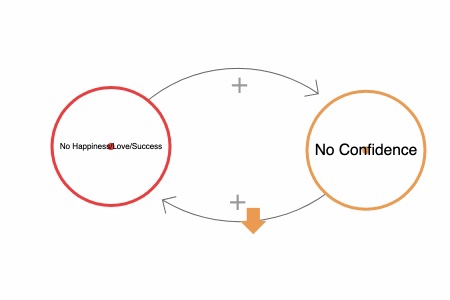
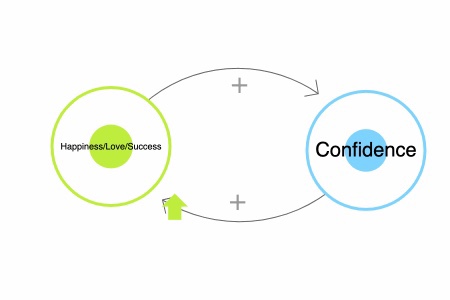
This is the confidence conundrum, where in order to be happy or loved or successful first you need to be confident… but to be confident, first you need to be happy or loved or successful.

So it seems like you’re stuck in one of two loops: either you’re already in a happy and confident loop, like this.

Or you’re in a loser loop, like this.

And if you’re in the loser loop, well it seems damn near impossible to get out.

It’s like a dog chasing its own tail. Or Domino’s ordering its own pizza. You can spend a lot of time cuticle gazing trying to mentally sort everything out, but just like with your lack of confidence, you’re likely to end up right back where you started.

But maybe we’re going about this all wrong. Maybe the confidence enigma isn’t really an enigma at all.

If we pay close attention, we can learn a few things about confidence just by observing people. So before you run off and order that pizza, let’s break this down:

• Just because somebody has something (tons of friends, a million euros, a bitchin’ beach body at tramore or bunmahon) doesn’t necessarily mean that this person is confident in it. There are business tycoons who totally lack confidence in their own wealth, models who lack confidence in their looks, and celebrities who lack confidence in their own popularity. So I think the first thing we can establish is that confidence is not necessarily linked to any external marker. Rather, our confidence is rooted in our perception of ourselves regardless of any tangible external reality.

• Because our confidence is not necessarily linked to any external, tangible measurement, we can conclude that improving the external, tangible aspects of our lives won’t necessarily build confidence. Chances are that if you’ve lived more than a couple of decades, you’ve experienced this in some form or another. Getting a promotion at your job doesn’t necessarily make you more confident in your professional abilities. In fact, it can often make you feel less confident. Dating and/or sleeping with more people doesn’t necessarily make you feel more confident about how attractive you are. Moving in with your partner or getting married doesn’t necessarily make you feel any more confident in your relationship.

• Confidence is a feeling. An emotional state and a state of mind. It’s the perception that you lack nothing. That you are equipped with everything you need, both now and for the future. A person confident in their social life will feel as though they lack nothing in their social life. A person with no confidence in their social life believes that they lack the prerequisite coolness to be invited to anyone’s pizza party. It’s this perception of lacking something that drives their needy, clingy, and/or bitchy behavior.

With all that being said, remember to drink your coffee this weekend, be kind to others and don’t get arrested 🫡

Love from Lee

3 Truths About Confidence:

Truth 1:

Being confident is understanding that you’re not always going to win, that you’re not always going to be the best and that you’re not always gonna be great every second of every day.

Truth 2:

When you see somebody who’s talking about how amazing they are, how they’re going to win everything, how they’re the best thing that’s ever happened to the planet, that’s not confidence, that’s overcompensation.

Truth 3:

Confidence isn’t related to success. Confidence is related to your relationship with failure.

You have to get so confident in who you are that no one’s opinion, rejection, or behaviour

can fucking rock you, even when you fail, even when you stumble or even when you crumble.

ONE THING FOR YOU TO THINK ABOUT THIS WEEK!

It is impossible to ruin your life.

If you are able to think then you are able to make different choices. If you are able to make different choices, you are able to improve. If you are able to improve, with enough time, you are able to overcome anything

TWO THINGS FOR YOU TO ASK YOURSELF THIS WEEK!

Is there something in your life that you have allowed yourself to believe is impossible to fix?

Often, the trick to dealing with an irreparable part of your life is to stop trying to repair it and instead focus on building something elsewhere.

Where else could you find happiness?

ONE THING FOR YOU TO TRY THIS WEEK

Shame is past-obsessed. One way of overcoming shame is to become future-obsessed.

Stop focusing on what’s broken. Instead, focus on what can be built. For one week, focus on what you can add to your life: a new hobby, a new friend, a new skill. Then go make an effort to add it. Pay attention to how that feels. Then let me know how it goes.

Oh and if all else don’t forget to drink your coffee 🤝🏻

#selfcare #timetothink #thisweek #getyourshitdone #tacticalpsychology

Self Care

Self care seems to be the “popular” thing to discuss and give talks on nowadays, while also charging you €100 for the privilege 😉, but what does it actually mean for me and you?

Well like I said, tactical psychology is all about taking the bullshit out of psychology so let’s get into it 🤝🏻

Limit your exposure to toxic people, toxic information, and toxic environments.

This means learning to say “no” (remember our last conversation about saying no? if not, click the link to give it a read https://tactical-psychology.com/2023/01/06/saying-no/) saying no doesn’t always mean just uttering the words “no” to someone it also means learning how to be fine on your own.

Do the unpleasant, unsexy habits that make everything else possible. Go to bed at a reasonable hour. Stay in on a Wednesday night. Pay off your credit card or credit union loan. Floss. It’s not sexy, but it has to be done.

Challenge yourself regularly.

When people think of self-care, they think it means getting away from life. But self-care means enriching your life with interesting challenges that force you to grow.

Have difficult conversations.

The quality of your life is proportional to the quality of your relationships. Take care of those relationships by having the uncomfortable conversations that result in trust and respect.

Rest. You don’t need to book a €500 spa treatment to rest. You don’t need to have a selfie in a hammock in the Caribbean to rest. Rest means rest. It can be your couch, your bed, on the floor, or in the arms of someone you care about.

So this weekend take some time to implement some self care, place yourself at the top of your priority list and enjoy the weekend!

Oh and don’t forget to drink your coffee 😏

#taketimetothink #tacticalpsychology #rules #lifecoach #lifelessons #liferules #psychology

Death

Death is a recurring theme across all human life. People we love die, people we need die, people we don’t know die, and eventually, we will die ourselves. For this reason it’s imperative to remember our mortality and learn to use it as a tool and a compass to orient ourselves. In history many philosophers and psychologists kept death in mind when conducting and releasing work, and they never wanted to forget how limited our time on earth is.

But tactical psychology is all about removing the bullshit from all the Philosophy, all of the psychology and giving you real world advice which you can implement in your life.

So ask yourself, how does one deal with the natural grief that loss provokes?

Speaking for myself, I had struggled to win a battle over depression and anger once my father died suddenly.

I’m here today with an amazing life surrounded by the most amazing people, because I won that battle.

But before I won, I felt nothing but hatred for the world and everyone in it, including me.

But from the ashes of my self destruction, I learned some of the most valuable life lessons, that a person can only learn when they’re faced with adversity.

Anything human is mentionable.

Anything mentionable is manageable.

When we talk about our feelings, they become less overwhelming, less upsetting and most of all less scary.

Don’t let social media fucking fool you, everyone and I mean everyone is fighting a battle you know nothing about.

Grief never ends. But it changes.

It’s a passage, not a place to stay

Grief is not a sign of weakness, nor a lack of faith. It is the price of love.

Have you ever heard some ask: “What would you do if you found out tomorrow that you had cancer?”

The question is designed to make you consider how different life might be if you were suddenly given just a few months or weeks to live. There’s nothing like a terminal illness to wake people up.

But here’s the thing: you already have a terminal diagnosis. We all do! As the writer Edmund Wilson put it, “Death is one prophecy that never fails.” Every person is born with a death sentence. Each second that passes by is one you’ll never get back.

Once you realize this, it will have a profound impact on what you do, say, and think. Don’t let another day tick away in ignorance of the reality that you’re a dying person. We all are. Can today be the day we stop pretending otherwise?

In conclusion, Life is short and death is all around us. Grief is all around us but so is happiness and so is life. The train keeps rolling whether we decide to jump on again or not.

Oh, I almost forgot. Don’t forget to drink your coffee 🫡

#lifecoach #lifelessons #grief #loss #positive #lesson #blog #blogpost #drinkyourcoffee

Saying No

“How many have laid waste to your life when you weren’t aware of what you were losing, how much was wasted in pointless grief, foolish joy, greedy desire, and social amusements, how little of your own was left to you. You will realize you are dying before your time!” -SENECA, ON THE BREVITY OF LIFE, 3.36

One of the hardest things to do in life is to say “No.” To invitations, to requests, to obligations, to the stuff that everyone else is doing.

Even harder is saying no to certain time consuming emotions: anger, excitement, distraction, obsession, lust. None of these impulses feels like a big deal by itself, but run amok, they become a commitment like anything else.

If you’re not careful, these are precisely the impositions that will overwhelm and consume your life. Do you ever wonder how you can get some of your time back, how you can feel less busy?

Start by learning the power of “No!” – as in “No, thank you, and “No, I’m not going to get caught up in that,” and “No, I just can’t right now.” It may hurt some feelings. It may turn people off. It may take some hard work. But the more you say no to the things that don’t matter, the more you can say yes to the things that do. This will let you live and enjoy your life the life that you want.

No person would give up even an inch of their estate, and the slightest dispute with a neighbor can mean hell to pay, yet we easily let others encroach on our lives worse, we often pave the way for those who will take it over. No person hands out their money to passers by, but to how many do each of us hand out our lives!

We’re tight fisted with property and money, yet think too little of wasting time, the one thing about which we should all be the

toughest misers.

Property can be regained, money can be re-earned. Time? Time is our most irreplaceable asset—we cannot buy more of it. We cannot get a second of it back. We can only hope to waste as little as possible. Yet somehow we treat it as the most renewable of all resources.

You can only hand so many hours of your day over to other people before there is none left.

Even if there are some left, you may have lost the clarity, the energy and the capacity to do anything with them. So, next time someone is asking for just a little of your time, or you feel the pressures of minor social obligations, or the temptations of potential financial gain remind yourself of this advice. SAY FUCKING NO.

But always say YES to coffee 😉

Love from

Lee ❤️

Why Failure Is Important

This Mondays Blog is all about the importance of failure and how we can view it as an important learning and self development tool rather than a disappointment.

Improvement at anything is based on thousands of tiny failures, and the magnitude of your success is based on how many times you’ve failed at something. If someone is better than you at something, then it’s likely because they have failed at it more than you have. If someone is worse than you, it’s likely because they haven’t been through all of the painful learning experiences you have.

If you think about a young child trying to learn to walk, that child will fall down and hurt itself hundreds of times. But at no point does that child ever stop and think, “Oh, I guess walking just isn’t for me. I’m not good at it.”

Avoiding failure is something we learn at some later point in life. I’m sure a lot of it comes from our education system, which judges rigorously based on performance and punishes those who don’t do well.

Another large share of it comes from overbearing or critical parents who don’t let their kids screw up on their own often enough, and instead punish them for trying anything new or not preordained. And then we have all the mass media that constantly expose us to stellar success after success, while not showing us the thousands of hours of dull practice and tedium that were required to achieve that success.

At some point. most of us reach a place where we’re afraid to fail, where we instinctively avoid failure and stick only to what is placed in front of us or only what we’re already good at.

This confines us and stifles us. We can be truly successful only at something we’re willing to fail at. If we’re unwilling to fail, then we’re unwilling to succeed.

A lot of this fear of failure comes from having chosen shitty values. For instance, if I measure myself by the standard “Make everyone I meet like me,” I will be anxious, because failure is 100 percent defined by the actions of others, not by my own actions. I am not in control; thus my self-worth is at the mercy of judgments by others.

Whereas if I instead adopt the metric “Improve my social life,” I can live up to my value of “good relations with others” regardless of how other people respond to me. My self-worth is based on my own behaviours and happiness

Shitty values, as we discussed in my previous blog, involve tangible external goals outside of our control.

The pursuit of these goals causes great anxiety. And even if we manage to achieve them, they leave us feeling empty and lifeless, because once they’re achieved there are no more problems to solve.

Better values, as we saw, are process oriented.

Something like “Express myself honestly to others,” a metric for the value

“honesty,” is never completely finished; it’s a problem that must continuously be reengaged. Every new conversation, every new relationship, brings new challenges and opportunities for honest expression. The value is an ongoing, lifelong process that defies completion.

Now that I’ve shown you how important failure is, grab a cup of tea (I know I know it should be coffee but it’s late) and relax.

See you Friday!

Lee

#lifecoach #liferules #tacticalpsychology #failure #psychology #positive #positivity #blog #wakeup #perspective

Why New Years Resolutions are damaging

Hi guys! After some time away from everything social media and spending it with family I’m back with a bang!

Buckle up because this post is gonna change your view on New Year’s resolutions 😉

I believe New Years can (not all the time) lead people into focusing on what’s wrong with their lives.

Instead try focusing on what you’re doing right and make small steps to make things even better, positivity shouldn’t be swayed because the social norm suggests we should all list out what’s wrong with ourselves or what needs to change. Instead I want only you to focus on two things.

Self belief is the first. If you can believe in ghosts, horoscopes, and magical crystals, why can’t you believe in yourself?

Are you seriously telling me that you have more faith in a fucking rock than you do your own mind?

The second is self love. Remember that no matter what happens in your life the one thing we can fall back on is our self love.

Don’t fucking forget it.Believe that you’re already good enough!

Be present and love your fucking

self. Polish your fucking zen. Cleanse your fucking chakras. Spitshine your soul and leave your fucking fears at home.

Combine sass with some spirit and enlighten the fuck up. Today is a good day not just because it’s new years, but because the sun has risen and you’re alive to manifest some abundance. Fucking namaste and all that.

For me? Very little is gonna change.

I’m going to continue to be the same guy I was in 2022

Just a little more confident

A little bit more positive

And a little bit more healthy both physically and mentally

Love to you all ❤️

Oh I nearly forgot. Don’t forget to start the year with a nice cup of coffee 😉

#psychology #tacticalpsychology #newgoalsthisyear #newyearsameus #positivity #goals #getyourshitdone

Christmas is here

Christmas is here. For many it is a time of celebration and happiness, for some it is not. It can be a difficult time filled with grief and sorrow. So for those of you that feel like Christmas is a little bit different this year, that’s ok. Christmas isn’t all sunshine and rainbows and you should feel ok with not feeling ok.

I understand, many people use holidays such as Christmas as somewhat of a checkpoint.

A checkpoint to see where you are at the end of the year so to speak, each time they come around we see all the things that have changed or have not changed this year.

We’re flooded with the feeling of familiarity, the meeting of friends, the time off from work and the time spent with family.

We are also met with the incredible awareness that things have changed (professionally or personally) since the last time you decorated the Christmas tree.

Maybe you’ve seen some heartbreak this year. Maybe you’ve been left go of your job. Or maybe you’ve lost a loved one. Maybe you’ve done some healing. No matter what you’ve seen or experienced you must not forget you have grown.

I’m so proud of you for that. For all you’ve made it through this year and will continue to get through as the promise of a new year is upon us. You should be proud of yourself.

Whether this Christmas feels heavy or light, even if your heart is caught between familiarity or change, my DMs will be open through the holidays, if you or anyone you know needs anything reach out.

Merry Christmas you amazing people!

Oh I almost forgot! Drink your damn coffee over the Christmas period it’ll help deal with trying to figure out what day it is 🥴

From

Lee

Why letting go is so liberating

Buddhism argues that your idea of who “you” are is an arbitrary mental construction and that you should let go of the idea that “You” exist at all: that the arbitrary metrics by which vou define yourself actually trap you, and thus you’re better off letting go of everything.

In a sense, you could say that Buddhism encourages you to not give a fuck. It sounds wonky, but there are some psychological benefits to this approach to life. When we let go of the stories we tell about ourselves, to ourselves, we free ourselves up to actually act (and fail) and grow.

That’s why letting go is so liberating.

There’s a kind of self absortion that comes with fear based on an irrational certainty. When you assume that your plane is the one that’s going to crash, or that your project idea is the stupid one everyone is going to laugh at, or that you’re the one everyone is going to choose to mock or ignore, you’re implicitly telling yourself, I’m the exception; I’m unlike everybody else, I’m different and special.

This is narcissism, pure and simple. You feel as though your problems deserve to be treated differently, that your problems have some unique math to them that doesn’t obey the laws of the physical universe.

My recommendation: don’t be special, don’t be unique.

Redefine your metrics in mundane and broad ways. Choose to measure yourself not as a rising star or an undiscovered genius.

Choose to measure yourself not as some horrible victim or dismal failure. Instead, measure yourself by more mundane identities: a student, a partner, a friend, a creator.

The narrower and rarer the identity vou choose for yourself. the more everything will seem to threaten you. For that reason, define yourself in the simplest and most ordinary ways possible.

This often means giving up some grandiose ideas about yourself: that you’re uniquely intelligent, or spectacularly talent-ed, or intimidatingly attractive, or especially victimized in ways other people could never imagine. This means giving up your sense of entitlement and your belief that you’re somehow owed something by this world, because I hate to break it to you, you’re not.

This means giving up the supply of emotional highs that you’ve been sustaining yourself on for years. Like a junkie giving up the needle, you’re going to go through withdrawal when you start giving these things up. But you’ll come out the other side so much better.