Meaning of Life

You know the question. It’s the ultimate question. The question that you and I and everyone have lain awake at night thinking about.

The question that brings equal parts wonder and terror to our feeble fucking minds. Why are we here? What is the point of it all? What is the meaning of life so to speak?

Well, fortunately, I figured it out while I was drinking a coffee this morning. I’m pretty sure it’s coffee. And no, I’m not saying that just because I’m having coffee. There’s an explanation here. I’m going to explain it, clickbait titles and all, in, oh, the next eight minutes or so.

First off, before we can even appropriately ask “What is the meaning of life?” we must first settle something more subtle and something more important. Namely, what is meaning?

WHAT IS MEANING?

What is meaning? That may strike you as terribly navel-gazey and ultra-philosophical. And if that’s the case, I invite you to think about coffee for a moment, and just stick with me for a minute. Because it’s important.

What does it mean for something to mean something? As humans, we have a constant need to attach meaning to everything that happens in our lives.

Look, a guy climbed a rock looking for meaning! My mom hugs me, that must mean that she loves me. My boss complimented me, that must mean I do good work. It’s going to be sunny tomorrow, that must mean I can wear my super-cool SpongeBob tank top to the store.

Meaning is the association that we draw between two experiences or events in our minds. X happens, then Y happens, so we assume that means X causes Y. Z happens, and we get really pissed off and feel shit, therefore we assume that Z sucks.

Our brains invent meaning the way dogs shit, they do it gleefully and not even realising that they’re ruining the fucking carpet.

Our brains invent meaning as a way to explain all the crazy shit going on in the world around us. This is important, as it helps us predict and control our lives.

But let’s be real: Meaning is an arbitrary mental construct.

Fifty people can watch the exact same event and draw fifty different meanings from said event. That’s why there’s so much arguing in politics. That’s why eyewitnesses are so unreliable in court.

That’s why your friends are sometimes the biggest assholes, because that meaning you just shared, to them, meant something completely different or nothing at all

TYPES OF MEANING IN LIFE

Our brains slap together two different types of meaning:

• Cause/Effect Meaning: You kick the ball, the ball moves. You tell your friend his hair is ugly, your friend slaps you in the face. You do X, and with reliable certainty, Y will result.We all need Cause/Effect meaning to survive. It helps us predict the future and learn from the past. Cause/Effect meaning primarily involves the logical parts of our brain. Science, for instance, is the constant search of more and more Cause/Effect Meaning.

• Better/Worse Meaning: Eating is better than starving. Making money is better than being broke. Sharing is better than stealing. Better/Worse meaning has to do with the nature of our values—what we perceive to be most important and useful in our lives.Better/Worse meaning relies mostly on the emotional parts of our brains. Generally what makes us feel good is what we immediately assume to be “good” or “better.”

Both forms of meaning evolved in our brains to help us survive. For thousands of years, humans needed to remember where certain food could be found, how various animals would respond when hunted, how weather patterns change and how to read the terrain. They also needed to know what would gain them acceptance within their tribe, what would curry favour from friends and earn approval from that sexy guy/gal in the loin cloth over yonder.

So in that sense, meaning is nature’s tool for motivation. It’s how evolution made sure we got shit done. Meaning drives all of our actions. When there is great meaning attached to something, like our child is sick and starving, we will go to insane lengths to make things right. People will often even go as far as giving up their lives for some grand sense of meaning (see: religion, every war ever). Meaning is that effective at moving people.

Meaning is nature’s tool for motivation.

Conversely, when we feel we lack meaning in our lives, when shit just doesn’t seem to matter, when there’s no clarity on how or why things happen to us, we do nothing. We sit on the couch and twiddle our thumbs and watch lame reruns while complaining on the internet about lame reruns. But here’s the kicker (and I swear I’m going to get to the coffee):

Meaning is a resource that we must cultivate in our lives.

Meaning is not something that exists outside of ourselves. It is not some cosmic universal truth waiting to be discovered. It is not some grand ‘eureka’ moment that will change our lives forever.

Meaning requires action. Meaning is something that we must continually find and nurture. Consistently.

Man’s great search for the meaning of life usually ends like this.

Meaning is like the water of our psychological health. Without it, our hearts and minds will shrivel and die. And like water, meaning flows through us—what is important today is not what was important years ago, and what is important tomorrow will not be the same as what is important today. Meaning must be sought out and replenished frequently.

HOW TO FIND MEANING IN YOUR LIFE

In a very real sense, the meaning of life is therefore to create meaning. So how does one create meaning? Two ways:

• Solve Problems. The bigger the problem, the more meaning one will feel. The more work you do towards that problem, also the more meaning you will feel. Solving problems basically means finding ways to make the world a slightly better place. Can be as simple as fixing up your aging mother’s dilapidated house. Or as complex as working on the new great breakthrough in physics.The point here is not to be picky. It’s easy, when we start thinking of how insignificant we are on a cosmic scale of the universe, to start thinking there’s no point in doing anything unless we’re going to save the world or something. This is just a distraction. There are tons of small, everyday problems going on around you that need your attention. Start giving it.

• Help Others. This is the biggie. As humans, we’re wired to thrive on our relationships. Studies show that our overall well-being is deeply tied to the quality of our relationships, and the best way to build healthy relationships is through helping others. In fact, some studies have even found that giving stuff away makes us happier than giving stuff to ourselves. Go figure. As such, it seems to be a “hack” in our brains that helping out other people gives us a greater sense of meaning and purpose. Just the fact you can say to yourself, “If I died, then someone is better off because I lived,” creates that sense of meaning that can propel you forward.

THE TRAP OF SETTING GOALS

A lot of people find meaning through setting goals for themselves. They want the corner office, the big car, the fancy-pants shoes. It gives them a reason to wake up in the morning, a reason to bust their ass at work. It gives them something that makes them feel important and something to look forward to every day.

But goals are a double-edged sword. You have to be careful.

Goals are good tools for building motivation. The problem is that, by themselves, they are arbitrary and empty. Unless there’s a “why” behind the goal full of meaning, the goal itself will provide little long-term happiness or satisfaction. Ever seen star athletes flounder after retirement? Or a guy who finally made his millions become deeply miserable because he doesn’t know what else to do with his life?

Goals are dangerous because the meaning they provide when you’re working towards them is the meaning that is taken away once you achieve them.

This is why all the superficial stuff like make a billion euros, or own a Rolls Royce, or get your face plastered on the cover of a magazine all lead to a type of happiness that is shallow and short-lived—because the meaning is shallow and short-lived.

There has to be a deeper reason for your goals. Otherwise, the goals themselves will be empty and worthless in the long run.
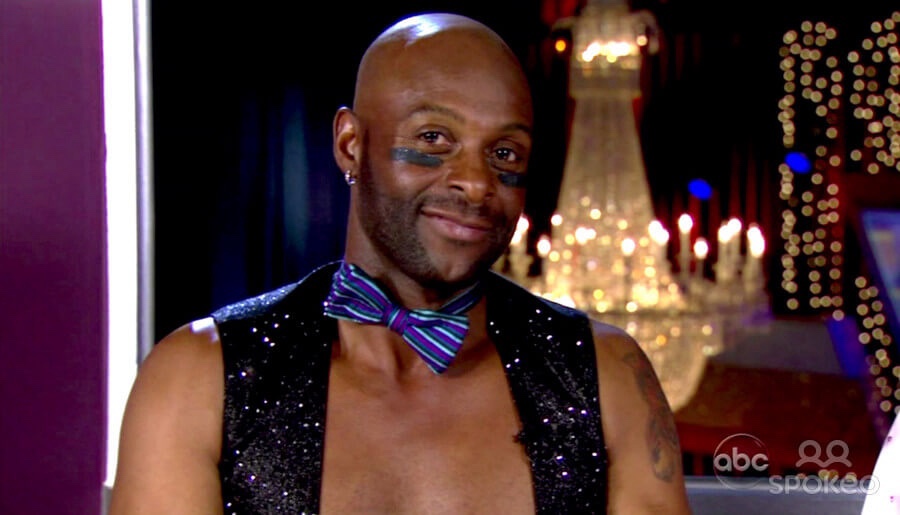
Some athletes handle retirement well. Others end up on Dancing with the fucking Stars.

Notice that it’s the athletes who aspire to be the best at their sport for some greater reason to build a charity, to start a business, to transition into another career who handle retirement the best.

Notice it’s the millionaires who spent their life working towards a deeper cause that remain content once all of their goals are checked off the checklist.

But some goals don’t even have to be big and sexy.

Take a cup of coffee. I sat down to write this blog craving a coffee. That’s a problem in my life. And I promised myself I’d pump out this draft before going and getting this magnificent sexy coffee. That gave this hour some extra meaning.

And you know what? Maybe my fiancé is craving one too and I can get her one. You know, make the world a better place and all that shit while I’m at it.

So what’s the meaning of life? Well, for me, right now, it’s a coffee. What will yours be?

PS: if you haven’t already, get a damn coffee and have an amazing day you beautiful motherfucker.
Where I’ve been these past few weeks

I know I know, before you even start I realise I’ve been MIA for the past god knows how long.

It’s with good reason.

Many major milestones (both good and bad) have been experienced since we last spoke.

For instance, my brother got married. It was an emotionally charged day, full of love and happiness but also tough, due to our own father not being there.

I travelled. Since we last spoke I’ve done some travelling around Ireland and taken a hiatus to the Italian alps, where me and my fiancé rented a Campervan and travelled, hiked and camped our way around the dolomites for two weeks.We also visited Tenerife for a cheeky few days where we did nothing! Kicked back in the sun and enjoyed just being together.

We lost our family pet since we last spoke also. Skylar was our baby for 13yrs. She helped me through some very dark times in my life and would always listen to me complain when it was just me and her in my life.

I’ve also experienced one of the worst set backs of my professional career since we last spoke. I had many many (5 to be exact) interviews with the same company for a position I felt I was perfect for. Which I knew I was perfect for. Even the recruitment lead for Europe agreed, my future boss to be agreed but at the last post I was pipped. Pipped by someone who has been left go by Meta who needed a job and “knew someone”. So to say this was a bitter pill to swallow would be a fucking understatement.

Going back to a job I had one foot out of was even tougher.

Alas, we are still here, still keeping my head down and attacking everyday as best as I can.

Being brutally honest I needed a break from writing also. This shit isn’t easy. I was never much of a story teller or writer so when I say I got burnt out quick, I mean it.

I felt I was repeating myself and had nothing of value to give you the reader so I said “fuck it” and didn’t write anything. I fell into that trap (something I hope to write about soon)

With all this being said, I’m back.

I’m back with a fucking bang to shake all of you awake to the harsh truths of life, the happiness that can be found in the mundane and how we can all say fuck you to mediocrity, depression and anxiety to create a better more successful and content version of ourselves!

Before I go tho.. I really hope you’ve been drinking your damn coffee 😏

You’ll be hearing from me soon motherfuckers.

Peace 👋🏻

The Backwards Law

There’s a part of Navy SEAL training called “drown-proofing” where they bind your hands behind your back, tie your feet together, and dump you into a 9-foot-deep pool.

Your job is to survive for five minutes.

Like most of SEAL training, the vast majority of sailors who attempt drown-proofing fail. Upon being tossed into the water, many of them panic and scream to be lifted back out. Some struggle until they slip underwater where they proceed to lose consciousness and have to be fished out and resuscitated. Over the years, a number of trainees have even died during the exercise.

But some people make it. And they do so because they understand two counterintuitive lessons.

The first lesson of drown-proofing is paradoxical: the more you struggle to keep your head above water, the more likely you are to sink.

With your arms and legs bound, it’s impossible to maintain yourself at the surface for the full five minutes. Even worse, your limited attempts to keep your body afloat will only cause you to sink faster. The trick to drown-proofing is to actually let yourself sink to the bottom of the pool. From there, you lightly push yourself off the pool floor and let your momentum carry you back to the surface. Once there, you can grab a quick breath of air and start the whole process over again.

Strangely, surviving drown-proofing requires no superhuman strength or endurance. It doesn’t even require that you know how to swim. On the contrary, it requires the ability to not swim. Instead of resisting the physics that would normally kill you, you must surrender to them and use them to save your own life.

The second lesson of drown-proofing is a bit more obvious, but also paradoxical: the more you panic, the more oxygen you will burn and the more likely you are to fall unconscious and drown. In a sick and twisted way, the exercise turns your survival instinct against you: the more intense your desire to breathe, the less you will be able to breathe. The more intense your will to live, the greater the chance you will die.

More than a test of physical will, drown-proofing is a test of each sailors emotional control in situations of extreme danger. Can he control his own impulses? Can he relax in the face of potential death? Can he willingly risk his life in the service of some higher value or goal?

These skills are far more important than any cadet’s ability to swim. They’re more important than his resilience, his physical toughness, or his ambition. They’re more important than how smart he is, what school he went to, or how damn good he looks in a crisp Italian suit.

This skill the ability to let go of control when one wants it most is one of the most important skills anyone can develop. And not just for SEAL training. For life.

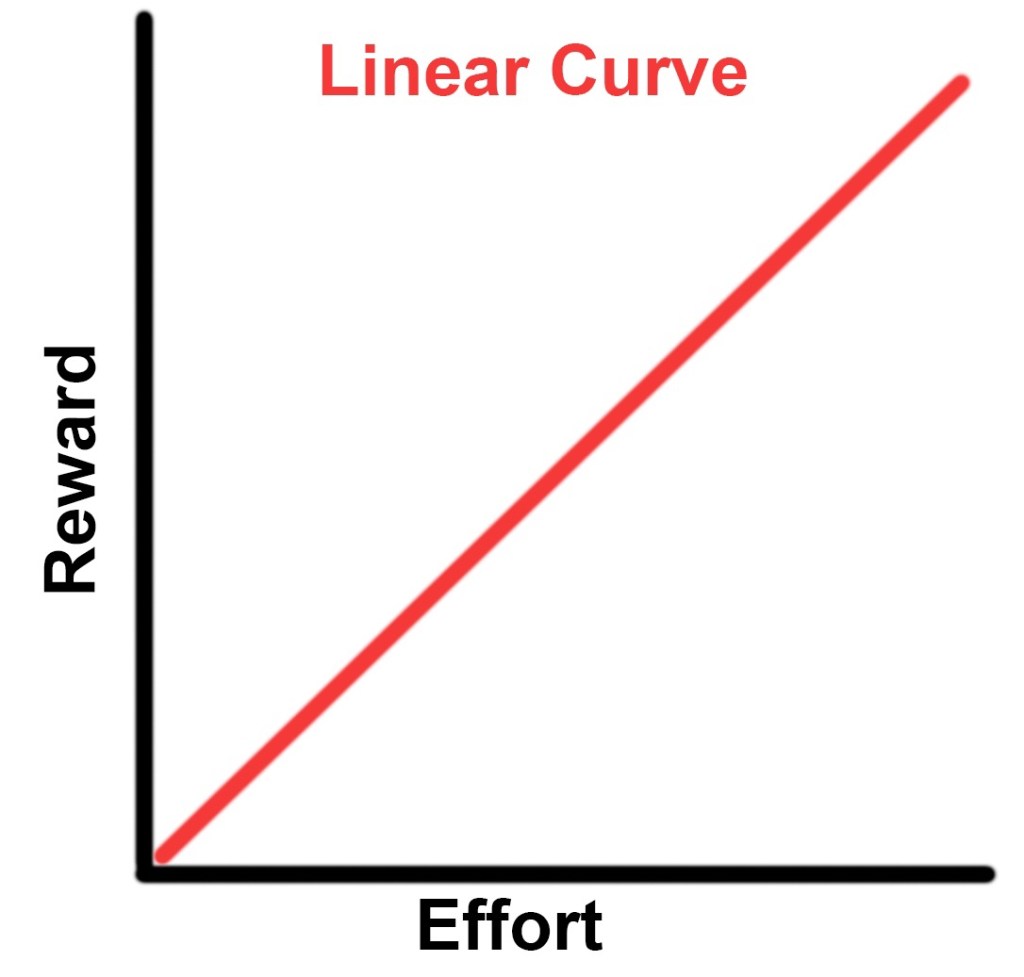
Most people assume the relationship between effort and reward is one-to-one. We think that working twice as long will produce twice the result. That caring about a relationship twice as much will make everyone feel twice as loved. That yelling your point twice as loud will make you twice as right.

The assumption here is that most of life exists on a linear curve, that there’s a one-to-one ratio between effort and reward with everything:

But allow me to inform you as someone who just tried drinking twice the normal amount of coffee so he could finish editing this damn thing—this is almost never true. Most of the world does not exist on a linear curve. Linear relationships only exist for mindless, rote, repetitive tasks—driving a car, filling out reams of paperwork, cleaning the bathroom, etc. In all of these cases, doing something for two hours will double the output of doing it for one hour. But that’s simply because they require no thought or ingenuity.

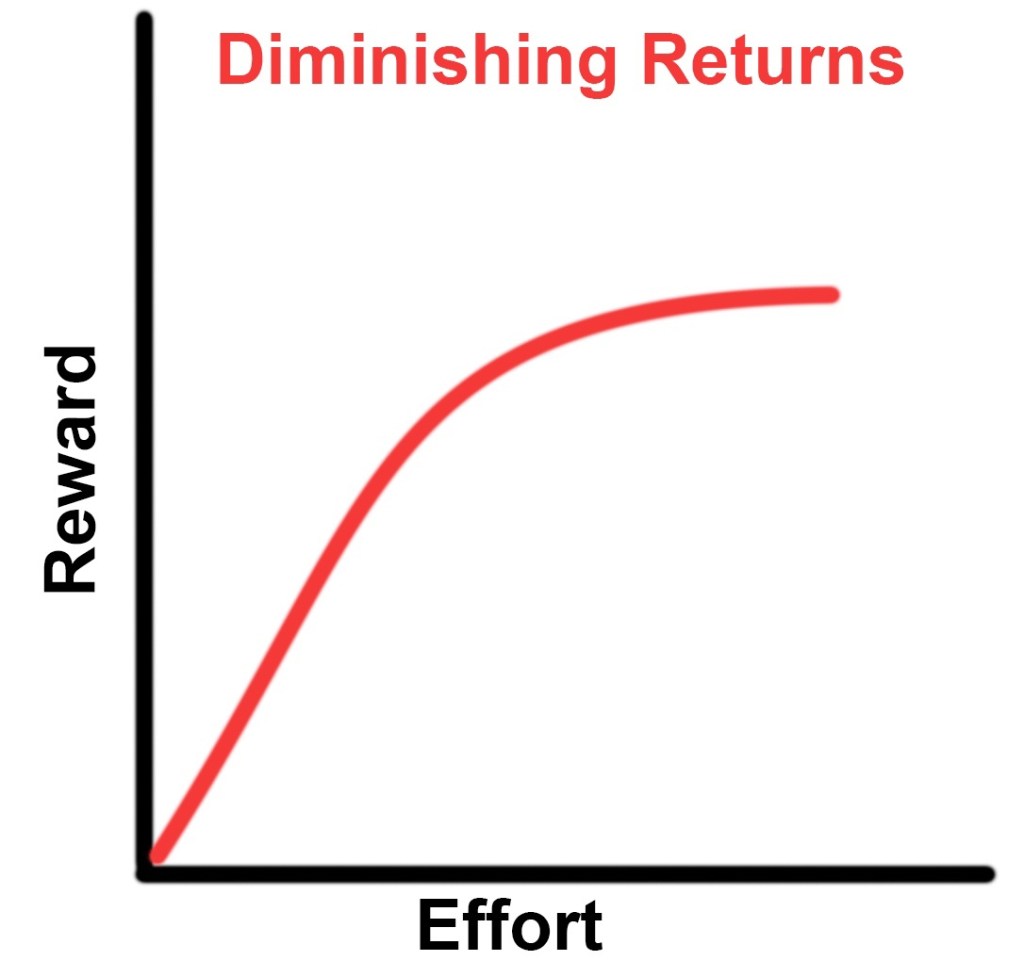
Most activities in life do not operate along the linear effort/reward curve because most activities in life are not basic nor mindless. Most activities are complex, mentally and/or emotionally taxing, and require adaptation.

Therefore, most activities produce a diminishing returns curve:

Diminishing returns means that the more you experience something, the less rewarding it becomes. The classic example is money. The difference between earning €20,000 and €40,000 is huge and life-changing. The difference between earning €120,000 and €140,000 means your car has slightly nicer seat heaters. The difference between earning €127,020,000 and €127,040,000 is basically a rounding error on your tax return.

The concept of diminishing returns applies to most experiences that are complex and novel, and even many of the mundane ones. The number of showers you take in a day, the number of chicken wings you inhale during happy hour, the number of trips home to visit your mother in a year—these are all experiences that start out highly valuable at first but then diminish in value the more frequently you do them (sorry, Mum).

Another example: studies on work productivity show that we’re really only productive for the first four to five hours of each day. Everything after that suffers severely diminished returns, to the point where the difference between working for 12 hours and 16 hours is basically nothing (not counting sleep deprivation).

Friendships operate on a diminishing returns curve. Having one friend is vital. Having two is clearly better than one. But having 10 instead of 9 changes little in your life. And having 21 instead of 20 just makes remembering people’s names that much more difficult.

Sex has diminishing returns, as does eating, sleeping, drinking alcohol, working out at the gym, reading books, taking vacations, hiring employees, consuming caffeine, saving for retirement, scheduling business meetings, studying for an exam, masturbating, staying up late to play video games, the examples are endless. All give back less the more you do them, the more you try, or the more you have. All operate on a diminishing returns curve.

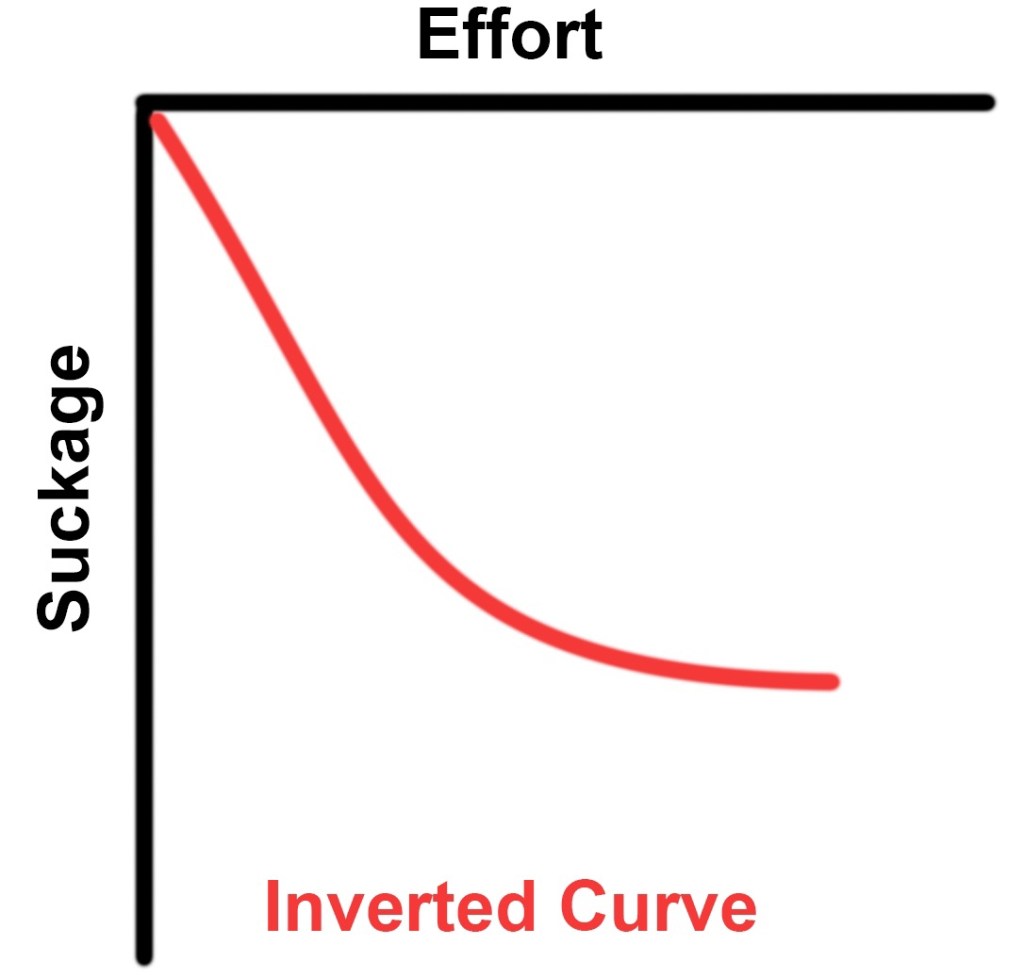
But there’s another curve, one that you’ve probably never seen or heard of before and that’s largely because I make a lot of this fucking shit up. That’s the inverted curve (yes I know, sounds sexy right):

The inverted curve is the bizarro “Twilight Zone” curve, where effort and reward have a negative correlation—that is, the more effort you put into doing something, the more you will fail to do it.

Drown proofing exists on an inverted curve. The more effort you put into rising to the surface, the more likely you will be to fail at it. Similarly, the more you want to breathe, the more likely you are to choke on a bunch of chlorinated piss water.

But I know you’re thinking, “So what, Lee? I’ve usually had too many piña coladas to even find the deep end of the pool, much less bind my arms and legs and try to survive in it. Who gives a shit about inverted curves?”

It’s true, few things in life function on an inverted curve. But the few things that do are extremely important. In fact, I will argue that the most important experiences and goals in life all exist on an inverted curve.

Effort and reward have a linear relationship when the action is mindless and simple. Effort and reward have a diminishing returns relationship when the action is complex and multivariate.

But when the action becomes purely psychological, an experience that exists solely within our own consciousness, the relationship between effort and reward becomes inverted.

Pursuing happiness takes you further away from it. Attempts at greater emotional control only remove us from it. The desire for greater freedom is often what causes us to feel trapped. The need to be loved prevents us from loving and accepting ourselves.

Aldous Huxley once wrote, “The harder we try with the conscious will to do something, the less we shall succeed. Proficiency and results come only to those who have learned the paradoxical art of doing and not doing, or combining relaxation with activity.”

The most fundamental components of our psychology are paradoxial. This is because when we consciously try to create a state of mind, the desire for that state of mind creates a different and often opposite state of mind from the one we’re trying to create.

This is “The Backwards Law” I explained in earlier blogs, but in a nutshell for all you shitheads who didn’t read it is this: desiring a positive experience is itself a negative experience, accepting a negative experience is a positive experience.

But this extends to most–if not all–aspects of our mental health and relationships:

• Control – The more we strive to control our emotions and impulses, the more powerless we will feel. Our emotional life is unruly and often uncontrollable, and it’s the desire to control it that makes it worse. Conversely, the more we accept our feelings and impulses, the more we’re able to direct and process them.

• Freedom – The constant desire for freedom ironically limits us in a number of ways. Similarly, it’s only by limiting ourselves–by choosing and committing to certain things in life–that we truly exercise our freedom.

• Happiness – trying to be happy, makes us less happy. Accepting unhappiness makes us happy.

• Security – Trying to make ourselves feel as secure as possible generates more insecurity. Being comfortable with uncertainty is what allows us to feel secure.

• Love – The more we try to make others love and accept us, the less they will, and more importantly, the less we will love and accept ourselves.

• Respect – The more we demand respect from others, the less they will respect us. The more we ourselves respect others, the more they will come to respect us.

• Trust – The more we try to make people trust us, the less inclined they will be to do so. The more we trust others, the more they will trust us in return.

• Confidence – The more we try to feel confident, the more insecurity and anxiety we will create. The more we accept our faults, the more comfortable we will feel in our own skin.

• Change – The more we desperately want to change ourselves, the more we will always feel as though we are not enough. Whereas, the more we accept ourselves, the more we will grow and evolve because we’ll be too busy actually doing cool shit to notice.

• Meaning – The more we pursue a deeper meaning or purpose of our lives, the more self-obsessed and shallow we will become. The more we try to add meaning to others’ lives, the more profound impact we will feel.

These internal, psychological experiences exist on an inverted curve because they are both the cause and the effect of the same thing: our minds. When you desire happiness, your mind is simultaneously the thing that is desiring and the target of its own desires.

When it comes to these lofty, abstract, existential goals, our minds are like a dog who, after a lifetime of successfully chasing and catching various small creatures, has turned and decided to exact that same strategy on its own tail. To the dog, this seems logical. After all, chasing has led her to catch everything else in her doggy life. Why not her tail, too?

But a dog can never catch her own tail. The more she chases, the more her tail seems to run away. That’s because the dog lacks the perspective to realise that she and the tail are the exact same thing.

The goal is to take your mind—a wonderful thing that has spent its life learning to chase various creatures and teach it to stop chasing its own tail. To stop chasing meaning and freedom and happiness because those only serve to move it further away from itself. To teach it to achieve what it desires by giving up what it desires. To show it how the only way to reach the surface is to let itself sink.

And how do we do this? By letting go. By giving up. By surrendering. Not out of weakness. But out of a respect that the world is beyond our grasp. By recognising that we are fragile and limited and but temporary specks in the infinite reaches of time. You do it by relinquishing control, not because you feel powerless, but because you are powerful. Because you decide to let go of things that are beyond your control. You decide to accept that sometimes, people won’t like you, that often you will fail, that usually you have no fucking clue what you’re doing.

You lean into the fear and uncertainty, and just when you think you’re going to drown, just as you reach the bottom, it will launch you back to your salvation. When it does launch you back, make sure its to your closest coffee shop to grab the sweet nectar of the gods, a freshly brewed coffee, life seems a hell of a lot simpler then.

The importance of your emotions

Years ago, I knew one of those guys who seemed to always be happy and excited. He was always a bundle of warm fuzzies. First to give you a hug. Always happy to see you. Complimented you about things that had no business being complimented. We’ll call him ‘Jon.’

Jon was like a dog, one of those rare people whose enthusiasm and unbridled joy is so unceasing that it actually becomes a little irritating at times. “Can you, just like… hate life a little?” I used to think to myself. And no, I wasn’t wearing eyeliner.

Alas, it never happened. And I felt like an asshole for having such thoughts. I was jealous. Or maybe worse: I was just a bad person.

But I never felt like a bad person for that long, because Jon was so damn fun and engaging. You couldn’t help but be lifted up by his spirits. He always wanted to know what was going on in your life. He was always encouraging. He was always happy for you and proud of you, even when you weren’t happy or proud of yourself.

I eventually just decided that Jon was one of those people who had it figured out. One of those people that the shittier parts of life seemed to pass on by. A person who somehow managed to walk between the raindrops. A person who was blessed and knew it and spent his days trying to make others feel just as great as he did.

Then one day, I walked in on him doing lines of coke off the back of a toilet. What the fuck?

No! This guy was supposed to be the one who had it figured out! This guy was the one who was supposed to be immune to these kinds of moments of weakness! Damnit man, you were the chosen one! (Insert Star Wars reference)

It turned out, Jon was a fucking mess. His family life was a mess. His personal life was a mess. His unceasing positivity and the occasional nose candy were the only things holding him together, like raggedy pieces of duct tape and a shoestring.

And here’s what took me a long time to figure out but surprised me: Jon sucked at emotions. I know that might sound crazy — on the surface, he appeared to be what we all want to be perfectly happy, loving and giving, always positive and encouraging, never in a dull mood. But it was true. He sucked at dealing with his emotions and he suffered more because of it.

WHAT DO EMOTIONS DO ANYWAY?

Emotions are the result of your mind comparing your external environment to your expectations.

The same way you feel hot and cold when you walk outside (you step into the air, your skin moderates the temperature relative to your body temperature and then sends a signal to your brain saying, “it’s hot” or “it’s cold”), your emotions do the same for complex psychological phenomena.

So you step outside, your body sends your brain the signal “it’s cold” and you run inside and get a coat. Similarly, if you come home from work and catch your husband blowing the mailman, your body sends the emotional signal to your brain which says, “What the actual fuck?” and then you divorce his ass and enjoy a massive settlement and lots of ice cream on the couch.

Emotions are designed to create strong incentives for us to take action and do something to get rid of conflict between our expectations and our environment, either by changing our environment or changing our expectations. We want alignment between the two, and we get mighty uncomfortable when they are at odds with each other. Emotions are like marriage counsellors, trying to get our expectations and our environment to read out loud what they wrote down for today’s session to try and make things work.

So for instance, say you’re talking with a co-worker and they let slip that bitch Betty took credit for your awesome idea and got a raise as a result. Fucking Betty.

Chances are you’re going to feel some strong emotions like anger, jealousy, and betrayal, among others. Chances are you’re going to take some sort of action to let that bitch Betty (and/or your boss) know exactly what you think of them. Shit’s going to get real in cubicle-ville because this injustice cannot stand, man.

That anger and pain you feel is also likely to make you take a long, hard look at your workplace and career. They’ll also probably make you a lot more vigilant in the future by virtue of the fact that you don’t want to ever feel like this again. So now you’ll do more to make sure your work gets noticed in the future. It might have been a painful experience at the time, but your emotions provoked you into dealing with the situation then and they will help you again in the future.

And that’s what makes our emotions so powerful and so useful. It doesn’t matter if they make us feel good or bad. What matters is they motivate us to take appropriate action and deal with whatever comes our way and bring balance to the force. Unlike this asshole.

Here’s the thing though: our emotions won’t help us deal with the shitty things life throws at us if they don’t match up well with the situation we find ourselves in. If I’m bored when I should be scared, or overjoyed when I should be raging pissed, then how the hell are my emotions going to help me do anything to help me cope with life, let alone survive? If your emotions don’t know what is going on, they cannot bring the tools required to fix the situation.

This is the problem with the feel good no matter what is happening in your fucking life mentality. And this is why Jon ended up being such a fucking mess. Instead of engaging the right emotions in the right situations, he was trying to wallpaper over everything with a bunch of bright, sunshiny bullshit.

HOW DIVERSIFYING YOUR EMOTIONS MAKES YOU A MORE RESILIENT PERSON

There’s a concept in psychology called “emotional diversity.” Emotional diversity is just what it sounds like: experiencing a variety of emotions. And it turns out that people who experience a wide variety of both positive and negative emotions are a lot better off, both mentally and physically, than people who only experience a few emotions regularly, good or bad.

Just like a more diverse stock portfolio is more resilient to large swings in stock values, the more diverse your emotional life is, the more resilient you are to the large swings in experience that life gives you. If you’re comfortable with anger, you’ll be able to call it up at the appropriate moments and use it. If you’re comfortable with joy or guilt or grief, you’ll be able to use those when you need to as well.

A diverse emotional life isn’t just made up of a few “good” and “bad” emotions. You can also have lots of emotional subcategories, like amusement, joy, contentment, greatfulness, pride, love, hope, and anger, sadness, guilt, contempt, anxiety, disgust, embarrassment, and on and on. People with access to emotional diversity have a network of roads to get to where they need to go; people without it might only have one big highway of anger and a dirt road of sadness.

Researchers think that people who experience a wider range of these types of specific subcategories of emotions are more resilient in the face of adversity because they’re better at identifying what triggers those emotions. And if you know exactly what’s making you feel the way you feel, it’s a whole lot easier to react appropriately.

People who practice a wide range of emotions are self aware enough to know what triggers these emotions and then act accordingly. Research has shown that self-awareness and the ability to self-label emotions has positive links to well-being. This awareness and labelling makes people feel more in control of their lives, a huge factor in determining happiness and general well-being.

More variety in emotional experience also gives you a greater appreciation for just how transient emotions are. When you only allow yourself to feel one or two emotions all the time, you start to feel as though they are permanent (or should be permanent). The world always sucks. Life is always great. You always feel guilty because you’re a horrible person. You’re always proud because you’re narcissistic and jerk off to your own high school yearbook pictures.

When you’re stuck in these one-emotion-defines-the-world mentalities, you forget that emotions are transient superficial things that don’t necessarily mean anything.

Emotional diversity shows us that emotions come and go. If you feel angry now, that’s fine, you won’t in a few hours. If you’re happy now, that’s great, enjoy it, because the next struggle is around the corner. If you feel guilty or sad, then that’s okay too, things will look up some time in the near future. The question is then how do we begin to diversify our emotional lives?

BECOMING AN EMOTIONAL NINJA

The first step in achieving greater emotional diversity: simple self awarness. Noticing and accepting what you feel when you feel it.

This sounds so simple. So simple as to be stupid. But what you’ll likely find is that if you’ve denied a certain emotion in yourself for long enough, you’ll actually stop realising when you’re feeling it. If you deny to yourself that you are sad for long enough, you lose the ability to recognize sadness in yourself.

I’ve always talked about identifying and infusing your emotions as one way to become more self-aware and to understand your emotions better. This is the next step. Learning to identify the emotion and then separating your decision-making from the emotion.

It’s the difference between wanting to punch some fucker in the face, and actually doing it. Doing it is unacceptable. Feeling like you want to is a natural human reaction (sometimes).

Practices like meditation become really useful in developing these skills: first awareness, then detachment. It’s also an aim of some treatments and practices within therapy and psychology.

Besides the number of health benefits that seem to come with meditating, and practicing detachment, it teaches you the ability to recognise what is going on in your mind and what you are feeling. If you stick with it long enough, you realise your emotions are just that, emotions. And they not only don’t last forever, they are a signal you can choose to listen to or to ignore when you are making your decisions.

Your emotions no longer have to control your actions.

Some practices within therapy and counseling also teach you to put your feelings into words, a practice called affect labelling that has been shown to lessen the intensity of those emotions If you can name or label the feeling, it seems to lose its power.

Once you unfused your emotions from your decisions, you can experience greater depth and complexity in your emotions. For example, you might feel depressed at some point, but if you can examine that feeling more closely, you might find that you’re also angry about the thing that’s making you depressed. Now we’re getting somewhere.

Instead of just being a depressed slouched on the couch and resigning to the fact that life is meaningless—and oh, what’s the point anyway?—that anger can motivate you to do something about your situation, to not withdraw from but rather to engage with it.

This is what being an emotionally well-adjusted person is all about. It is not about being happy or having some bubbling feeling of contentment all the time. It is about recognising the layers of feeling going on inside you and utilising them in ways that are helpful. Anger can lead to action. Sadness can lead to acceptance. Guilt can lead to change. Excitement can lead to motivation.

Life is not about controlling our emotions. That’s impossible. Emotions come and they go whether we want them to or not.

Life is about channeling emotions. And each emotion is almost its own skill. Like learning to fight with nunchucks and sweet-ass bo staffs and samurai swords are different skill sets within the realm of fighting, channeling each of our emotions for productive action is its own skill to be practiced and mastered through the experience of life.

And once you master them all, you become an emotional ninja, able to adapt and silently slice through any adversity life throws at you. And then maybe you skateboard through the sewers and eat a lot of pizza too (Yes I’m referring to teenage mutant ninja turtles)

That’s right. You thought the Ninja Turtles was just a kid’s show? Come on, man. There’s a deeper lesson there. They represent the mastery of each class of life’s emotions—Raphael is anger, Donatello is curiosity, Leonardo is insecurity, Michaelangelo is pizza.

Master them all and master yourself (hence, “Master Splinter”). Dude, where are you going? I’m serious here. Don’t hit the “back” button just yet. I’m just getting started.

You see, the pizza is a metaphor for the multilayered consumption of our own existential meaning and existence (Mind fucking blown right!), and each emotion consumes it differently.

Right, I’m done. Cowabunga, dude. Drink your damn coffee and namaste, fuckfaces

Confidence Part 2

I had someone reach out to me following my last blog dealing with confidence, asking this question: ⬇️

“How are you supposed to be confident about something when you have nothing to feel confident about?”

I like this question and I’d like to expand on it a little more before I try answer it, how are you (yes you reading this as this might apply to even just one of you) supposed to be confident at your new job if you’ve never done this type of work before? Or how are you supposed to be confident in social situations when no one has ever liked you before? Or how are you supposed to be confident in your relationship when you’ve never been in a positive, healthy relationship before?

On the surface, confidence appears to be an area where the rich get richer and the poor stay the fucking losers they are. After all, if you’ve never experienced much social acceptance, and you lack confidence around new people, then that lack of confidence will make people think you’re clingy and weird and not accept you.

Same deal goes for relationships. No confidence in intimacy will lead to bad breakups and awkward phone calls and emergency Ben and Jerry’s runs at three in the morning.

And seriously, how are you supposed to be confident in your work experience when previous experience is required to even be considered for a job in the first place?

THE CONFIDENCE ENIGMA!

If you’ve always lost in life then how could you ever expect to be a winner? And if you never expect to be a winner, then you’re going to act like a loser. Thus the cycle of suckage continues.

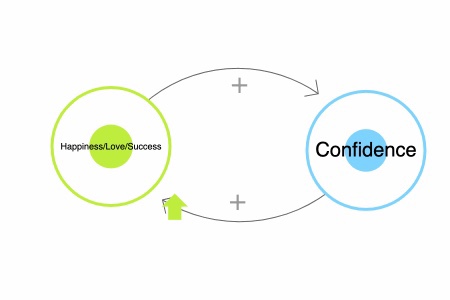
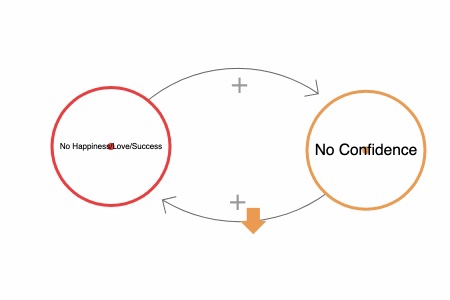
This is the confidence conundrum, where in order to be happy or loved or successful first you need to be confident… but to be confident, first you need to be happy or loved or successful.

So it seems like you’re stuck in one of two loops: either you’re already in a happy and confident loop, like this.

Or you’re in a loser loop, like this.

And if you’re in the loser loop, well it seems damn near impossible to get out.

It’s like a dog chasing its own tail. Or Domino’s ordering its own pizza. You can spend a lot of time cuticle gazing trying to mentally sort everything out, but just like with your lack of confidence, you’re likely to end up right back where you started.

But maybe we’re going about this all wrong. Maybe the confidence enigma isn’t really an enigma at all.

If we pay close attention, we can learn a few things about confidence just by observing people. So before you run off and order that pizza, let’s break this down:

• Just because somebody has something (tons of friends, a million euros, a bitchin’ beach body at tramore or bunmahon) doesn’t necessarily mean that this person is confident in it. There are business tycoons who totally lack confidence in their own wealth, models who lack confidence in their looks, and celebrities who lack confidence in their own popularity. So I think the first thing we can establish is that confidence is not necessarily linked to any external marker. Rather, our confidence is rooted in our perception of ourselves regardless of any tangible external reality.

• Because our confidence is not necessarily linked to any external, tangible measurement, we can conclude that improving the external, tangible aspects of our lives won’t necessarily build confidence. Chances are that if you’ve lived more than a couple of decades, you’ve experienced this in some form or another. Getting a promotion at your job doesn’t necessarily make you more confident in your professional abilities. In fact, it can often make you feel less confident. Dating and/or sleeping with more people doesn’t necessarily make you feel more confident about how attractive you are. Moving in with your partner or getting married doesn’t necessarily make you feel any more confident in your relationship.

• Confidence is a feeling. An emotional state and a state of mind. It’s the perception that you lack nothing. That you are equipped with everything you need, both now and for the future. A person confident in their social life will feel as though they lack nothing in their social life. A person with no confidence in their social life believes that they lack the prerequisite coolness to be invited to anyone’s pizza party. It’s this perception of lacking something that drives their needy, clingy, and/or bitchy behavior.

With all that being said, remember to drink your coffee this weekend, be kind to others and don’t get arrested 🫡

Love from Lee

3 Truths About Confidence:

Truth 1:

Being confident is understanding that you’re not always going to win, that you’re not always going to be the best and that you’re not always gonna be great every second of every day.

Truth 2:

When you see somebody who’s talking about how amazing they are, how they’re going to win everything, how they’re the best thing that’s ever happened to the planet, that’s not confidence, that’s overcompensation.

Truth 3:

Confidence isn’t related to success. Confidence is related to your relationship with failure.

You have to get so confident in who you are that no one’s opinion, rejection, or behaviour

can fucking rock you, even when you fail, even when you stumble or even when you crumble.

ONE THING FOR YOU TO THINK ABOUT THIS WEEK!

It is impossible to ruin your life.

If you are able to think then you are able to make different choices. If you are able to make different choices, you are able to improve. If you are able to improve, with enough time, you are able to overcome anything

TWO THINGS FOR YOU TO ASK YOURSELF THIS WEEK!

Is there something in your life that you have allowed yourself to believe is impossible to fix?

Often, the trick to dealing with an irreparable part of your life is to stop trying to repair it and instead focus on building something elsewhere.

Where else could you find happiness?

ONE THING FOR YOU TO TRY THIS WEEK

Shame is past-obsessed. One way of overcoming shame is to become future-obsessed.

Stop focusing on what’s broken. Instead, focus on what can be built. For one week, focus on what you can add to your life: a new hobby, a new friend, a new skill. Then go make an effort to add it. Pay attention to how that feels. Then let me know how it goes.

Oh and if all else don’t forget to drink your coffee 🤝🏻

#selfcare #timetothink #thisweek #getyourshitdone #tacticalpsychology