ACTION AND MOTIVATION

Here’s a news flash for you:

Action isn’t just the effect of motivation, but also the cause of it.

Most people only commit to action if they feel a certain level of motivation. And they only feel motivation when they feel an emotional inspiration.

People only become motivated to study for the exam when they’re afraid of the consequences. People only pick up and learn that instrument when they feel inspired by the people they can play for.

And we’ve all slacked off for lack of motivation before. Especially in times where we shouldn’t.

We feel lethargic and apathetic towards a certain goal that we’ve set for ourselves because we lack the motivation and we lack the motivation because we don’t feel any overarching emotional desire to accomplish something.

We typically think motivation works something like this:

Emotional Inspiration → Motivation → Desirable Action

But there’s a problem with operating under this framework: often the changes and actions we need in our lives are inspired by negative emotions that simultaneously hinder us from taking action.

If someone wants to fix their relationship with their mother the emotions of the situation (hurt, resentment, avoidance) completely go against the necessary action to fix it (confrontation, honesty, communication).

If someone wants to lose weight but experiences massive amounts of shame about their body, then the act of going to the gym is apt to inspire in them the exact

emotions that kept them at home on the couch in the first place.

Past traumas, negative expectations, and feelings of guilt, shame, and fear often motivate us away from the actions necessary to overcome those very traumas, negative expectations, and negative emotions.

HOW TO GET MOTIVATED: THE “DO SOMETHING” PRINCIPLE

It’s a Catch-22 of sorts. But the thing about the motivation chain is that it’s not only a three-part chain but an endless loop:

Your actions create further emotional reactions and inspirations and move on to motivate your future actions. Taking advantage of this knowledge, we can actually re-orient our mindset in the following way:

Action → Inspiration → Motivation

The conclusion is that if you lack the motivation to make an important change in your life, then do something, anything really, and then harness the reaction to that action as a way to begin motivating yourself.

This is known as The “Do Something” Principle.

It began out of simple pragmatism: you paid me to be here so you might as well do something. I don’t care, do anything!

What I found is that often once they did something, even the smallest of actions, it would soon give them the inspiration and motivation to do something else. They had sent a signal to themselves, “OK, I did that, I guess I can do more.” And slowly we could take it from there.

Over the years, I’ve applied The “Do Something” Principle in my own life as well.

I quickly learned that forcing myself to do something, even the most menial of tasks, quickly made the larger tasks seem much easier.

If I had to redesign an entire website (like this exact one) or project, then I’d force myself to sit down and would say, “OK, I’ll just design the header right now.” But after the header was done, I’d find myself moving on to other parts of it. And before I knew it, I’d be energised and engaged in the project.

If I’m about to tackle a large project that I’m anxious about, or if I’m in a new country and I need to give myself a little push to get out and meet people, I apply the “Do Something” Principle. Instead of expecting the moon, I just decide, “OK, I’ll start on the outline,” or “OK, I’ll just go out and have a beer and see what’s going on.” The mere action of doing this almost always spurs me on.

Inevitably, the appropriate action occurs at some point or another. The motivation is natural. The inspiration is genuine. It’s an overall far more pleasant way of accomplishing my goals

You may recognise this concept among other writings in different guises. I’ve seen it mentioned in terms such as “failing forward” or “ready, fire, aim.”

But no matter how you frame it to yourself, it’s an extremely useful mindset and habit to adopt. The more time goes on, the more I realize that success in anything is tied less to knowledge or talent, and more to action supplemented by knowledge and talent.

You can become successful at something without knowing what you are doing. You can become successful at something without having much particular talent at it. But you can never become successful at anything without taking action. Ever.

A FEW TIPS ON STAYING MOTIVATED

Willpower is finite. Motivation comes and goes. Inspiration can strike when you least expect it and leave you high and dry when you need it the most.

So whatever you call it—motivation, willpower, inspiration, your “muse”—you need to regularly nourish and replenish your supply.

The “Do Something” Principle is one such way to do this since it helps you get the ball rolling over and over again. You focus on starting, and that’s it.

Below are a few more tips on staying motivated in the long run.

1. DEVELOP A RITUAL

You might think that doing the same thing over and over again, day in and day out, sounds not only incredibly boring but incredibly limiting. But you’d be dead wrong.

Rituals put The “Do Something” Principle in overdrive. You designate a behaviour or set of behaviours to perform at a predetermined place or time—or ideally, both—in order to get you moving toward your desired behaviour. It won’t take long until all you have to do is simply set the ritual in motion—using the “Do Something” Principle, of course—and let inertia do the rest.

Then, something magical happens: The ritual soon takes on a life of its own. It becomes a sacred space and time and often just as important as your target behavior itself. Performing the desired action starts to feel empty without performing the ritual and vice versa.

Now, be careful not to get too caught up in exactly what your ritual is. A lot of people see someone who’s successful doing something like eating or wearing the same thing every day or working out at exactly 5:27 AM every morning because some study said it’s the best time to do it and blah blah blah and they think they need to do exactly the same thing as them. 

But you don’t. The important thing is simply having a ritual—any ritual—that gets you started in the right direction.

The rest will follow.

2. RUTHLESSLY CUT DISTRACTIONS OUT OF YOUR LIFE

Instagram memes. Email from the boss. Unread group texts from last night. Nine notifications on Facebook! Snap your oatmeal acai breakfast bowl (but forget that burger and fries you had for lunch yesterday). Odd DM from that weird girl in high school you friended 6 years ago… pyramid scheme. Leave on read—LOL! Group text is heating up again. Stacey and Jared need to break up. What is that kid doing on TikTok? Also, what is TikTok? Shocker: politician says something stupid again. What’s the weather today? And tomorrow… and next Thursday? Oooo, match on Tinder! Oh… dick pic. Guh, Brexit! Am I right?!?!

I apologise if you find it creepy that I just described the first 30 minutes of every day of your life for the past four years or more.

Im writing an article called how to improve your concentration that I feel will strike a chord with a lot of people. And that’s because we’re all collectively coming around to the reality that all this wonderful technology we use has a dark side with very real fucking consequences.

Part of that dark side is distraction. Now, this might seem like a little harmless fun, but distractions like these are rarely harmless.

The distractions of the digital age hack the vulnerabilities of our psychology. They give us little microbursts of dopamine that feel good in the moment, but amount to very little in the grand scheme of things.

Meanwhile, they’re sapping our motivation to do other things that don’t always feel good in the moment but add up to something much grander and more meaningful in the long run.

Calling your friend who’s having a bad day is more uncomfortable than texting them a winky smiley kissy-face with a “thinking of you” tacked on for good measure, but it’s much more helpful for them and your relationship.

Going for a silent walk through the park is much more demanding than scrolling through feeds with your thumb on one hand and mainlining a mocha latte quad shot swirly frappa caramel whip cream with the other, but—well, Jesus Christ, do I have to explain that one?

3. UNCOVER THE REAL REASONS FOR YOUR LACK OF MOTIVATION

If you’re still having trouble staying motivated after all of that, it’s time to take a good, hard look at your life and figure out what might be the proverbial piss in your cornflakes all the time.

If you consistently have no motivation to be productive at work, maybe you hate your job and it’s time to get serious about a new career.

If you’re having a hard time fitting regular exercise into your day, it might be time to examine your beliefs around your body, what you think a healthy lifestyle is, and whether or not you’re doing exercise that you find enjoyable and worthwhile.

If you find it difficult to want to work on your relationship with your partner, maybe it’s time to get brutally honest with each other and figure out a way forward, which could mean breaking up if it’s for the best.

Notice all of these situations require you to address some uncomfortable emotions.

But I’ve argued for years now that facing uncomfortable emotions is precisely what makes us grow as individuals, that traumatic events, as horrible as they are, can spur positive changes in our lives, that being happy all the time isn’t just impossible, it wouldn’t even be good for us, and that the demons we all try to hide are actually just the other side of our better angels.

So these are the moments you have to not only face, but embrace. Rather than turning away from discomfort, you turn towards it as a source of motivation itself.

And that’s when shit gets real, my friend.

And if all else fails in life, never forget, grab a brew, take a seat and take a sip and watch all the worlds problem seem a little less shitty.
DELAYING TODAY FOR A BETTER TOMORROW

What do Christianity, Islam, Judaism, Buddhism, Confucianism, Hinduism, Shintoism, and just about any other “ism” that’s survived more than a few Kool-Aid chugging parties have in common?

No, it’s not that they feature old guys dressed up in togas.

No, it’s not that they all rip off each other’s myths and verses.

No, it’s not that they spent thousands of years slaughtering each other in the name of some ethereal deity.

It is this: They each promote delayed gratification as one of the highest human virtues.

Yes, at some point, each culture discovers, in their own way, that eating, drinking, conquering, and fucking anything and everything at a moment’s notice can kinda backfire.

They also discover at some point that saving their resources and not spontaneously killing each other in a vainglorious blood orgy—you know, that whole “resist temptation” thing—can pay off nicely in the long run.

You could therefore say that delayed gratification is the foundation of civilisation. It’s the call to sacrifice a little satisfaction today to greatly increase the quality of life tomorrow.

So, in order to help you all increase your quality of life tomorrow (and do your part for civilisation), I’ve taken the liberty of writing this article on exactly what delayed gratification is and included a few life rules to help you delay your own gratification and live a more fulfilling existence. Also: there are marshmallows.

DELAYING TODAY FOR A BETTER TOMORROW

Delayed gratification works because the benefits compound. When you save food, you aren’t just guaranteeing that you have food in a few months’ time, you are protecting yourself from people dying from famine or drought. You are freeing up people’s time to pursue more useful things than scrounging up food all the time. This leads to further innovations that then make life even better.

The same is true in other areas. We go through the pain of constructing roads or buildings or investing in businesses with the understanding that over the long run, they will produce far more value than we put into them.

We spend years getting educated with the understanding that picking up knowledge while we’re young will pay dividends throughout our lives.

Our entire system of money and trade hinges on the concept of delayed gratification as we assume that people will make prudent decisions now that will pay profits in the future.

So, if delayed gratification is so great, if it’s the bedrock of civilisation and, as I will argue, integral to pretty much every good outcome in life, why is it so fucking hard to practice?

Delaying gratification today for a better future tomorrow is so central to so many of our cultural and religious institutions precisely because it’s so hard to do. We need the constant reminders—not to mention the occasional kick in the ass—in order to overcome our instinctive laziness.

And just like the cultural systems that keep us in check, you can create systems in your own life to practice a little more delayed gratification from time to time. Because delayed gratification didn’t just duct tape human civilisation together—it’s arguably one of the most important traits for achieving health and success in any individual’s life. Therefore, it’s on each of us to learn and practice delayed gratification as much as possible.

So, are you ready to get your act together for the good of humanity?

WHAT IS DELAYED GRATIFICATION?

Imagine you’re four years old. On a plate in front of you is the greatest treasure of all treasures: a white fluffy marshmallow. You’re told you can have that marshmallow when you feel like it, but… there’s a catch. If you can wait a few minutes, you’ll get two marshmallows. Two! Two fluff balls of glory.

What do you do? Do you wait? Or do you say fuck it and YOLO and gobble that shit down with four year old glee?

The above is a simplified version of one of the most famous psychological experiments ever conducted what’s now simply known as “The Marshmallow Study.”

Hundreds of preschoolers were put to the test in this study. The goal of the experiment was to measure their ability to delay gratification. Years later, after the children had grown up, the researchers then went back to see how they were doing in the adult world. What they found was stunning.

The children who were able to resist the temptation of the marshmallow were doing better in life by almost any metric—they went to better schools, got better grades, had better relationships made more money and were happier and healthier.

Delayed gratification is when you skip the cake because you promised yourself to only have a dessert once a week. Delayed gratification is when you stop splurging on kitchenware so you can save up for your dream house. It’s when you deny having just that one cigarette now so you can stay on course to quitting and salvage your lungs.

Delayed gratification is being able to trade your present happiness for a greater amount of so called future happiness two marshmallows instead of one and if you’re anything like the rest of humanity, you’re probably terrible at it. We live in a world with soaring consumer debt, rising rates of drug addiction, worsening mental health and worrying obesity levels… all outcomes associated with failures of delayed gratification.

So the question is, how do we develop delayed gratification? How can we get better at it? Because if you’re like me, you’ve tried the whole willpower thing—and let me tell you, it sucks.

There’s got to be a better way…

.

IT’S NOT ABOUT SELF-CONTROL

The inability to delay gratification is most commonly thought of as a self-control problem. And, unfortunately, we tend to morally judge self-control problems. You can’t resist the temptation of that chocolate cake? “Interesting,” people think, “You must definitely suck at life.”

Though self-control certainly plays a part in delaying gratification, using it to completely explain why people can’t stop themselves from face-planting into chocolate fun-time is both misguided and unhelpful.

Thankfully, we have dozens of studies from torturing children with offers of marshmallows to help us understand what can help us delay gratification more effectively and more often.

For example, researchers found that if they broke the children’s trust—i.e., promised something and then didn’t follow through—the kids were far less likely to wait for the second marshmallow.

This makes sense: it’s only rational to delay gratification if and only if you believe you will receive that long-term reward. When you’re unsure of getting the results you’re holding out for, it can be rational to not wait and instead indulge. In these cases, immediate gratification isn’t so much a failure of willpower, it can also be a calculated choice—habituated over years and years of shitty, lying adults.

If you lived in a country with 500% inflation, would you save for your nest egg or go for the tequila fountain instead? If you lived in a downtrodden neighbourhood with drug dealers threatening you at every street corner, would it be easier or harder to say “no” to a free hit?

Having self-control helps, but in these situations where your environment threatens you and causes you to feel insecure or uncertain, most of us go YOLO.

But there are other factors that fuck with delayed gratification. Emotions, as you might expect, can do a number on our ability to resist temptation.

Research shows that when in emotional distress, our desire to feel better overrides our decision making , resulting in immediate gratification and engaging in dumb shit, like calling your ex-girlfriend at 3 AM or buying a Maserati on finance. This is why I have long argued that developing strong self discipline is less a question of willpower and more about developing the ability to manage your own emotions.

Believing the ability to delay gratification is all about self-control is misguided. It ignores the powerful roles of situational context and emotions which are often the ones responsible for our choice.

But worse, ascribing the failure to delay gratification to self-control is unhelpful. It leads us to point the finger and blame the individual for their apparent failure. You have poor self-control. You are at fault. You are bad. Most people will internalise this narrative. Then they will come to believe that they are somehow inherently deficient and fucked up and, oh, what’s the point?

A much better way to frame the issue is to look at the failure to delay gratification as resulting from the interplay of different factors: self-control is one, but also the context—what situation the individual is in, how they’re feeling at that moment, what is their relationship with the action or people around them, what’s their history of issues, etc.

Empathy, as usual, can go a long way.

HOW TO DELAY GRATIFICATION

While we are not always at fault for succumbing to immediate gratification, we are still  responsible for our actions. Luckily, there are some simple rules we can implement to become better at delaying gratification and save humanity from certain marshmallowy doom.

RULE #1: OUT OF SIGHT, OUT OF MIND

There’s an old saying, “out of sight, out of mind.” And it’s true.

Marshmallow research shows that covering the treat helps children resist the temptation of eating it. With some creativity, this lesson can be applied to many of the vices you struggle with in your own life. On a diet? Don’t buy junk. Period. If someone else in your house buys junk, ask them to put it somewhere you cannot see it. The easiest way to resist temptation is to simply not be tempted in the first place.

RULE #2: REMIND YOURSELF OF WHAT YOU’RE GIVING UP

I had a friend who smoked cigarettes for much of their teens and early 20s. Like most smokers, they grew to hate it. And like most smokers, they tried to quit dozens of times with no success.

Eventually, they made a list of everything smoking was costing them in their life—everything from health, to the financial cost, to the social stigma, to the time wasted, to the embarrassment around friends and family, and so on. Then, each time they lit another cigarette, they would quietly remind themselves of all of the things they were giving up at that moment.

Along with a few other strategies, it worked, and they quit smoking in 2014.

When we crave immediate gratification, we tend to only consider the benefits of the immediate action. But if we stop and remind ourselves of the costs, it can quickly affect how we feel at that moment. Highlighting the losses associated with choosing immediate over delayed gratification can work.

RULE #3: HAVE REALISTIC, TIME-BOUND GOALS

As I mentioned earlier, trust is necessary to delay gratification. We have to believe the bank is going to hold our money to be willing to save. We need to believe the government’s not going to fuck us over to pay our taxes.

For this reason, when motivating yourself to delay gratification for a future outcome, it’s important to be realistic about that future outcome. Sure, it’s nice to imagine being a billionaire. But how about you start by focusing on getting a raise? Being realistic about what you can achieve will help get you there.

If you want to lose weight, set a time-bound and realistic goal. Don’t say you’ll fit into those jeans one day or sign up to that gym when you’ve got time. That’s bullshit and will get you nowhere. You won’t trust it. And because you don’t trust it, you won’t do anything.

How much weight do you want to lose? How many months will that take? How will you go about losing that weight? When will you go to the gym?

Write that shit down and stick to it.

This is just basic goal-setting hygiene, but it will work wonders for strengthening your motivation and helping you delay gratification. When you’re committed to a realistic, time-bound goal, it becomes that much easier to not gobble down that leftover cake (which you will have hidden behind a mountain of bananas in the fridge).

RULE #4: LEARN TO WORK WITH YOUR EMOTIONS, NOT AGAINST THEM

If people who succumb to their emotions tend to indulge in the moment, then it makes sense that developing the ability to identify and manage our emotions will help prevent that indulgence.

RULE #5: HANG OUT WITH THE RIGHT PEOPLE

If you want to get better at delaying gratification, surround yourself with people who delay gratification. Put yourself in a community where this is the expected behaviour, where delaying gratification is common practice. Join a weight loss group. Become an AA member. Seek out fellow marshmallow denouncers.

Social cues can be a powerful tool when it comes to delaying gratification. Two separate studies have found that children delay gratification better when they’ve engaged in ritualistic behaviour that primes them to see delaying gratification as “what everyone else does,”and when witnessing someone doing similar behaviours.

Obviously, these five rules are a starting point. They are not a cure-all. You will not magically fix all of your problems and make all the right decisions tomorrow. Or the next day. But they are fundamental principles to delaying gratification consistently and should help you approach the problems in your life with better strategies.

Sure, you’ll fail a bunch of times. But that’s to be expected. Don’t feel bad about it. Here, have a marshmallow… or two.

Or if you can’t have a marshmallow, grab yourself a fresh brew, because as we know at Tactical Psychology life is much easier with coffee 😏

The Backwards Law

There’s a part of Navy SEAL training called “drown-proofing” where they bind your hands behind your back, tie your feet together, and dump you into a 9-foot-deep pool.

Your job is to survive for five minutes.

Like most of SEAL training, the vast majority of sailors who attempt drown-proofing fail. Upon being tossed into the water, many of them panic and scream to be lifted back out. Some struggle until they slip underwater where they proceed to lose consciousness and have to be fished out and resuscitated. Over the years, a number of trainees have even died during the exercise.

But some people make it. And they do so because they understand two counterintuitive lessons.

The first lesson of drown-proofing is paradoxical: the more you struggle to keep your head above water, the more likely you are to sink.

With your arms and legs bound, it’s impossible to maintain yourself at the surface for the full five minutes. Even worse, your limited attempts to keep your body afloat will only cause you to sink faster. The trick to drown-proofing is to actually let yourself sink to the bottom of the pool. From there, you lightly push yourself off the pool floor and let your momentum carry you back to the surface. Once there, you can grab a quick breath of air and start the whole process over again.

Strangely, surviving drown-proofing requires no superhuman strength or endurance. It doesn’t even require that you know how to swim. On the contrary, it requires the ability to not swim. Instead of resisting the physics that would normally kill you, you must surrender to them and use them to save your own life.

The second lesson of drown-proofing is a bit more obvious, but also paradoxical: the more you panic, the more oxygen you will burn and the more likely you are to fall unconscious and drown. In a sick and twisted way, the exercise turns your survival instinct against you: the more intense your desire to breathe, the less you will be able to breathe. The more intense your will to live, the greater the chance you will die.

More than a test of physical will, drown-proofing is a test of each sailors emotional control in situations of extreme danger. Can he control his own impulses? Can he relax in the face of potential death? Can he willingly risk his life in the service of some higher value or goal?

These skills are far more important than any cadet’s ability to swim. They’re more important than his resilience, his physical toughness, or his ambition. They’re more important than how smart he is, what school he went to, or how damn good he looks in a crisp Italian suit.

This skill the ability to let go of control when one wants it most is one of the most important skills anyone can develop. And not just for SEAL training. For life.

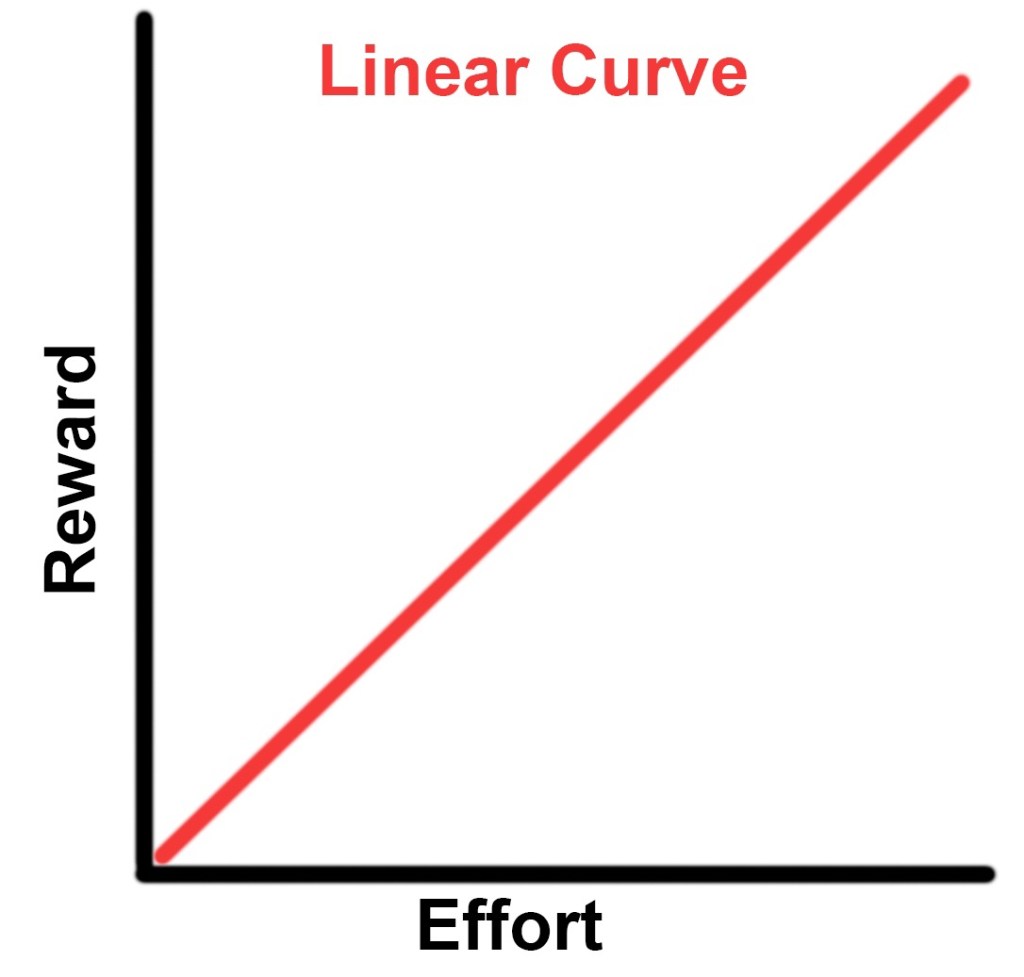
Most people assume the relationship between effort and reward is one-to-one. We think that working twice as long will produce twice the result. That caring about a relationship twice as much will make everyone feel twice as loved. That yelling your point twice as loud will make you twice as right.

The assumption here is that most of life exists on a linear curve, that there’s a one-to-one ratio between effort and reward with everything:

But allow me to inform you as someone who just tried drinking twice the normal amount of coffee so he could finish editing this damn thing—this is almost never true. Most of the world does not exist on a linear curve. Linear relationships only exist for mindless, rote, repetitive tasks—driving a car, filling out reams of paperwork, cleaning the bathroom, etc. In all of these cases, doing something for two hours will double the output of doing it for one hour. But that’s simply because they require no thought or ingenuity.

Most activities in life do not operate along the linear effort/reward curve because most activities in life are not basic nor mindless. Most activities are complex, mentally and/or emotionally taxing, and require adaptation.

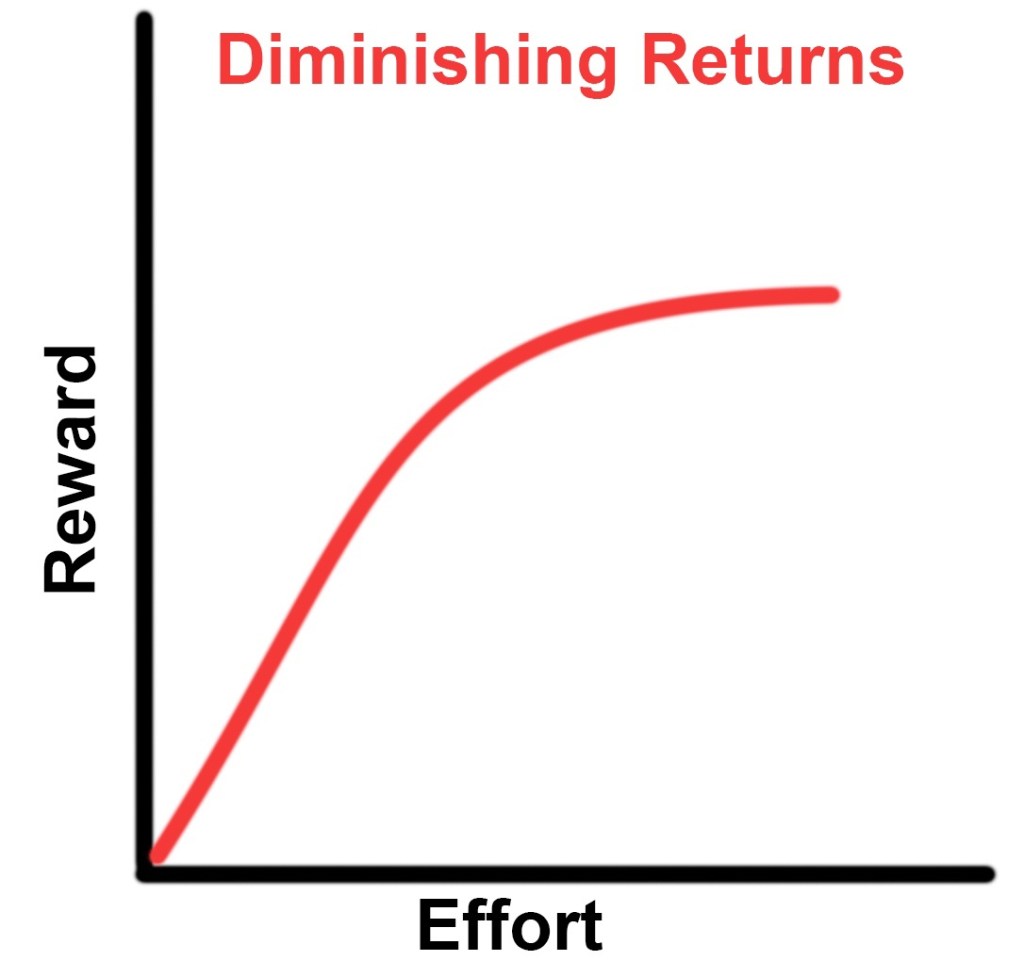
Therefore, most activities produce a diminishing returns curve:

Diminishing returns means that the more you experience something, the less rewarding it becomes. The classic example is money. The difference between earning €20,000 and €40,000 is huge and life-changing. The difference between earning €120,000 and €140,000 means your car has slightly nicer seat heaters. The difference between earning €127,020,000 and €127,040,000 is basically a rounding error on your tax return.

The concept of diminishing returns applies to most experiences that are complex and novel, and even many of the mundane ones. The number of showers you take in a day, the number of chicken wings you inhale during happy hour, the number of trips home to visit your mother in a year—these are all experiences that start out highly valuable at first but then diminish in value the more frequently you do them (sorry, Mum).

Another example: studies on work productivity show that we’re really only productive for the first four to five hours of each day. Everything after that suffers severely diminished returns, to the point where the difference between working for 12 hours and 16 hours is basically nothing (not counting sleep deprivation).

Friendships operate on a diminishing returns curve. Having one friend is vital. Having two is clearly better than one. But having 10 instead of 9 changes little in your life. And having 21 instead of 20 just makes remembering people’s names that much more difficult.

Sex has diminishing returns, as does eating, sleeping, drinking alcohol, working out at the gym, reading books, taking vacations, hiring employees, consuming caffeine, saving for retirement, scheduling business meetings, studying for an exam, masturbating, staying up late to play video games, the examples are endless. All give back less the more you do them, the more you try, or the more you have. All operate on a diminishing returns curve.

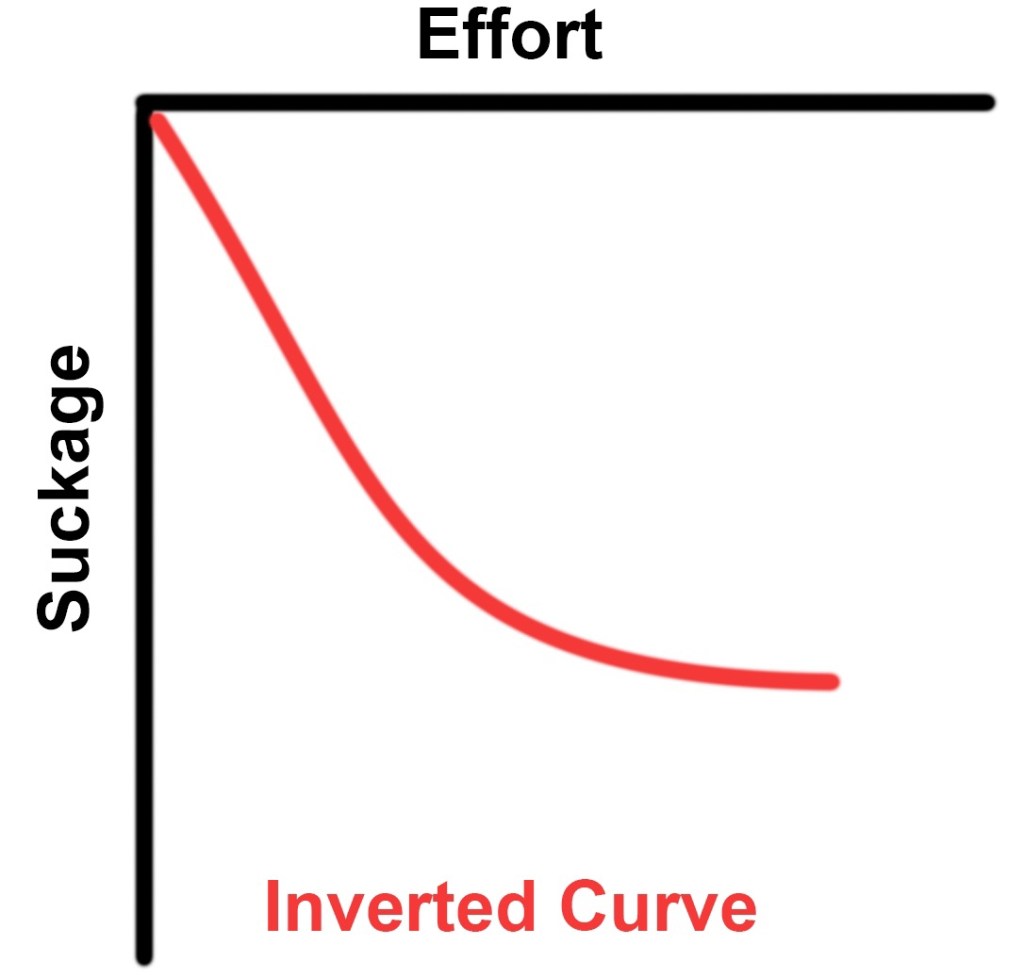
But there’s another curve, one that you’ve probably never seen or heard of before and that’s largely because I make a lot of this fucking shit up. That’s the inverted curve (yes I know, sounds sexy right):

The inverted curve is the bizarro “Twilight Zone” curve, where effort and reward have a negative correlation—that is, the more effort you put into doing something, the more you will fail to do it.

Drown proofing exists on an inverted curve. The more effort you put into rising to the surface, the more likely you will be to fail at it. Similarly, the more you want to breathe, the more likely you are to choke on a bunch of chlorinated piss water.

But I know you’re thinking, “So what, Lee? I’ve usually had too many piña coladas to even find the deep end of the pool, much less bind my arms and legs and try to survive in it. Who gives a shit about inverted curves?”

It’s true, few things in life function on an inverted curve. But the few things that do are extremely important. In fact, I will argue that the most important experiences and goals in life all exist on an inverted curve.

Effort and reward have a linear relationship when the action is mindless and simple. Effort and reward have a diminishing returns relationship when the action is complex and multivariate.

But when the action becomes purely psychological, an experience that exists solely within our own consciousness, the relationship between effort and reward becomes inverted.

Pursuing happiness takes you further away from it. Attempts at greater emotional control only remove us from it. The desire for greater freedom is often what causes us to feel trapped. The need to be loved prevents us from loving and accepting ourselves.

Aldous Huxley once wrote, “The harder we try with the conscious will to do something, the less we shall succeed. Proficiency and results come only to those who have learned the paradoxical art of doing and not doing, or combining relaxation with activity.”

The most fundamental components of our psychology are paradoxial. This is because when we consciously try to create a state of mind, the desire for that state of mind creates a different and often opposite state of mind from the one we’re trying to create.

This is “The Backwards Law” I explained in earlier blogs, but in a nutshell for all you shitheads who didn’t read it is this: desiring a positive experience is itself a negative experience, accepting a negative experience is a positive experience.

But this extends to most–if not all–aspects of our mental health and relationships:

• Control – The more we strive to control our emotions and impulses, the more powerless we will feel. Our emotional life is unruly and often uncontrollable, and it’s the desire to control it that makes it worse. Conversely, the more we accept our feelings and impulses, the more we’re able to direct and process them.

• Freedom – The constant desire for freedom ironically limits us in a number of ways. Similarly, it’s only by limiting ourselves–by choosing and committing to certain things in life–that we truly exercise our freedom.

• Happiness – trying to be happy, makes us less happy. Accepting unhappiness makes us happy.

• Security – Trying to make ourselves feel as secure as possible generates more insecurity. Being comfortable with uncertainty is what allows us to feel secure.

• Love – The more we try to make others love and accept us, the less they will, and more importantly, the less we will love and accept ourselves.

• Respect – The more we demand respect from others, the less they will respect us. The more we ourselves respect others, the more they will come to respect us.

• Trust – The more we try to make people trust us, the less inclined they will be to do so. The more we trust others, the more they will trust us in return.

• Confidence – The more we try to feel confident, the more insecurity and anxiety we will create. The more we accept our faults, the more comfortable we will feel in our own skin.

• Change – The more we desperately want to change ourselves, the more we will always feel as though we are not enough. Whereas, the more we accept ourselves, the more we will grow and evolve because we’ll be too busy actually doing cool shit to notice.

• Meaning – The more we pursue a deeper meaning or purpose of our lives, the more self-obsessed and shallow we will become. The more we try to add meaning to others’ lives, the more profound impact we will feel.

These internal, psychological experiences exist on an inverted curve because they are both the cause and the effect of the same thing: our minds. When you desire happiness, your mind is simultaneously the thing that is desiring and the target of its own desires.

When it comes to these lofty, abstract, existential goals, our minds are like a dog who, after a lifetime of successfully chasing and catching various small creatures, has turned and decided to exact that same strategy on its own tail. To the dog, this seems logical. After all, chasing has led her to catch everything else in her doggy life. Why not her tail, too?

But a dog can never catch her own tail. The more she chases, the more her tail seems to run away. That’s because the dog lacks the perspective to realise that she and the tail are the exact same thing.

The goal is to take your mind—a wonderful thing that has spent its life learning to chase various creatures and teach it to stop chasing its own tail. To stop chasing meaning and freedom and happiness because those only serve to move it further away from itself. To teach it to achieve what it desires by giving up what it desires. To show it how the only way to reach the surface is to let itself sink.

And how do we do this? By letting go. By giving up. By surrendering. Not out of weakness. But out of a respect that the world is beyond our grasp. By recognising that we are fragile and limited and but temporary specks in the infinite reaches of time. You do it by relinquishing control, not because you feel powerless, but because you are powerful. Because you decide to let go of things that are beyond your control. You decide to accept that sometimes, people won’t like you, that often you will fail, that usually you have no fucking clue what you’re doing.

You lean into the fear and uncertainty, and just when you think you’re going to drown, just as you reach the bottom, it will launch you back to your salvation. When it does launch you back, make sure its to your closest coffee shop to grab the sweet nectar of the gods, a freshly brewed coffee, life seems a hell of a lot simpler then.

Mental Health Pt 2

Everyone has heard of therapy in some form or another, but a lot of people don’t have a clear idea of what it is or what they’re getting into. One stereotype is that you lay on a couch and cry like a child. Another is that it’s just some guy who prescribes you pills. Another is that it’s some guy who shows you ink blots and asks you what you see (boobs, I always see boobs). As with many things, these are caricatures created by pop culture for entertainment purposes. Most therapy is far duller and far more personal than this.

WHAT IS THERAPY?

The idea behind therapy is that most of our decision making comes from unconscious aspects of our mind. As long as these parts of our mind are unconscious, we’re unable to exercise control over them.

The primary purpose of therapy is to help us become aware of these sections of our unconscious, accept them, and then begin exerting control over them. This is how you generally learn to take care of your daily mental health.

The primary purpose of therapy is to help us become aware of the unconscious parts of our mind, accept them, and then begin exerting control over them.

This form of therapy where the therapist helps you uncover the unconscious is common and looks something like this in real life:

You get uncontrollably angry when your significant other doesn’t call back. The culprit is something buried within your unconscious which is causing you to react in such an irrational manner.

By attending therapy, you can start digging into the past, your emotional development, traumas, life problems, childhood, and find the trigger. Maybe your mother made a habit of leaving you behind when you were most vulnerable. Perhaps your past relationships involved someone cheating on you repeatedly or they were rarely available. Whatever.

Once uncovered, then you can process the anger and the hurt in a safe environment. This will then allow you to become more aware of the anger and therefore not feel so powerless when these outbursts occur. Eventually, you should be able to exert enough control over your emotion to modify your behaviour.

Another popular form of therapy is Cognitive-Behavioural Therapy (CBT). CBT is useful for changing specific habits or thought patterns, particularly those related to anxiety and depression. CBT focuses more on observing your thoughts and how they lead to behaviours rather than unconscious emotions.

Both forms of therapy have their own strengths and weaknesses. Both are quite effective depending on the issue.

PROBLEMS WITH THERAPY

There are a lot of criticisms of therapy, and although most of them are made by people who have never actually attended therapy, some of them are legitimate. If you are considering therapy or are already in therapy, here are some things to watch out for:

PROFESSIONAL PILL PRESCRIBERS

People often mistake psychologists/therapists for psychiatrists. Psychiatrists prescribe medications and specialise in mental illnesses. Psychologists (generally) do not. Unfortunately, the reputation has developed that ALL therapy consists of, whether by a psychologist or psychiatrist, is a queue to get easy drugs.

Unfortunately, this is true for some practitioners. Unless you believe you suffer from a mental illness, I would recommend you see a therapist/psychologist and only pursue medication if therapy seems ineffective over an extended period of time. Many people go straight to a psychiatrist who then hands them anti-depressants or some other pill like it’s candy.

BECOMING A COUCH POTATO

Many people attend therapy with the expectation that they go sit in a comfy chair and the therapist will magically fix them. Sometimes they even get frustrated when

“nothing happens” in their therapy sessions, when in actuality they’re hardly participating in them.

Therapy is a participatory activity. In fact, I would argue that if therapy is going well, it’s because you are doing 80% of the work.

You should approach it with the attitude that you are there to work on yourself and the therapist is there to facilitate and give you a push in the right direction. See them as a personal trainer for your mind and emotions. You’re still doing all of the heavy lifting, but they’re there to spot, encourage, and direct you. If you aren’t willing to do the work, then they can’t do anything to help.

THE NEVER-ENDING THERAPY

Therapy is still subject to the Law of self help: You can judge the usefulness of any self-help tool by how many people are leaving it. If people are leaving it, it works. If people are staying, then it’s not working.

Many people leave therapy with success stories (myself included), but many people stay for years and years with little to show for it.

Many people fall into comfortable patterns with their therapists. In the beginning, they may uncover some major issues and make some big changes, but eventually, the therapist won’t be able to offer a new perspective, the patient will come in every week or month for years on end, they will discuss the same topics, and they will enter into a loop of patient shares problems, therapist validates problems, patient feels better about problems and leaves, comes back later with similar (or the same) problems.

Don’t fall into the trap of paying someone to validate your issues. It’s tempting and it’s easy to do, both for you and for your therapist. But don’t do it.

Therapy should feel a little uncomfortable. It should challenge you. It should make you think about your life from new perspectives. It shouldn’t feel good all the time. If it ever becomes repetitive, then it may be time to get out and find a new therapist or try something else.

THE EASY HIRE

Another problem people have is that they are not selective with the therapist they hire. You should treat this step of the process seriously, as if you’re interviewing people for a job opening in your life.

Most therapists offer free consultation sessions where you can meet them, get to know them, and describe your problems to them. There will be some therapists you naturally click with and others you don’t. Some therapists will be able to relate to your problems personally, others won’t.

When I sought out a therapist, I purposefully found a younger male who used to party a lot and was a musician. I felt like he could relate to me and where I was in my life. Things went really well.

Maybe you need someone who will make you feel uncomfortable, someone who will challenge you and won’t put up with your bullshit. Whatever your case may be, take a moment to consider what type of therapist could best relate to your issues and help you, and seek them out.

Hiring a therapist is a large commitment, so take it seriously.

SIX SIGNS THAT YOU NEED THERAPY

I’ve actually referred a lot of people to therapy over the years. Many have ignored it (especially men…). Some have gone. A few have come back and thanked me for recommending it to them. It’s hard to say for sure who needs it and who doesn’t.

Therapy is one of those tricky things, like most self-development tools, because it’s rarely ever a bad thing to do. One could argue that everyone needs therapy in some form or another or for some period of time.

But I would only recommend it if you feel you aren’t able to handle your emotional issues and have tried on your own for a while.

Here are six signs that you may need therapy:

SIGN 1: IMPULSES

All of us struggle with impulses from time to time (that chocolate cake is just begging to be devoured). Some of us are more successful than others at resisting them. If you find  yourself regularly succumbing to impulses, you may want to consider therapy.

The most common impulses people succumb to are emotional—angry outbursts, bouts of depression, etc.—and sexual—fear of intimacy, sexual anxiety, etc. Having little to no control over these impulses can be a major obstacle to living a functional life, not to mention a happy and healthy one.

SIGN 2: DIFFICULT CHILDHOOD

The influence of childhood experiences on our thoughts, emotions, and actions as an adult cannot be overstated. What makes it worse is that we’re usually not aware of them—they reside in the unconscious parts of our mind.

Many people, including myself in the past, go about their lives completely unaware of attachment issues that result from not receiving enough love and affection from their parents as a child. You may know someone who just can’t seem to get their finances in control, unaware that they’ve been influenced by their parents’ reckless ways with money all those years ago.

Unfortunately, when it comes to mental inclinations, the apple rarely falls far from the tree unless you’ve developed the ability to self-reflect and act against your tendencies. And few people do.

So if you come from a difficult childhood, if you had absent parents or a poor relationship with them, you may be suffering the after-effects without knowing.

SIGN 3: MAJOR TRAUMAS

I probably don’t have to convince you that traumas are a big deal, and it never hurts to get help to deal with them. Major traumas in life could be the death of loved ones, abuse, major health problems, etc.

Even if you think you’re perfectly fine, chances are you’re psychologically suffering in one way or another without knowing it. Getting therapy could help you uncover these blind spots and truly turn the page.

SIGN 4: COMPULSIVE BEHAVIOURS

We all succumb to vices from time to time. These vices in moderate amounts on occasion don’t necessarily hurt—that ice cold beer at the end of a long working day, that chocolate cake we finally devour.

However, in some cases the vices become compulsive behaviours and begin to interfere with other areas of your life, the most common ones being alcohol and drug abuse.Similarly to the emotional and sexual impulses I mentioned above, these compulsive behaviours do you no favours and will thoroughly derail your life. Seek help.

SIGN 5: DYSFUNCTIONAL RELATIONSHIPS

Humans are social animals, so it should come as no surprise that having dysfunctionalrelationships has an outsized impact on your quality of life.

The sad truth is that many, if not the majority, of us have at least one dysfunctional relationship and are simply putting up with it, thinking it’s part and parcel of life. This is the wrong approach.

Always fighting with your other half over pointless things like duvet sets or pillow cases? Always guilt-tripped into visiting your aging parents? Always getting blamed for mistakes at work? Always saying “yes” to your best friend’s never-ending requests? These are tell-tale signs of unhealthy and, in some cases, dysfunctional relationships.

Tolerate them, you should not.

SIGN 6: OBSESSION

Some of us are overly pre-occupied with one aspect of our lives. Joe next door is obsessed with being “cool” or popular. Your aunt is obsessed with impressing everyone at family gatherings. Your partner has a constant need for approval from others and is always looking for that pat on the back from you for every little thing they do. Hell, maybe even you yourself are obsessing about improving yourself (you are reading this article after all). Don’t get me wrong, I’m all for self improvement But sometimes this devolves into feeling like you’re never good enough and mindlessly executing self help hacks which you can probably tell is not a bueno idea.

In the end, therapy is nothing to be ashamed of. In fact, it could be the difference between a healthy and happy life and a life full of agonising crapfests. I prefer the former myself.

WHAT IS MENTAL HEALTH?

For the vast majority of modern medical history, “health” was basically defined as the absence of disease. If you weren’t sick, you were healthy. Mental health was treated the same way: if you weren’t a fucking crazy loon, then you were considered mentally healthy.

But as medicine and psychology advanced, it became clear that our mental health included a wider range of emotional and social factors that don’t necessarily have much to do with mental illness. Mental health became more closely associated with well-being across all domains of our lives—both personally (psychological, emotional, cognitive, etc.) and interpersonally (community and family, romantic relationships, professional fulfilment, etc.).

Our mental health affects our everyday lives, influencing how we respond to stress, how we make decisions, how we interact with others, our sense of fulfillments and purpose in the world, and on and on.

It’s important, then, that we take a step back and really think about our mental health in holistic terms like this, not just as a lack of mental disorder.

FACTORS THAT AFFECT YOUR MENTAL HEALTH

GENETICS

Studies have found that our genes play a significant role in our mental health and well-being. Your baseline level of happiness, for instance, is about 50% determined by your genes. If mom and dad were grumpy assholes, well you’ll probably have a tendency to be a grumpy asshole too.

And, of course, if a close relative of yours has a mental disorder, then you’re also at a higher risk for mental illness as well.

Now, before you start thinking that this sounds a bit too fatalistic, a significant portion of your mental health is also influenced by environmental factors that you can control.

You might be predisposed to anxiety, but you can take steps to lessen the impact of your anxiety on your life. You can work with a therapist to identify the things that make you anxious and learn coping strategies that help you deal with your anxiety on a day-to-day basis. You can read books and meditate and tap your forehead and chant mantras, or whatever the fuck the kids do these days. The point is: you can actively minimise your anxiety despite your genetics.3

LIFE EXPERIENCES AND TRAUMA

Here’s a shocker: intense negative experiences and trauma can mess you up.

Having nice things like a job you like, friends and family you can count on, and your health intact, you’re more likely to have good mental health. If you hate yourself, your life and the people in it, well, then your mental health is going to suffer.

Some degree of trauma is unavoidable. We all get screwed in one way or another. Research suggests that virtually everyone experiences at least four or five traumatic experiences in their life. This could include everything from losing a job, to losing a loved one, health scares, or, in severe cases, physical and psychological abuse.

The time at which we experience trauma can also influence how big of an impact it has on us. Trauma experienced early in life has a bigger chance of causing problems throughout our lives.5 But trauma as an adult can have a severe effect as well.

But here’s the thing: trauma, while terrible, doesn’t have to fuck us up so bad for so long. In fact, most people don’t see their mental health suffer due to trauma. In fact, for most people, it turns out trauma can give us an opportunity to grow as individuals.

HOW TO IMPROVE YOUR MENTAL HEALTH

Below are just a few guidelines to get you to a place where you can manage your mental health more confidently if you often feel out of place, unfulfilled, or like something is “missing” and it causes you some degree of distress at times.

Note, however, that I’m not a therapist and if you or someone you know is struggling with a mental illness, you need to seek help from a licensed healthcare professional (more on that later).

CREATE DEEPER SOCIAL CONNECTIONS

One of the best predictors of good mental health is having a solid social network. Money, sex, prestige, status—all of that will only give your mood a short-lived boost. Soon enough, you’ll be back to being the miserable fuck you were. Trust me: do not chase sources of external validation to fill some sort of void you’re feeling. Been there, done that. Got the vomit stains to prove it.

Instead, knowing that you have just a few people—or even one person—you can turn to when shit gets real gives you a social and psychological safety net. The thing is, relationships like these have to be cultivated and fostered over time.

You do this by sharing yourself with others honestly and with vulnerability, This will turn some people off, but that’s okay. You don’t need to make friends with everyone. When it comes to relationships, always strive for quality over quantity.

The people who do respond positively to your honest expression are the people you can start to build your “tribe” with.

DEVELOP HEALTHY LIFESTYLE HABITS

Look, I know everyone “knows” they should take better care of their bodies, but most of us (myself included) are still pretty terrible about it. And it’s arguably even more important if you’re trying to improve your mental health.

Your mental health will almost always benefit from incorporating healthy lifestyle habits into your day. The whole “mind-body” connection, after all, is only a thing because the brain is a part of the body. So taking care of your body means you’re taking care of your brain too.

The big areas to really, actually, like for real focus on are:

GET SOME SLEEP

Seriously. The medical field has finally woken up (pun intended) to the fact that it’s not just a “good idea” to get a solid eight hours of sleep—it’s absolutely critical for your health.

Sleep-deprived people who regularly get less than 7-8 hours of sleep per night are not only more irritable and less focused, they also show a lot of the hallmark signs of depression and anxiety. A few nights of bad sleep here and there are inevitable, but if you haven’t slept well in years or even a decade or more, it will have outsized effects across your entire life.

Get into a regular sleep routine, limit/eliminate your caffeine and alcohol consumption, and turn the screens off at night.

If you have real trouble sleeping, see a doctor. It might be as simple as figuring out a new routine or you might need more intervention. Either way, it’s worth it.

Solid sleep will also make all the following healthy habits that much easier because, well, you won’t be so damn tired and burnt out when it comes time to do them.

So onward.

EXERCISE

I probably don’t need to tell you that regular exercise has all sorts of health benefits and makes you feel better and blah blah blah… I’m not going to tell you that exercise is a cure-all for any mental health issues you might be having, but it can definitely start to push your body and mind in the right direction.

A short walk can boost your energy levels when you’re dragging a bit, giving you the extra nudge you need to get some work done or get through a setback in your day. Nearly all forms of exercise help relieve stress, especially things like martial arts.

The key is to find exercise that 1) you enjoy and 2) fits into your life. You don’t have to spend hours in a gym to get the benefits of exercise and you don’t have to go completely out of your way to do it either. Daily walks/jogs or simple stretches and calisthenics are often enough to get you the boost you need to work on your mental health.

Once you get into a habit of exercising, you can optimise from there.

HEALTHY EATING

Good sleep and regular exercise provide your mind and body a better starting point from which to manage your mental health on a day-to-day basis. Healthy eating habits will help fuel you from there.

Honestly, I’m not the best person to ask for nutritional information, but I will say this: whenever I’ve been on a streak of indulgent eating and drinking, my mental health takes a hit. I’m more tired, I start to feel uneasy, and I find it way easier to slide into bad habits from there, starting a vicious cycle that gets harder and harder to get out of.

There is no need to get complicated with this. In fact, keeping it dead simple and sticking to the basics will make it way more likely that you maintain a healthy diet. So, lean meats (if you eat meat), fruits, and vegetables should make up the vast majority of your diet. Limit fat and carbs, including sugar.

MEDITATE

Briefly, in terms of helping your mental health, meditation can help you identify toxic thought patterns and examine them more closely. It gets you more in tune with your body as well as your self-talk. It can help you slow down and think—really think—and be more present while being less attached to the daily ups and downs of life.

There are literally millions of resources to help you meditate. A few I like are apps like calm and headspace. The neuroscientist and famous podcaster Sam Harris also offers a guided course on his app, Waking Up, as well.

SPEND TIME IN NATURE

Outdoor enthusiasts have long touted the health benefits of being in nature, both physical and mental. But scientists—being scientists—thought they needed to run fancy studies with control groups and write really nerdy articles with graphs and tables and overly complicated English.

Their conclusion: yep, the enthusiasts were right. Spending time in nature does benefit your mental and physical well-being.

Thanks, scientists.

Seriously though, they’ve found that about two hours per week in nature produced measurably better reports of health and well-being. It doesn’t have to be all at once either. It could be as simple as going on a walk through a park near your house (double gold star for combining with exercise) a few times a week.

Whatever it is, nature just has a calming effect on people, especially those of us who spend all of our time in bustling, noisy city environments.

For me, it gives me a better sense of the scale of everything—my life, my problems, etc. You realise you’re a part of something that’s much bigger than yourself, something that will be here long after you’re gone. For a few moments, when I’m in nature, I feel like I can connect with whatever that something is. And it has a way of making all my problems seem smaller.

GET PROFESSIONAL HELP

There is no magical cure-all for your mental health. But even small changes in the areas I’ve outlined so far can help tremendously.

Even then, you might still feel like you need some outside help. If so, I encourage you to give therapy a try while you continue to develop a healthier lifestyle.

Therapy, too, is not a cure-all for whatever you’re going through, but it can be an effective tool in getting you to a place where you can better manage your mental health.

With all that being said, one thing I cannot stress enough is, drink your damn coffee 😏

Procrastination

It’s ironic, but for two days now, I’ve been procrastinating writing a post on procrastination. I’ve done it all. I’ve distracted myself with other, less important work. I’ve taken “breaks” that extended about three hours longer than they should have. I’ve done that thing where I sit on Facebook and then I close the window, open a new one, and instinctively type in Facebook again.

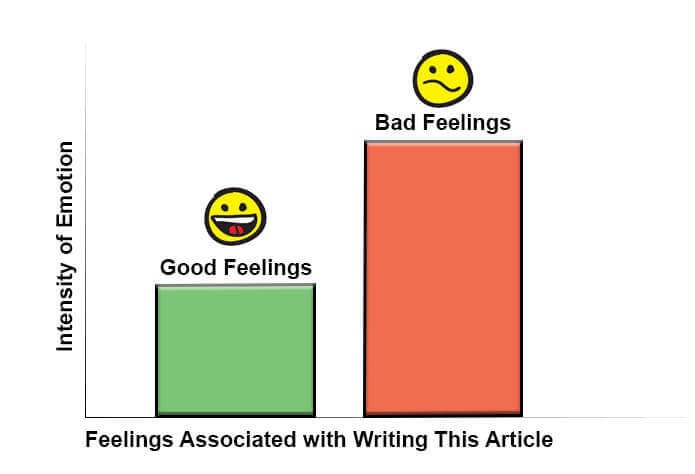
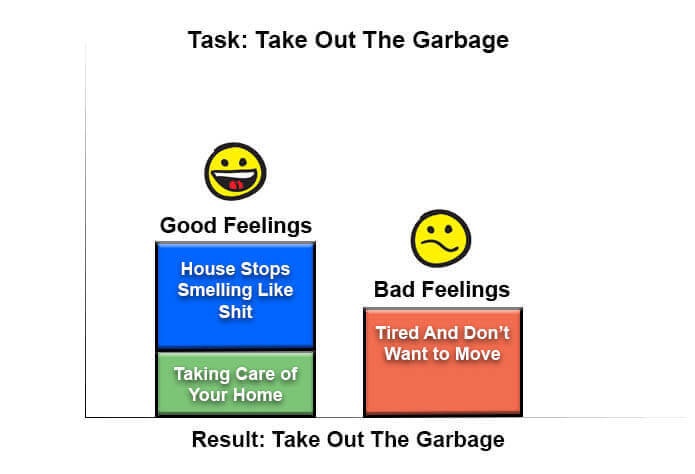
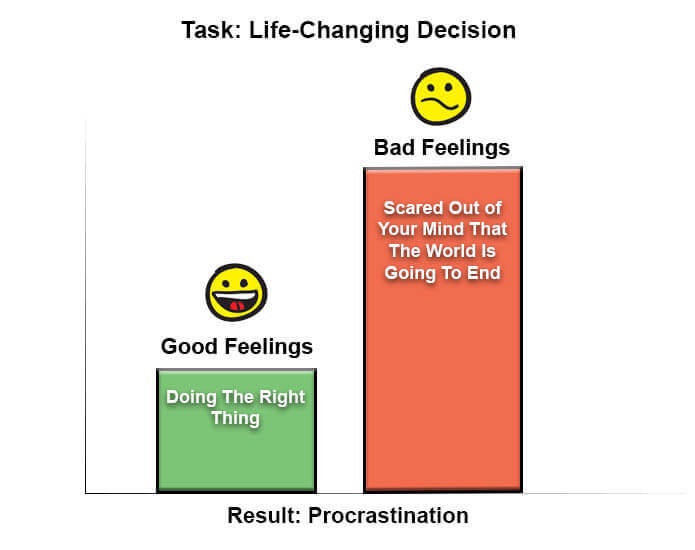
If I were to graph out the process of my own procrastination it would look something like this:

The red bar includes all of the negative feelings associated with getting off my fat ass and doing something productive. Things such as lack of sleep, mental fatigue, being distracted by a few personal problems going on, the uncertainty surrounding whether what I write will be any good or not, insecurity that people may hate it, that they’ll call me bad names and make disparaging comments about my mother, etc.

The green bar includes all of the positive feelings associated with writing this bad boy. Feelings such as the pleasure of productivity, the relief of knowing it’s done, the chuckles I get writing the inevitable poop jokes that are to come, knowing that I helped people out , the simple pleasure of writing, and so on.

As you can see though, the red bar—the total of all the negative feelings—is higher than the green bar—the total of all the positive feelings. Therefore, I just don’t write a fucking thing. I sit on Youtube, then instagram, then take a nap, then spend way longer than I’d like to admit figuring out how to make an ugly bar graph with smiley faces on it.

And instead of writing that life-changing, pants-pooping, mother-hollering, epiphanic psycho-spiritual orgy of life advice that I promised, I sit here, analyzing my own laziness.

But such is being human.

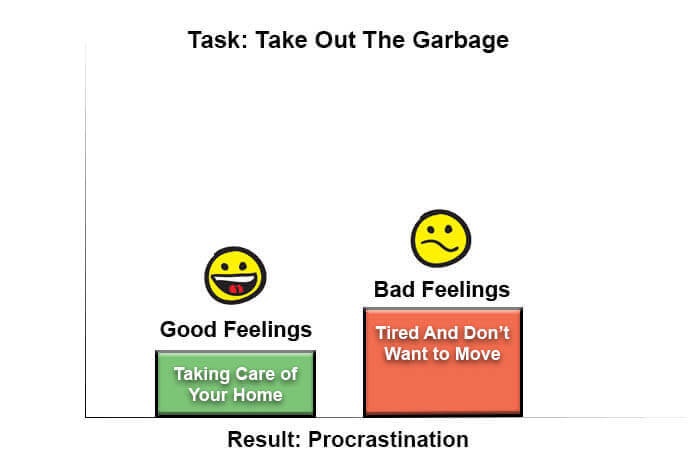
The model above is simplistic but it essentially explains why we often don’t do the things that we should. That raise you never ask for. That attractive person you never ask out. That mother you always forget to call. The article you don’t bother to write. The unpleasant feelings outweigh the pleasant ones in the short-term, and so we avoid the unpleasantness, even if we’re making our lives worse in the process.2

It often isn’t until the 11th hour, until the night before, until someone is screaming at you or the threat of complete and utter failure is breathing down your neck, that the equation finally shifts, the pressure becomes too much and the associated positive feelings of doing said action outweigh the negative ones.3 It becomes more painful not to do something than it does to do it, and that’s when the bastard finally gets done.

YOUR TYPICAL WAYS TO BEAT PROCRASTINATION

There are a couple strategies that “trick” your brain into doing something it doesn’t really want to do.

One is by creating what’s sometimes referred to as “an environment of inevitability.” Basically what that means is that you create an environment where it’s more difficult not to do something than to do it.

For example, if you want to lose weight, you can go buy €500 worth of personal training and schedule classes for the next 10 weeks. Now the pain of wasting €500 and not showing up for the classes will outweigh the pain of getting off your ass and going to the gym.

I basically got through college by forcing myself to go to the library every day. I discovered that if I was there, I would inevitably end up studying. If I just went home, I would fuck off all week.

Another common strategy for beating procrastination is what people call “The do something principle.” The Do Something Principle basically says that if you want to do something—anything—then you just start with the simplest component of that task.

I was procrastinating writing this article, so I just told myself that I’d open up a blank document and write the first sentence. Strangely, once you bring yourself to write one sentence, the next 40 get quite easy.

Same goes for the gym example. Just tell yourself to put on your gym clothes. That’s easy. Then once your gym clothes are on, you feel like a moron if you don’t go work out. So you work out.

The “Do Something” Principle takes advantage of the fact that action is both the cause of motivation as well as the effect of motivation. And once you take one small, simple action, there’s a momentum that builds inside you, making the rest easier.

But, while these strategies are all sexy and make you want to rub your nipples with cocoa butter, they don’t get at the root of your procrastination problems.

Don’t start rubbing your nipples just yet, your procrastination problems still aren’t solved. These are like the band-aid solutions. They get you through to the next day, but they don’t solve a lifetime of laziness. Because if you’re like most people, then you experience procrastination, over and over again. It’s incessant. And that’s because there’s a deeper issue underlying for why you procrastinate.

THE ROOT CAUSE OF PROCRASTINATION

So here’s the deal. When it’s something dumb and plain like taking out the rubbish, we all know why we procrastinate. Rubbish sucks. It smells bad. It’s annoying to pick it up and walk it outside. We’re lazy. And so on.

It usually isn’t until our garbage is overflowing and spreading the sweet stench of rotting flesh throughout our house that we finally feel motivated enough to do something about it.

But what about the serious and sometimes personal stuff on which we procrastinate? Applying for that job, breaking up with your boyfriend, Starting a web business. Writing your master’s thesis. Telling your girlfriend you have herpes

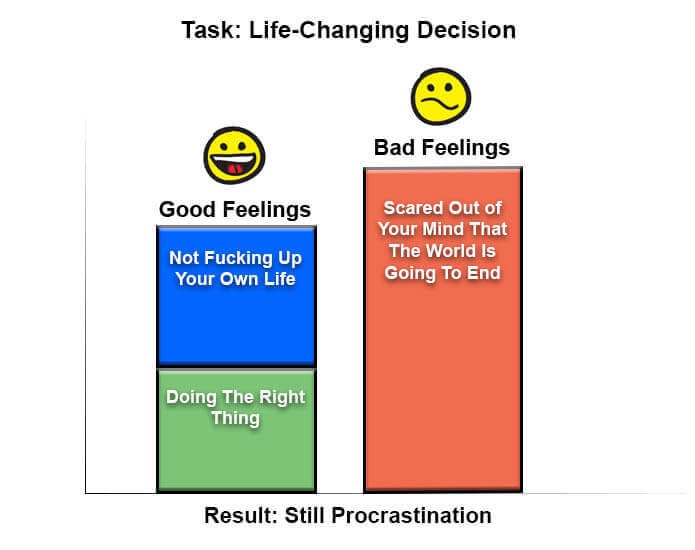
These are deeply emotional, stressful events. And as such, we go to extreme lengths to avoid them, procrastinating doing them for days, weeks, even months or years, even though we know they’re best for us. We feel permanently stuck.

“Oh, I’ll go back and finish my degree one day,”—goes on and on and tortures us, yet the red and green bars never rebalance to where we’re able to do it. This is due to the fact that underlying our worst procrastination is a deep underlying fear that doesn’t go away. Maybe it’s a fear of failure. Maybe it’s a fear of success. Maybe it’s a fear of vulnerability. Or maybe it’s a fear of hurting someone else.

But there’s always a fear behind it, and that’s why you procrastinate. Procrastination, when not rooted in some petty displeasure, when debilitating and life-destroying and hair-greying in its intensity, is always rooted in some form of fear.

But where does this fear come from?

Conroy’s Law of Avoidance

Chances are you’ve heard of Parkinson’s Law, It says that “work expands so as to fill up the time available for its completion.” So whether you’re given two weeks or two days to finish a project, you’ll feel like you need all of the time given to you.

You’ve also undoubtedly heard of Murphys Law the immortal, “Whatever can go wrong, will go wrong.”

Well, next time you’re at a swanky cocktail party and you want to impress somebody, try dropping Conroy’s Law of Avoidance on them. What? Never heard of Conroy’s Law? Of course you haven’t, I just made it up. Check it out:

The more something threatens you, the more you will avoid doing it.

That means that the more something threatens to change how you view yourself, how you believe yourself to be, the more you will procrastinate ever getting around to doing it.

The crazy thing about Conroy’s Law is that it can apply to both good and bad things in one’s life. Making a million euro can threaten your identity just as much as losing all your money. Becoming a famous rock star can threaten your identity just as much as losing your job. This is why people are often so afraid of success—for the exact same reason they’re afraid of failure—it threatens who they are and what they know now.

You avoid writing that screenplay you’ve always dreamt of because that would call into question your identity as a practical insurance adjuster. You avoid talking to your husband about being more adventurous in the bedroom because that would challenge your identity as a good, moral woman. You avoid telling your friend you don’t want to see them anymore because that would conflict with your identity as a nice, forgiving person.

These are good, important decisions that we consistently pass up because they threaten to change how we view and feel about ourselves. It sounds insane, but it’s true.

I had a friend who, for the longest time, talked about putting his artwork online and making a go of it as a professional (or at least semi-professional) artist. He talked about it for years. He saved up money. He even built a few websites and uploaded his portfolio.

But he never launched. There was always some reason. The resolution of his work wasn’t good enough. Or he had just painted something better. Or he wasn’t in a position to dedicate enough time to it yet. Years passed and he never did it. Why? Because despite dreaming it, the reality of being an artist threatened his non-artist, non-vulnerable identity.

I had another friend who was a party guy, always chasing after the girls. Yet, after years of living the “high life,” he was terribly lonely, depressed, and unhealthy. He wanted to give it up. He spoke with a fierce jealousy of those of us who were in relationships and more “settled down” than him. Yet he never gave it up. For years he went on, empty night after empty night, bottle after bottle. Always some excuse. Always some reason he couldn’t slow down. It threatened his identity too much. The Party Guy was all he knew. To give it up was tantamount to psychological harakiri.

We all have a set of beliefs about who we are. Generally speaking, we protect these beliefs. So if I believe I’m a nice guy, I will avoid situations that could potentially contradict that belief. If I believe that I’m an awesome cook, then I will seek out opportunities to prove that to myself over and over again.

Generally, the hardest things for us to do in life are full of emotional resistance. Whether it’s putting in the time to study and make good grades, or finally moving away from our hometown, or shutting up and starting to write that idea that we’re always telling people about, we avoid these things because in some way they threaten to contradict the beliefs we have about ourselves. The kid doesn’t study because she believes herself to be a rebel and a loner. The man doesn’t leave his hometown because he secretly believes he’s not good enough to be successful anywhere else. The woman never sits down to write the book because ironically, the possibility of failure would threaten her belief that she’s smart and capable of anything.

If you believe you are only good at video games, then you will avoid anything that doesn’t involve video games.

The belief always takes precedence. Until we change how we view ourselves, what we believe we are and what we are not, we cannot adopt the decisions and behaviours we spend so much time avoiding.

THE SUBTLE DANGER OF POSITIVE THINKING

There’s something funny that happens to me when I write these blogs. The more I think about how amazing the article I’m going to write is going to be, the more I procrastinate and the harder it is to write it.

Conversely, when I stop caring whether the article is great or not, the article feels as though it “writes itself” and it usually turns out great.

Chances are you’ve experienced this in some area of your life as well. The more you care about the outcome, the harder it feels to achieve. The less you care, the more naturally it comes to you.

It’s backward in a way. The more I try to convince myself that I’m a brilliant writer and that I have something important to say, the more the simple act of writing an article threatens my identity, and the more I procrastinate writing it.

Whereas if I just believe that I’m just some random dude who puts words on paper, eventually the act of writing then threatens nothing and procrastination stops. This is one (of many) ways that positive thinking can derail us. Most people’s approach to deep-seated procrastination is to give themselves a lot of positive self-talk:

“Come on, you can do this. You’re so smart. You’re amazing. You can do anything you want to do.”

But the more you talk yourself up like this, the more you attach your identity to superlatives like being the “smartest” and “most amazing,” the more any action has the ability to threaten that belief.

And because it threatens your newfound belief of being this amazing, perfect little snowflake, you’re less likely to actually go do it than you were before.

THE SOLUTION: KILL YOURSELF (FIGURATIVELY, OF COURSE)

In Buddhism, there’s a strong emphasis on letting go of the concept that we even exist at all.

What this means is that, psychologically speaking, your idea of who “you” are is constructed throughout your life with a bunch of arbitrary stuff. Buddhism argues that this stuff actually just traps you and that you’re better off just letting go of it.

It sounds wonky, but there are some psychological benefits to this. When we let go of the stories we tell about ourselves, to ourselves, we free ourselves up to actually act (and fail) and grow. When the wife admits to herself, “You know, maybe I’m not a great wife or good at relationships,” then she is suddenly free to act and end her bad marriage. She has no identity to protect.

When the student admits to himself, “You know, maybe I’m not a rebel, maybe I’m just scared,” then he is free to be ambitious again. He has no reason to feel threatened. When the insurance adjuster admits to himself, “You know, maybe there’s nothing unique or special about my dreams or my job,” then he’s free to give that screenplay an honest go and see what happens.

Because I have some good news and bad news for you: there’s very little special about you or your problems.

My recommendation:

redefine yourself in mundane and broad ways. Choose to see yourself not as this rising star or unheard genius. Choose to see yourself not as some horrible victim or dismal failure. Instead, see yourself as just a few simple things: a student, a partner, a friend, a creator.

This often means giving up some grandiose and pleasant ideas about yourself: that you’re uniquely intelligent, or spectacularly talented, or intimidatingly attractive, or especially victimised in ways other people simply could never imagine.

We like telling ourselves these stories and giving ourselves these labels. They make us feel good. But they also hold us back.14

Define yourself in the simplest and most mundane ways possible. Because the narrower and rarer the identity you choose for yourself, the more everything will begin to threaten you. And with those threats will come the avoidance, the fear, and the procrastination of all of the things that really matter.

I hope you enjoyed this blog, It took me a lot longer to finish like I’ve stated 🙂

But do me a favour take in what I’ve said, learn from it and drink your damn coffee!

#liferules #lifecoach #psychology #procastination #energy #positivepsychology #wakeup #getyourshitdone #gettowork

Everything wrong with the self help industry!

The self-help industry is a multi-billion euro industry. It fills bookstores like easons up and conference rooms in hotels. It’s made media celebrities out of people and capitalised wildly off the growing self-consciousness of recent generations. And although it’s changed the lives of millions of people, mostly for the better, I assume, it still lacks a certain credibility with most. Many regard it as simple snake oil. Others laugh at the bizarre superstitions that get passed off as legitimate life advice. Many try self-help out but are left feeling disgruntled.

Clinical psychology doesn’t exactly have a stellar track record of personal change either, but at least when you lay down on the sofa you know you’re dealing with a qualified expert who is telling you what to do based on what I fucking hope is 100+ years of empirical research.

With self help, god only knows where half of these people come from. It’s a market driven, rather than a peer reviewed industry. The onus is on the reader to sift through the material and decide what’s credible and what’s fucking nonsense. And that’s not always easy to do.

The following are five major problems with the self-help industry today, and they’re unlikely to go away anytime soon.

1. SELF-HELP REINFORCES PERCEPTIONS OF INFERIORITY AND SHAME

Two types of people get hooked on self-help material: those who feel something is fundamentally wrong with them and they are willing to try anything to make it better, and those people who think they’re already generally a good person, but they have some problems and blind spots and want to become great people.

Call these the “Bad-to-OK” people and the “OK-to-Great” people. Bad-to-OK people are in it because they believe that they’re fundamentally flawed and want to fix themselves. OK-to-Great people are in it because they think they are OK, but they want to become great.

Generally speaking, the OK-to-Great people do just that — they go from having an average and “OK” life and turn it into something unique and great over the course of years.

The Bad-to-OK people improve little, if at all, even after years of “effort”. In some cases, they may even get worse.

OK, why?

Bad-to-OK people consistently fail because they possess a fundamental worldview that interprets everything they do, including self-help, to support their inferiority or lack of worthiness.

For example, an OK-to-Great person may read a book on becoming happy and think, “Oh, cool, there are a bunch of things in here that I’m not doing. I should try them out.”

A Bad-to-OK person will read the same book and say, “Wow, look at all of this stuff I’m not doing. I’m an even bigger loser than I initially thought.”

The fundamental difference is that Bad-to-OK lack self-acceptance that most people have. An OK-to-Great person will look at the string of bad choices and mistakes throughout their life and decide that they should make better choices and learn how to be a better person. A Bad-to-OK person will assume every choice they make is bad because they are a fundamentally flawed person and that the only way they can make good choices is by doing exactly what someone else says, word-for-word.

The irony here is that the pre-requisite for self-help to be effective is the one crucial thing that self-help cannot actually help: accept yourself as a good person who occasionally fucks up.

Sure, sit with your Chi, be still in the “now,” say your affirmations and journal until you’re blue in the face, but Bad-to-OK people will continue to perceive themselves as “Bad” and never reach the “OK” they’re desperately looking for. Because this inadequacy is their worldview, everything they do will only reinforce it further. At best, all they can hope for is to cover it up or suppress it.

2. SELF-HELP IS OFTEN YET ANOTHER FORM OF AVOIDANCE

People consciously perceive their problems in all sorts of unique and creative ways: I don’t know when to kiss her; my family and I always fight; I feel tired and lazy all the damn time, I can’t stop eating sweets; my dog hates me; my ex-girlfriend burnt my house down; and on and on.

These all feel like “real” problems. But in almost every situation, the root of the problem is actually some deep form of anxiety/neuroticism or an unconscious feeling of shame or unworthiness.

We already saw how self-help usually proves ineffectual in dealing with the shame.

Unfortunately, it often fails in handling the anxiety/neuroticism as well.

When someone with an inordinate amount of anxiety comes to self-help material, two things usually happen, and neither of them fix the problem.

• They simply replace one neuroticism with another, slightly healthier neuroticism — think someone who goes from being an alcoholic and unable to hold a job, to meditating and doing yoga five hours a day and still unable to hold a job.

• Or they use the self-help material as another form of avoidance. Dating advice is a classic example here — I don’t know how to ask out the person I like on a date, so I’ll read four books about it and feel like I did something. Suddenly reading the books feels far more important than actually asking the person out.

(This is also commonly known as analysis paralysis.)

3. SELF-HELP MARKETING CREATES UNREALISTIC EXPECTATIONS

Although theoretically, I have no issue with the profit motive in the self help industry, in practice it causes problems.

With the profit motive, the incentive is not on creating real change but creating the perception of real change.

This can be done with placebos, teaching clients to suppress certain negative feelings or to pump their temporary emotional states. It can be done by placating anxious people with more information and neurotics with more relaxation techniques. These all create short-term sensations of accomplishment and improvement, but almost always dissipate within a few days or weeks.

I’m sorry, but you’re not going to get over a lifetime of feeling inadequate or shame in a single damn weekend. You just aren’t. What will happen is you’ll feel better about that inadequacy and shame for a weekend and then it will come back again. With a bang!

4. SELF-HELP IS (USUALLY) NOT SCIENTIFICALLY VALIDATED

Here are the self-help practices which have been shown in scientific studies to have some validity: meditation or mindfulness, keeping a journal, stating what you’re grateful for each day, being charitable and giving to others.

Here’s where the science is hit and miss (it usually depends on how or why it is used): Neuro Linguistic Programming, affirmations, hypnotherapy, getting in touch with your inner child.

Here’s what is complete bullshit: Feng shui, manifestations, tarot cards, telekinesis, psychics, crystals, power animals, tapping, the law of attraction, anything supernatural or woo woo.

The fact is that the majority of self-help information out there is either a placebo at best or complete bunk at worst.

Fortunately, in the past decade, many academics such as Brene Brown and Dan Gilbert are getting into the mix by writing self-help books based on scientific studies, rather than the usual trope of “I was cleaning out my closet when God spoke to me and I suddenly became enlightened and here’s my completely arbitrary and half-baked book on what you should and should not do with your life” Type of shit.

5. SELF-HELP IS A CONTRADICTION

The contradiction of self help is that the first and most fundamental step to growth is to admit that you’re ok as you are and that you don’t necessarily need anyone else’s help. It’s the prime belief and by its very definition, it’s something that can’t be given to you by someone else, it must be reached on your own.

The irony is that once you do accept that you don’t need someone else’s help or advice to become a good person, it’s only then that their advice truly becomes useful to you.

So in a way, self-help is most useful for people who don’t actually need self-help. It’s for the OK-to-Great people, not the Bad-to-OK people, although those are most of the people who get caught in its net and spend their money on it.

Self improvement is quite literal in its meaning — it’s used to enhance oneself, not to replace it. If you’re looking to replace who you are with something else, then you will never succeed, and you’re more likely to get sucked up into the nonsense and pseudo science and suppress your feelings of inadequacy rather than deal with them head on.

In other cases, self-help allows people to transfer and project their feelings of inadequacy onto others, or live vicariously through a fucking “guru” or someone else’s success. Again, it’s the perception of progress and not progress itself.

So what’s the point of all of this?

It’s this: figure this shit out for yourself! That may sound like an obvious cop out, but seriously, why would anyone else have the answers to your life but you?

You can take their experiences and ideas into consideration, but ultimately it’s their application to your life that matters.

None of this was supposed to be easy.

Anyone who tells you otherwise is probably fucking marketing something.

Be skeptical. Be selfish. And be fucking ruthless. This is your life we’re talking about. Nobody else can be happy for you.

If you find yourself having that expectation, well, then there’s your problem. And no one can help you except yourself.

Now, that’s out of the way. Drink your damn coffee 😏

Till next time you beautiful sons a bitches 🫡

#psychology #selfcare #selfhelp #problems #liferules #lifecoach #tacticalpsychology #trustyourgut #beruthless #positive #goodenergy #drinkyourcoffee

Facing our own mortality Pt2

Confronting the reality of our own mortality is important because it obliterates all the crappy, fragile, superficial values in life. While most people whittle their days chasing another buck, or a little bit more fame and attention, or a little bit more assurance that they’re right or loved, death confronts all of us with a far more painful and important question: What is your legacy?

How will the world be different and better when vou’re gone? What mark will you have made? What influence will vou have caused? They say that a butterfly flapping its wings in Africa can cause a hurricane in Florida; well, what hurricanes will you leave in your wake?

As Becker pointed out, this is arguably the only truly important question in our life. Yet we avoid thinking about it. One. because it’s hard. Two, because it’s scary. Three, because we have no fucking clue what we’re doing.

And when we avoid this question, we let trivial and hateful values hijack our brains and take control of our desires and ambitions. Without acknowledging the ever-present gaze of death, the superficial will appear important, and the important will appear superficial. Death is the only thing we can know with any certainty. And as such, it must be the compass by which we orient all of our other values and decisions. It is the correct answer to all of the questions we should ask but never do.

The only way to be comfortable with death is to understand and see yourself as something bigger than yourself; to choose values that stretch beyond serving yourself, that are simple and immediate and controllable and tolerant of the chaotic world around you. This is the basic root of all happiness.

Whether you’re listening to Aristotle or the psychologists at Harvard or Jesus Christ or the goddamn Beatles, they all say that happiness comes from the same thing: caring about something greater than yourself, believing that you are a contributing component in some much larger entity, that your life is but a mere side process of some great unintelligible production.

This feeling is what people go to church for; it’s what they fight in wars for; it’s what they raise families and save pensions and build bridges and invent mobile phones for, this fleeting sense of being part of something greater and more unknowable than themselves.

And entitlement strips this away from us. The gravity of entitlement sucks all attention inward, toward ourselves, causing us to feel as though we are at the center of all of the fucking problems in the universe, that we are the one suffering all of the injustices that we are the one who deserves greatness over all others.

As alluring as it is, entitlement isolates us. Our curiosity and excitement for the world turns in upon itself and reflects our own biases and projections onto every person we meet and every event we experience. This feels sexy and enticing and may feel good for a while and sells a lot of tickets, but it’s spiritual poison.

It’s these dynamics that plague us now. We are so materially well off, yet so psychologically tormented in so many low-level and shallow ways. People relinquish all responsibility, demanding that society cater to their feelings and sensibilities. People hold on to arbitrary certainties and try to enforce them on others. often violently, in the name of some made up righteous cause.

People, high on a sense of false superiority, fall into inaction and lethargy for fear of trying something worthwhile and failing at

The pampering of the modern mind has resulted in a population that feels deserving of something without earning that something, a population that feels they have a right to something without sacrificing for it. People declare themselves experts, entrepreneurs, inventors, innovators, mavericks, and coaches without any real-life experience. And they do this not because they actually think they are greater than everybody else; they do it because they feel that they need to be great to be accepted in a world that broadcasts only the extraordinary.

Our culture today confuses great attention and great success assuming them to be the same thing. But they are not,

You are great. Already. Whether you realize it or not, Whether anybody else realises it or not. And it’s not because you launched an iPhone app, or finished school a year early, or bought yourself a sweet ass BMW or Audi. These things do not define greatness.

You are already great because in the face of endless confusion and certain death, you continue to choose what to give a fuck about and what not to.

This mere fact, this simple optioning for your own values in life, already makes you beautiful, already makes you successful and already makes you loved. Even if you don’t realize it. Even if you’re sleeping rough and starving your ass off. You too are going to die, and that’s because you too were fortunate enough to have lived. You may not feel this. But go stand on a cliff sometime, feel that sudden rush of adrenaline, the wind hitting you in the fucking face, and maybe you will.

Bukowski once wrote, “We’re all going to die, all of us. What a circus! That alone should make us love each other, but it doesn’t. We are terrorized and flattened by life’s trivialities; we are eaten up by nothing.”

Get your shit together this week, get your mindset right, get your mentality right and remember to feel ALIVE.

oh and don’t forget to drink your damn coffee, it’ll help with all of the above 😏

#getyourshitdone #positivepsychology #positivity #mortality #death #dealing #lifecoach #liferules #mondayvibe #mondays #goodenergy

Facing our own mortality.

To begin this deep fucking topic (which I believe is extremely important for your own personal development) it is important to introduce you to one of the most influential anthropologists in the world. Ernest Becker.

Bare with me here, he’s fucking important and has some invaluable points you should be applying to your life.

I’m here to break it all down for you and give you the no bullshit approach like always!

Grab your coffee, beer or glass of wine and enjoy!

To begin, a little about the man himself. Ernest Becker was an academic outcast. In 1960, he got his Ph.D. in anthropology; his doctoral research compared the unlikely and unconventional practices of Zen Buddhism and psychoanalysis. At the time, Zen was seen as something for hippies and fucking drug addicts, and Freudian psychoanalysis was considered a quack form of psychology left over from the Stone Age.

Swiftly moving on, Becker died in 1974. I know tragic stuff right, but his book The Denial of Death, would win the Pulitzer Prize and become one of the most influential intellectual works of the twentieth century, shaking up the fields of psychology and anthropology, while making profound philosophical claims that are still influential today.

The Denial of Death essentially makes two points:

Humans are unique in that we’re the only animals that can conceptualize and think about ourselves abstractly. Dogs don’t sit around and worry about their career. Cats don’t think about their past mistakes or wonder what would have happened if they’d done something differently. Monkeys don’t argue over future possibilities. just as fish don’t sit around wondering if other fish would like them more if they had longer fins (get it 😏).

As humans, we’re blessed with the ability to imagine Ourselves in hypothetical situations. To contemplate both the past and the future. To imagine other realities or situations where things might be different. And it’s because of this unique mental ability, Becker says, that we all, at some point, become aware of the inevitability of our own death.

Because we’re able to conceptualize alternate versions of reality, we are also the only animal capable of imagining a reality without ourselves in it.

This realization causes what Becker calls ” death terror, a deep existential anxiety that underlies everything we think or do.

Becker’s second point starts with the premise that we essentially have two “selves.” The first self is the physical self the one that eats, sleeps, snores, and poops. The second self is our conceptual self our identity, or how we see ourselves.

Becker’s argument is this: We are all aware on some level that our physical self will eventually die, that this death is inevitable, and that its inevitability. On some unconscious level scares the shit out of us.

Therefore. in order to compensate for our fear of the inevitable loss of our physical self, we try to construct a conceptual self that will live forever. This is why people try so hard to put their names on buildings, on statues, on spines of books. It’s why we feel compelled to spend so much time giving ourselves to others, especially to children, in the hopes that our influence our conceptual self will last way beyond our physical self.

That we will be remembered and revered and idolized long after our physical self ceases to exist.

Becker called such efforts our “immortality projects,” projects that allow our conceptual self to live on way past the point of our physical death.

All of human civilization, he says, is basically a result of immortality projects: the cities and governments and structures and authorities in place today were all immortality proiects of men and women who came before us. They are the remnants of conceptual selves that ceased to die. Names like Jesus, Muhammad, Napoleon, and Shakespeare are just as powerful today as when those men lived. if not more so. And that’s the whole point.

Whether it be through mastering an art form, conquering a new land, gaining great riches, or simply having a large and loving family that will live on for generations, all the meaning in our life is shaped by this innate desire to never truly die.

Religion, politics, sports, art, and technological innovation are the result of people’s immortality projects. Becker argues that wars and revolutions and mass murder occur when one group of people’s immortality projects rub up against another group’s. Centuries of oppression and the bloodshed of millions have been justified as the defense of one group’s immortality project against another’s.

But, when our immortality projects fail, when the meaning is lost, when the prospect of our conceptual self outliving our physical self no longer seems possible or likely, death terror-that horrible, depressing anxiety creeps back into our mind.

Trauma can cause this, as can shame and social ridicule. As can, as Becker points out, mental illness. If you haven’t figured it out yet, our immortality projects are our values. They are the barometers of meaning and worth in our life. And when our values fail, so do we, psychologically speaking. What Becker is saying, in essence, is that we’re all driven by fear to give way too many fucks about something, because giving a fuck about something is the only thing that distracts us from the reality and inevitability of our own death. And to truly not give a single fuck is to achieve a quasi spiritual state of embracing the impermanence of one’s own existence. In that state, one is far less likely to get caught up in various forms of entitlement.

Becker later came to a startling realization on his deathbed: that people’s immortality projects were actually the problem, not the solution; that rather than attempting to implement, often through lethal force, their conceptual self across the world, people should question their conceptual self and become more comfortable with the reality of their own death. Becker called this «the bitter antidote,” and struggled with reconciling it himself as he stared down his own demise. While death is bad, it is inevitable.

Therefore, we should not avoid this realization, but rather come to terms with it as best we can. Because once we become comfortable with the fact of our own death the root terror, the underlying anxiety motivating all of life’s frivolous ambitions we can then choose our values more freely, unrestrained by the illogical quest for immortality, and freed from dangerous dogmatic views.

Now. I bet you’re feeling overwhelmed, I know I was. So take a breath.

If you’re gonna take anything from this let it be “while death is bad it’s inevitable”

Have your coffee and enjoy the sense of psychological freedom that comes from this realisation!

Oh this blog is long so for the sake of your sanity I’ve broken it down into two parts, the second will be posted Monday because who doesn’t like reading about mortality on a Monday eh! 👍🏻😂

Till then motherfuckers have a beautiful day!

Love from Lee ❤️🤝🏻

Never Trust Your Emotions

Look, I know you think the fact you feel upset or angry or anxious is important. That it matters. Hell, you probably think that because you feel like your face just got shat on makes you important. But it doesn’t. Feelings are just these… things that happen. The meaning we build around them what we decide is important or unimportant comes later.

There are only two reasons to do anything in life: a) because it feels good, or b) because it’s something you believe to be good or right. Sometimes these two reasons align. Something feels good AND is the right thing to do and that’s just fucking fantastic. Let’s throw a party and eat cake.

But more often, these two things don’t align. Something feels shitty but is right/good (getting up at 5AM and going to the gym, hanging out with grandma Joanie for an afternoon and making sure she’s still breathing), or something feels fucking great but is the bad/wrong thing to do (pretty much anything involving penises).

Acting based on our feelings is easy. You feel it. Then you do it. It’s like scratching an itch. There’s a sense of relief and cessation that comes along with it. It’s a quick satisfaction. But then that satisfaction is gone just as quickly as it fucking arrived.

Acting based on what’s good/right is difficult. For one, knowing what is good/right is not always clear. You often have to sit down and think hard about it. Often we have to feel ambivalent about our conclusions or fight through our lower impulses.

But when we do what’s good/right, the positive effects last much longer. We feel pride remembering it years later. We tell our friends and family about it and give ourselves cute little awards and put shit on our office walls and say, “Hey! I did that!”

The point is: doing what is good/right builds self-esteem and adds meaning to our lives.

YOUR TRICKY BRAIN

So we should just ignore our feelings and just do what is good/right all the time then, right? It’s simple.

Well, like many things in life, it is simple. But that doesn’t necessarily mean it’s easy.

The problem is that the brain doesn’t like to feel conflicted about its decision making. It doesn’t like uncertainty or ambiguity and will do mental acrobatics to avoid any discomfort.

So you know you shouldn’t eat ice cream or popping that beer open. But your brain says, “Hey, you had a hard day, a little bit won’t kill ya.” And you’re like, “Hey, you’re right! Thanks, brain!” What feels good suddenly feels right. And then you shamelessly inhale a bowl of Ben and Jerry’s and wash it down with a Peroni .

You know you shouldn’t cheat on your exam, but your brain says, “You’re working two jobs to put yourself through college, unlike these spoiled brats in your class. You deserve a little boost from time to time,” and so you sneak a peek at your classmate’s answers and voila, what feels good is also what feels right.

You know you should vote, but you tell yourself that the system is corrupt, and besides, your vote won’t matter anyway. And so you stay home and play with your new drone that’s probably illegal to fly in your neighborhood. But fuck it, who cares? This is Ireland and the whole point is to get fat doing whatever you want. That’s like, the sixth holy commandment, or something.

If you do this sort of thing long enough—if you convince yourself that what feels good is the same as what is good—then your brain will actually start to mix the two up. Your brain will start thinking the whole point of life is to just feel really awesome, as often as possible.

And once this happens, you’ll start deluding yourself into believing that your feelings actually matter. And once that happens, well…

If this is rubbing you the wrong way right now, just think about it for a second. Everything that’s screwed up in your life, chances are it got that way because you were too beholden to your feelings. You were too impulsive. Or too self-righteous and thought yourself the center of the universe.

Feelings have a way of doing that, you know? They make you think you’re the center of the universe. And I hate to be the one to tell you, but you’re not.

A lot of young people hate hearing this because they grew up with parents who worshipped their feelings as children, and protected those feelings, and tried to buy as many happy meals and swimming lessons as necessary to make sure those feelings were nice and fuzzy and protected at all times.

Sadly, these parents probably did this because they were also beholding their emotions, because they were unable to tolerate the pain of watching a child struggle, even if just for a moment.

They didn’t realize that children need some controlled measure of adversity to develop cognitively and emotionally, that experiencing failure is actually what sets us up for success , and that demanding to feel good all the time is pretty much a first-class ticket to having no friends once you hit adulthood.

This is the problem with organizing your life around feelings:

YOUR FEELINGS ARE SELF-CONTAINED

They are wholly and solely experienced only by you. Your feelings can’t tell you what’s best for your mother or your career or your neighbor’s dog. They can’t tell you what’s best for the environment. Or what’s best for the next parliament of Lithuania. All they can do is tell you what’s best for you… and even that is debatable.

YOUR FEELINGS ARE TEMPORARY

They only exist in the moment they arise. Your feelings cannot tell you what will be good for you in a week or a year or 20 years. They can’t tell you what was best for you when you were a kid or what you should have studied in school. All they can do is tell you what is best for you now… and even that is debatable.

YOUR FEELINGS ARE INACCURATE

Ever been talking to a friend and thought you heard them say this horrible mean thing and start to get upset and then it turned out your friend didn’t say that horrible, mean thing at all, you just heard it wrong?

Or ever got really jealous or upset with somebody close to you for a completely imagined reason? Like their phone dies and you start thinking they hate you and never liked you and were just using you for your westlife tickets?

Or ever been really excited to pursue something you thought was going to make you into a big bad ass but then later realized that it was all just an ego trip, and you pissed off a lot of people you cared about along the way?

Feelings kind of suck at the whole truth thing. And that’s a problem.

WHY IT’S HARD TO GET OVER YOUR OWN FEELINGS

Now, none of what I’m saying is really that surprising or new. In fact, you’ve probably tried to get over some of your own obnoxious feelings and impulses before and failed to do it.

The problem is when you start trying to control your own emotions , the emotions multiply. It’s like trying to exterminate rabbits. The fuckers just keep popping up all over the place.

Be vewy, vewy quiet, I’m trying to get rid of my fucking feelings.

This is because we don’t just have feelings about our experiences, we also have feelings about our feelings. I call these “meta-feelings” and they pretty much ruin everything.

There are four types of meta-feelings:

⁃ Feeling bad about feeling bad (self loathing)

⁃ Feeling bad about feeling good (guilt)

⁃ Feeling good about feeling bad (self righteousness)

⁃ Feeling good about feeling good (ego/narcissism)

Here, let me put those into a pretty little table for you to stare at:

MEET YOUR META-FEELINGS

Feeling Bad About Feeling Bad (Self-Loathing)

• Anxious/Neurotic behavior

• Suppression of emotions

• Engage in a lot of fake niceness/politeness

• Feeling as though something is wrong with you

• Feeling Bad About Feeling Good (Guilt)

• Chronic guilt and feeling as though you don’t deserve happiness

• Constant comparison of yourself to others

• Feeling as though something should be wrong, even if everything is great

• Unnecessary criticism and negativity

• Feeling Good About Feeling Bad (Self-Righteousness)

• Moral indignation

• Condescension towards others

• Feeling as though you deserve something others don’t

• Seeking out a constant sense of powerlessness and victimisation

• Feeling Good About Feeling Good (Ego/Narcissism)

• Self-congratulatory

• Chronically overestimate yourself; a delusionally-positive self-perception

• Unable to handle failure or rejection

• Avoids confrontation or discomfort

• Constant state of self-absorption

Meta-feelings are part of the stories we tell ourselves about our feelings. They make us feel justified in our jealousy. They applaud us for our pride. They shove our faces in our own pain.

They’re basically the sense of what is justified/not justified. They’re our own acceptance of how we should respond emotionally and how we shouldn’t.

But emotions don’t respond to shoulds. Emotions suck, remember? And so instead, these meta-feelings have the tendency to rip us apart inside, even further.

If you always feel good about feeling good, you will become self-absorbed and feel entitled to those around you. If feeling good makes you feel bad about yourself, then you’ll become this walking, talking pile of guilt and shame , feeling as though you deserve nothing, have earned nothing, and have nothing of value to offer to the people or the world around you.

And then there are those who feel bad about feeling bad. These “positive thinkers” will live in fear that any amount of suffering indicates that something must be sorely wrong with them. This is the feedback loop from hell that I eluded to in an earlier blog! that many of us are thrust into by our culture , our family and the self help industry at large.

But perhaps the worst meta-feeling is increasingly the most common: feeling good about feeling bad. People who feel good about feeling bad get to enjoy a certain righteous indignation. They feel morally superior in their suffering, that they are somehow martyrs in a cruel world.

These self-aggrandizing victimhood trend-followers are the ones who want to shit on someone’s life on the internet, who want to march and throw shit at politicians or businessmen or celebrities who are merely doing their best in a hard, complex world.

Much of the social strife that we’re experiencing today is the result of these meta-feelings. Moralizing mobs on both the political right and left see themselves as victimized and somehow special in every miniscule pain or setback they experience.

Greed skyrockets while the rich congratulate themselves on being rich in tandem with the increasing rates of anxiety and depression as the lower and middle classes hate themselves for feeling left behind.

These narratives are spun not only by ourselves but fed by the narratives invented in the media. Right-wing talk show hosts stoke the flames of self-righteousness, creating an addiction to irrational fears that people’s society is crumbling around them. Political memes on the left create the same self-righteousness, but instead of appealing to fear, they appeal to intellect and arrogance.

Consumer culture pushes you to make decisions based on feeling great and then congratulates you for those decisions, while our religions tell us to feel bad about how bad we feel.

CONTROL MEANING, NOT EMOTIONS

To unspin these stories we must come back to a simple truth:

Feelings don’t necessarily mean anything.

They merely mean whatever you allow them to mean.

Maybe I’m sad today. Maybe there are eight different reasons I can be sad today. Maybe some of them are important and some of them aren’t. But I get to decide how important those reasons are—whether those reasons state something about my character or whether it’s just one of those sad days.

This is the skill that’s perilously missing today: the ability to de-couple meaning from feeling, to decide that just because you feel something, it doesn’t mean life is that something. This skill is so crucial to living an emotionally healthy life.

So with all this being said, have a great Monday. A great and fulfilling week.

But most of all DRINK YOUR DAMN COFFEE!